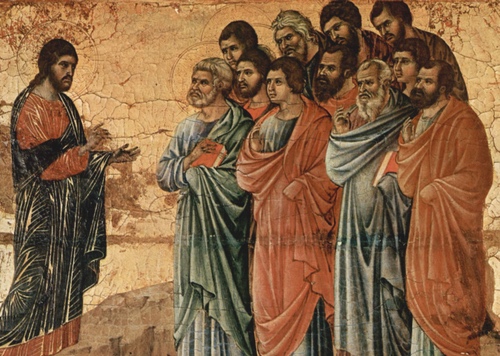
 In today’s gospel, Jesus gives a “pep talk” to the twelve disciples he is sending out on mission. It has to be the worst pep talk ever – realistic, but grim.
16 “Behold, I am sending you like sheep in the midst of wolves; so be shrewd as serpents and simple as doves.17 But beware of people, for they will hand you over to courts and scourge you in their synagogues,18 and you will be led before governors and kings for my sake as a witness before them and the pagans.19 When they hand you over, do not worry about how you are to speak or what you are to say. You will be given at that moment what you are to say.20 For it will not be you who speak but the Spirit of your Father speaking through you.21 Brother will hand over brother to death, and the father his child; children will rise up against parents and have them put to death.22 You will be hated by all because of my name, but whoever endures to the end will be saved.23 When they persecute you in one town, flee to another. Amen, I say to you, you will not finish the towns of Israel before the Son of Man comes. (Matthew 10:16–23)
Continue reading →

 The parable’s focus on the seeds is an allegory for those who hear the word of the kingdom proclaimed. The parables describe the varying receptiveness to what they hear; all hear the same word. Yet each type of person is identified as what was sown in a certain place. This might strike us as odd since we are biased to understand the “seed” as the Word of God proclaimed, but understanding of the parable rests on the interaction of the unvarying seed with the various types of ground. Continue reading
  If you have been following the daily gospel readings, you have read about the growing opposition to Jesus. He has been performing miracles, casting out demons, curing the sick, and yet people are hesitant to believe. In some cases, they outright refuse, and in the most extreme, they recognize the supernatural but attribute it to being in league with Satan. The people resist, the authorities accuse, and in today’s gospel it seems as though Jesus’ family wants to see him. Unsaid, but its seems as though they want to have an intervention.
  Several weeks ago on my blog, I published “
 “Whoever loves father or mother more than me is not worthy of me, and whoever loves son or daughter more than me is not worthy of me; and whoever does not take up his cross and follow after me is not worthy of me.” (Matthew 10:35-37)
 All of us tell stories. Sometimes were are the hero of the stories about ourselves. Stories define us. To know someone well is to know his or her story—the experiences that have shaped them, the trials and turning points that have tested them. When we want someone to know us, we share stories of our childhoods, our families, our school years, our first loves, and so on. And there in milieu are the stories that inspire us. I wrote about
  James Carville, the Ragin’ Cajun, is an American political consultant and author who has strategized for candidates for public office. Carville gained national attention for his work as the lead strategist of the Bill Clinton presidential campaign. Also interesting is that he is married to Mary Matalin, an American political consultant well known for her work with the Republican Party. They don’t talk politics at home.
  Back in 1983 the division of the company I worked for bought an IBM personal computer and hard drive (they were an add-on, were only 10 MB and were about as expensive as the computer.) That was going to be our “competitive edge” or so said one of the senior executives. I inwardly rolled my eyes knowing that the rapid advance in the personal computer world / emerging technology would transform the business world as performance improved and prices dropped. I had already purchased a portable computer (ok…”luggable” would be a better description) that came with word processing software, a spreadsheet, and a database – and 20MB hard drive and for 50% of the costs of the new office computer. To put this in context, there was no Microsoft or MS-DOS. Unix or CPM were the operating systems de jour. OK … enough history. My point is that there is this underlying belief that technology would make our lives better – especially in the world of business.
  In
In  Knowing the Mission. I have two thoughts for you today. The first concerns “the twelve” while the second involves Jesus’ instructions: “Do not go into pagan territory or enter a Samaritan town. Go rather to the lost sheep of the house of Israel. As you go, make this proclamation: ‘The Kingdom of heaven is at hand.’” (Mt 10:5-6)
 friarmusings