
 OK, pop quiz time. Who were the “Freedom Riders?” My random (and quite small) sample yielded some interesting answers. The most common was a speculation that it was an organized motorcycle ride akin to the “Rolling Thunder” ride in Washington D.C. around Memorial Day. As it turns out the initial “Rolling Thunder” ride was officially titled “Ride for Freedom.” These rides are a way to bring full accountability for prisoners of war (POWs) and missing in action (MIA) service members of all U.S. wars. It was a good guess and in their way, the Rolling Thunder rides honor those who struggled to preserve our freedom. But they are not the “Freedom Riders.”
Freedom and Choice
1
 After entering a boat, Jesus made the crossing, and came into his own town. And there people brought to him a paralytic lying on a stretcher. When Jesus saw their faith, he said to the paralytic, “Courage, child, your sins are forgiven.” At that, some of the scribes said to themselves, “This man is blaspheming.” Jesus knew what they were thinking, and said, “Why do you harbor evil thoughts? Which is easier, to say, ‘Your sins are forgiven,’ or to say, ‘Rise and walk’? But that you may know that the Son of Man has authority on earth to forgive sins”– he then said to the paralytic, “Rise, pick up your stretcher, and go home.” He rose and went home. When the crowds saw this they were struck with awe and glorified God who had given such authority to men. (Matthew 9:1-8)
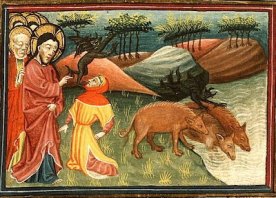 Following along in Matthew’s gospel, we recall the previous narrative was about the calming of the storm that beset the apostles while they and Jesus were crossing the lake. They arrive at their destination, a place known as the Gadarenes – among the Decapolis – 10 gentile cities on that side of the lake.. Here Jesus was met by two people possessed by demons who completely controlled the two people. While people are often blind to the true identity of Jesus, the demons clearly have an insight into Jesus’ identity. “What have you to do with us, Son of God” – not Jesus’ usual self-reference as Son of Man. “Have you come here to torment us before the appointed time?”
 Most of the apostles and lots of saints have their own feast day, but how about the two most famous saints of the early church? There is February 22nd in which the Church celebrates the “Chair of Peter” the sign that Peter was the first among the apostles and the one designated to lead the early Church after Jesus’ Resurrection and Ascension. But there is no “Feast of St. Peter.”
 Righteous Father, the world also does not know you, but I know you, and they know that you sent me. I made known to them your name and I will make it known, that the love with which you loved me may be in them and I in them. (John 17:25-26) – from the
  While I like technology, I don’t think I am too much of a gadget person. I am rarely-to-never an early adopter and will acquire gadgets when I think they serve a functional purpose I might value. The one exception was Amazon Echo. They promoted it at about 25% of the first generation Echo and I thought why not, buying the device before it was generally available.. The year was 2014. Really nothing too different since then – until last year.
 “…every good tree bears good fruit, and a rotten tree bears bad fruit. A good tree cannot bear bad fruit, nor can a rotten tree bear good fruit. Every tree that does not bear good fruit will be cut down and thrown into the fire.” Jesus was speaking about false prophets, a warning to his disciples. Not bad advice in general.
 Shira Ovide sent out an interesting article. Shira writes a technology column for the NY Times. It is not a deeply technical article about software or the newest tech devices, but more a “big picture” view of things technical going on in the world. Her post today looks at what we think we know – that ain’t necessarily so. Some curious factoids:
 Today is the Memorial of Saints John Fisher and Thomas More, the latter of the two who is more popularly known as he was the central character of the movie, “A Man for All Seasons.” The film depicts the final years of Sir Thomas More, the 16th-century Lord Chancellor of England who refused both to sign a letter asking Pope Clement VII to annul Henry VIII of England’s marriage to Catherine of Aragon and to take an Oath of Supremacy declaring Henry VIII Supreme Head of the Church of England. But St. John Fisher was in the same situation as Thomas More.
  friarmusings