The entire first reading (Isa 11:1-10) gives us a prophetic vision of the coming Messiah, a figure who will bring justice, peace, and harmony to all creation. Today’s first reading also offers two quite famous verses we have all encountered:
“But a shoot shall sprout from the stump of Jesse, and from his roots a bud shall blossom.” (Isaiah 11:1)
“The wolf shall be a guest of the lamb, and the leopard shall lie down with the young goat..” (Isaiah 11:6)
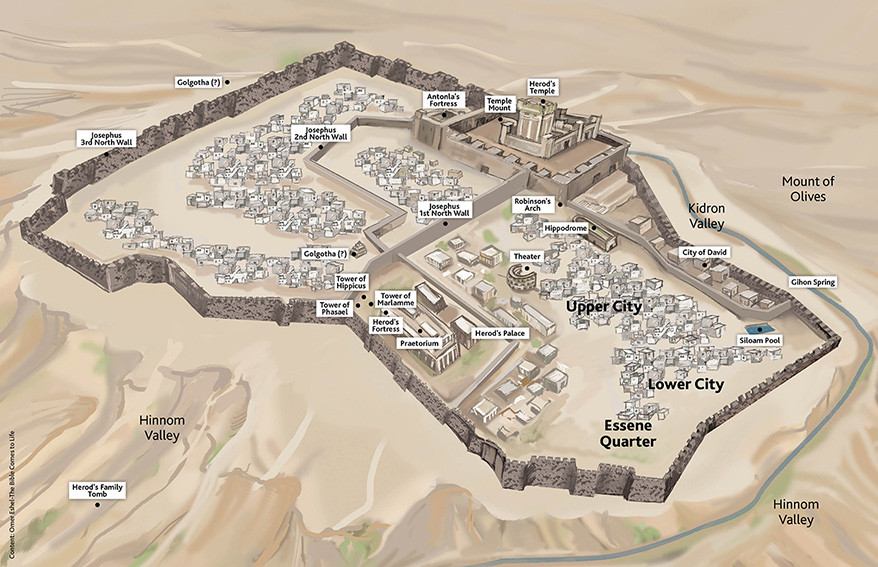
In the course of reading Scriptures you will often encounter the terms “Mt. Zion”, “Jerusalem”, and the “City of David.” Are the terms identical? Are they all actual locations? Do they carry symbolic meaning? Perhaps it is good to offer a brief post on what this all means.
Originally, Mount Zion referred specifically to the Jebusite fortress that King David conquered and made his capital (2 Samuel 5:7): “But David did capture the stronghold of Zion, which is the City of David.” The City of David is located south of what in our day is referred to as the “Old City” of Jerusalem, in a ridge area. The term “City of David” is often synonymous with the earliest settlement of what became Jerusalem.
In his efforts to unify all the tribes on Israel into one nation, David relocated the Ark of the Covenant to Zion indicating that God’s presence among His people was not centered on Zion and in the City of David: “The Ark was brought into the City of David with great rejoicing.” (2 Samuel 6:12-19). While David offered to build the Lord a “house,” construction of the Temple fell to David’s son, Solomon. The Temple was built on Mount Moriah, a part of the broader Zion area (1 Kings 8:1).
Zion is repeatedly described as a place of refuge and a symbol of God’s kingship over Israel (Ps 2:6). Today’s first reading holds the prophetic promise that the Law and the Word of the Lord will come forth from Zion, promising the possibility of divine wisdom and peace. “From Zion shall go forth instruction, and the word of the LORD from Jerusalem.” (Isa 2:3)
Zion is envisioned as the site of the Messiah’s reign, bringing justice and peace to all nations: “Rejoice heartily, daughter Zion… See, your king shall come to you.” (Zechariah 9:9) Zion is identified with the heavenly city, the ultimate destination of God’s faithful. In Revelation, the Lamb (Christ) stands victorious on Mount Zion with His redeemed people: “Then I looked, and there was the Lamb standing on Mount Zion, and with him a hundred and forty-four thousand.” (Rev 14:1)
There are several theological themes that are thus associated with Zion
God’s Presence: Zion represents God’s dwelling among His people, through the Ark, the Temple, and ultimately through Christ.
Redemption and Restoration: Zion is a symbol of hope, where God restores His people and fulfills His promises.
Eschatological Hope: The heavenly Zion is a vision of eternal communion with God. In the New Testament, associated with the heavenly Jerusalem (Hebrews 12:22)
Where does Jerusalem fit into all of this? It doesn’t “fit it” but rather surrounds it all. As the capital of Israel grew, it outgrew the City of David and expanded to encompass the ancient settlement and Mount Zion. Jerusalem then took on all the historical and theological significance from both the City of David and Mount Zion and then served as the central city in biblical history and prophecy.
I am grateful for a day in which we, as a people, pause to give thanks. And who do we have to thank for this holiday? Your answer is likely “The Pilgrims.” You would not be wrong, but then not completely correct, either. Certainly, Thanksgiving and the religious response of giving thanks to God is as old as time. When one considers enduring cultures, one always finds men and women working out their relationship to God. There is almost always a fourfold purpose to our acts of worship: adoration, petition, atonement, thanksgiving. Such worship is part and parcel of life. And yet, there is still a very human need to specially celebrate and offer thanksgiving on key occasions and anniversaries. Since medieval times, we have very detailed records of celebrations marking the end of an epidemic, liberation from sure and certain doom, the signing of a peace treaty, and more. Continue reading →
This story about the “dishonest steward” follows immediately after St. Luke’s telling of the Prodigal Son in which the young man wastes wealth and opportunity, but comes to his senses, returns home and is restored to the family. The dishonest steward is one who wastes his position and opportunity, comes to his senses and works to restore his future from his pending dismissal. Did Luke intentionally put these two stories back-to-back? Hard to know. I will tell you that the parable of the dishonest steward is one of the most debated parables among scripture scholars. So, if you are hoping that I will unravel the wisdom and mystery of this parable for you … well, that would be a long wait for a train don’t come. But I will give it a go. Continue reading →
“For everyone who exalts himself will be humbled, but the one who humbles himself will be exalted;” a familiar verse from St. Luke, one echoed in our readings for this day. Today’s first reading follows well from yesterday’s, giving “the” example of humility in Jesus who “did not regard equality with God something to be grasped. Rather he emptied himself taking the form of a slave.” That is not an option for us, but does raise the question of the meaning of true humility. Merriam Webster defines humility as freedom from pride or arrogance. That’s a start; it tells us what humility is not and by implication tells us what not to do in life. St. Bonaventure offered that humility is the guardian and gateway to all the other virtues. So, humility is important for being in this life and getting to the next. Continue reading →
From the good folks at Merriam-Webster, today’s Word of the Day is psephology. It was not a word with which I was familiar, but on this day when we cast our votes it is an appropriate word. Psephology is the scientific study of elections.
The word comes from the Greek word “psēphos,” meaning “pebble” because pebbles were used by the ancient Greeks in voting. Today’s Word might have been “ballot” – an equally fine choice given it comes from ballotta, an Italian word meaning “little ball,” and Italians once voted by placing such balls in a container.
I think it is of note that one relative of psephology is “psephomancy”, meaning “divination by pebbles.” Maybe that should be our new moniker for the pre-election work of polling.
From time to time, my dad would remind me that “every person you meet is your better in that you can learn something from them.” Good and sage advice. I wonder if he knew he was echoing Ralph Waldo Emerson who wrote: “In my walks, every man I meet is my superior in some way, and in that I learn from him.” Of course one can then ask if the quote is original to Mr. Emerson. Continue reading →
The science fiction genre of books and movies, for me, are an interesting conglomeration of the good, the bad, and the downright ugly…. Of course, some might say the same thing about my posts on this blog. Outside of the self-publishing realm, the number of new science fiction books coming to market each year is falling. The economics are simple: there is only a narrow band of readers willing to purchase such novels. Each year the purchase of older, well-established novels outsells the newer offerings. The Dune novels received a boost in sales based on the success of the recent Dune movies offered via streaming services. I will admit that my “library” of read and re-read science fiction largely consisted of classics from Clarke, Herbert, Asimov, Le Guinn and others. I guess the future doesn’t sell. Continue reading →
Once we have honored our dearly departed with a funeral, a heart-felt eulogy and a gathering of friends, we settled into our on-going lives. For many that means finding a new normal. In time, stories arise that were not part of the eulogy. When I was growing up, these later stories were told on the porch, in the small gatherings of family and friends. They were told on benches, told to the rhythm of a rocking chair, told in love, and sometimes ending with “God bless their heart.” Continue reading →


 friarmusings