Where in the scene of Peter’s Denial (Luke 22:54-65), the focus and center of the narrative was Peter, here the focus returns to Jesus. In this trial (hearing, meeting) by the religious authorities of Jerusalem, the role of Jesus as prophet and Messiah is at the forefront of the narrative. Jesus had foretold the primary events of this scene—both Peter’s threefold denial before the crowing of the cock (v. 34; vv. 56–61) and his own maltreatment (esp. 18:32; cf. 20:10–11 and 22:63–65). Continue reading
Category Archives: Scripture
Betrayal: Spy Wednesday
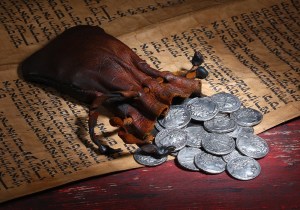
Today is known as “Spy Wednesday”, a reference to the betrayal of Jesus by Judas Iscariot for thirty silver coins. This event is described in the three Synoptic Gospels: Matthew 26:14-16, Mark 14:10-12, Luke 22:3-6. We know that Judas’ betrayal was but part of a larger vortex of events that would lead to Jesus’ arrest, trails, scourging, crucifixion, and death. Only Matthew (Matthew 27:3-6 ) narrates Judas’ own death. Continue reading
Peter’s Denial
The arrest of Jesus leads into three successive and connected scenes: Peter’s denial (vv. 54-62), the mocking of Jesus (vv. 63-65), and the trial before the religious authorities (vv. 66-71). What is interesting is that in the midst of the Passion narrative of Jesus, there is the scene in all four gospels that concentrate on Peter and his response. Luke’s account is unique in the following respects: sequence – in that the denials occur in the courtyard before the mocking and interrogation; structure – Luke does not connect the denial as a caused by the trial; and detail – such as the servant girl sitting at the fireside where there is light to clearly recognize Peter – and most vividly, it is Luke that reports Jesus looked Peter “dead in the eye,” bring the full gravitas of the denials to Peter. Continue reading
The time of testing
Of course we all know that after the meal with his disciples that Jesus went to the Garden of Gethsemane. Actually, no gospel says that. Matthew and Mark wrote that he went to a garden. John says he went to Gethsemane. Fuse them all together and you get the “Garden of Gethsemane.” What does Luke say? Luke only calls it “the place.” There is no garden specifically mentioned nor is Gethsemane. Is it important? Well, it is a reminder to be attentive to the text before you and not meld the familiar stories and scenes from other sacred writers. Each sacred writer has something distinctive that can be missed if one fuses all the details from other accounts. Continue reading
Teaching at the table
Who of us has not been part of a trivial argument in the middle of what is supposed to be a festive gathering of family and friends? A trivial moment that absorbs the energy from the group, refocuses everything from the “forest to the trees?” Only later did we discern what an amazing moment was in the making, something important at hand, a memory for a lifetime, and we frittered it away. Welcome to the Last Supper. Continue reading
The Passover Meal
The account of Jesus’ last supper is an important and key narrative in the Christian community. It provides the foundation of our Eucharistic celebration, a poignant theology of the Messiah’s death, and more. In our Catholic tradition, Jesus’ words convey the sacramental understanding of Real Presence of Christ in our celebrations. These ten short verses contain more than a simple commentary can provide. Continue reading
The Lucan Passion Narrative
The passion narratives provide the climax for each of the four gospels, catching up themes that weave their way through the evangelists’ entire portrayal of Jesus’ life and bringing them to a dramatic completion. In deft strokes the evangelists tell us of the final hours of Jesus’ life – his last meal with his disciples; his arrest in Gethsemane; his interrogation by the religious leaders; the trial before Pilate; and finally the heart clutching scenes of Jesus’ crucifixion, death and burial. Continue reading
Sin no more
This coming Sunday is the 5th Sunday in Lent, Year C. In yesterday’s post all the accusers and the crowd of people had left the scene. This prepares for the fourth and final stage of this story–Jesus’ response to the woman (vv. 10-11). He straightens up and asks for a report of what happened, as if he had been totally oblivious to what took place as he concentrated on his writing. He does not ask her about the charges but rather about that aspect of the situation most heartening to the woman: Woman, where are they? Has no one condemned you? (v. 10). Continue reading
Jesus’ Response
This coming Sunday is the 5th Sunday in Lent, Year C. In yesterday’s post we left the scene with the scribes and Pharisee awaiting Jesus’ answer: “So what do you say?” When he heard what the teachers of the law said, Jesus bent down and started to write on the ground with his finger. This action has been variously interpreted. Some say Jesus was embarrassed to be confronted by a promiscuous woman (unlikely); others, that it was a ploy to gain time to think how best to answer. Some suggest that he was writing the sins of the accusers, a tradition that goes back to St Jerome and which later appeared in 10th century Armenian gospel manuscript. Continue reading
Put to the test
This coming Sunday is the 5th Sunday in Lent, Year C. The gospel for the day is the well-known “woman caught in adultery.” In John 7 the Feast of Tabernacles is underway. Jesus has been publically teaching in the Temple precincts, arousing the interest of the people and the concern of the Jewish religious leadership. The leadership meeting presumably took place on the last (and seventh) day of the feast. They are discussing what to do with Jesus – and murder seems to be on their minds (7:1). Early the next day, Jesus is coming early to the temple to teach on the morning of the added eighth day of the feast, which was a day of rest (Lev 23:39). Continue reading