
Advice for the Guests

The gospel for the upcoming Sunday is taken from the Gospel of Luke describing an encounter with the Pharisees at a banquet.  In a wedding banquet setting it was expected that power and prestige would be placed closest to the head of the table (see Note on 14:7 below). This was probably more formal than most meals, but the words apply to any banquet.  Jesus points out the danger in pursuing seats of honor. He tells the story of a wedding where someone quickly grabs a high seat of honor. But then a person more distinguished walks in, and the host insists that the interloper vacate his position. At that point he may find all the other places occupied, so that the only course open to him is to take the lowest place, with all the shame and loss of face implied (cf. Prov. 25:7). So humiliated, the presumptuous one must head to the last seat. The description of the move down the social ladder is drawn out in Greek to underline the person’s shame (you begin with shame… to head for the last seat) It is as if every step hurts.

However, if one chooses the lowest place, the only way one can go is up. Rabbi Simeon b. Azzai is reported to have advised guests to take a place two or three seats lower than that to which they were entitled: ‘Better that people say to you “come up, come up,” and not say to you, “go down, go down”’ (Leviticus Rabbah I.5). 

Continue reading
Honor at Meals

The gospel for the upcoming Sunday is taken from the Gospel of Luke describing an encounter with the Pharisees at a banquet. In yesterday’s post we discussed “humility”. Today we consider “honor.” The meal setting is common in many of the gospels as a metaphor for the celebration of the Kingdom’s come. But it is also often a setting of controversy. Consider that 14:1-6 centered on the debate at table regarding the lawfulness of curing on the Sabbath – reminiscent of earlier discussions about appropriate behavior on the Sabbath (e.g., 6:2, 9; 13:14–16). When Jesus asks if it would be lawful to cure the man with dropsy, those at the table are silent. When Jesus next asks if their son or oxen fell into a cistern would they pull them out, again, they are silent. The easiest take on their reaction is that Jesus has them timid and stumped. But there was a long standing tradition for debate about the understanding of the Law. I would suggest that given Jesus’ challenging questions, one would need time to think about the reasoning – and in the face of such challenging wisdom, perhaps there is a struggle for the host to figure out exactly where this wandering preacher from Nazareth should be sitting.

That dynamic then opens the way for Jesus’ larger questions about honor at meals. Notice that vv.7-11, addressed to guests, is parallel to vv. 12-14, addressed to hosts, both showing a common pattern in which humility plays out.

Continue reading

Humility

The gospel for the upcoming Sunday is taken from the Gospel of Luke describing an encounter with the Pharisees at a banquet. A key theme from this text is “humility.” This word comes into our language from the Middle English, via Anglo-French, from Latin humilis low, humble, from “humus” the word for earth. Webster’s offers this as a definition

  1. not proud or haughty: not arrogant or assertive
  2. reflecting, expressing, or offered in a spirit of deference or submission
  3. ranking low in a hierarchy or scale: insignificant, unpretentious –or  : not costly or luxurious 

Does this capture the biblical sense of “humility?” Humility comes from the Greek tapeinoō (make low, humble; EDNT 3:334). In its verbal and noun forms, the word occurs 18 times in the NT and describes appropriate human conduct before God. And yet the use of the word often has a passive aspect to it.  For example, John the Baptist challenges his listeners to ready themselves for God’s salvation by preparing the way of the Lord and making his paths straight. The decisive feature, however, must be performed by God himself, for every valley will be filled (by him) and every mountain made low (by him), i.e., leveled.  The salvific action begins with God’s own actions. In this we are to humbly await actions from the Lord.

Continue reading

Keeping Track

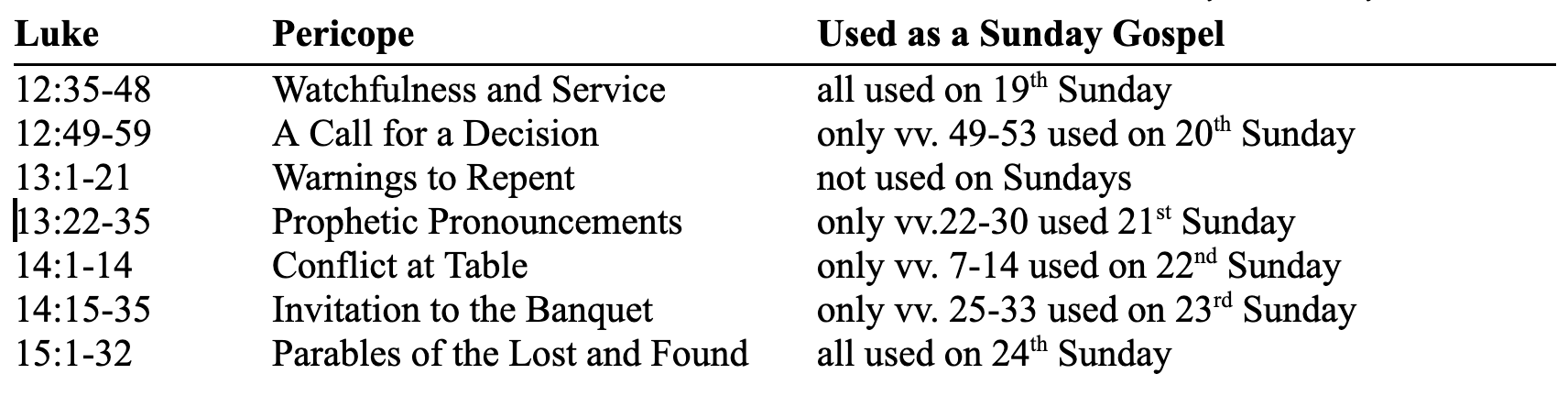
The gospel for the upcoming 22nd Sunday (Year C) is taken from the Gospel of Luke. On the journey to Jerusalem one of the principal themes has been that of discipleship. Much of Luke 12 attends to that theme especially in terms of preparedness and service.  As Luke’s gospel narrative moves ahead, Jesus continues to teach about the nature of discipleship (see, judge, and act), the urgency of the decision to become a faithful and prudent disciple, and that our decisions and actions have consequences in terms of the kingdom of heaven. To that end, here is the recent progression of Sunday gospels. You’ll notice there are gaps and skips. 

Among the portions missing from the Sunday gospels are

  • Jesus’ call to read the signs of the times as well as one reads the weather in order that one may judge rightly (12:54-59)
  • The parable of the fig tree that is permitted to remain in the vineyard for another season even though it has not yet produced fruit (13:1-9)
  • A healing of a woman, afflicted for 18 years, who was healed on the Sabbath that Jesus might again teach the meaning of the kingdom of God (13:10-17)
  • The parable of the mustard seed (13:18-21)
  • The lament of Jerusalem’s unfaithfulness (13:31-35)
  • A healing on the Sabbath at table (14:2-6)
  • The parable of the great feast (14:15-24)
  • The cost of discipleship and the necessity of preparations (14:25-35)

Some of the verses missing from Sunday gospels are well covered in the gospels of daily Mass, but there are some great images (reading the signs of time, the fig tree, and others) that would be great to have for Sunday homilies. 

That being said, one does well to remember and understand that these verses come after Jesus exhortation to strive to enter that place where are gathered “Abraham, Isaac, and Jacob and all the prophets in the kingdom of God” (13:28) (from last Sunday’s gospel) and before the parable of the great feast (14:15-24) which speaks to the OT image of the kingdom of God as likened to a great banquet. The placement points out that the attitudes of discipleship in this life are reflected in the banquet of the kingdom of God.

This week’s gospel is at table. As Johnson [Luke, 223] notes: “If Jesus eats a meal with a Pharisee on the Sabbath, there surely will be conflict! During the meal Jesus addresses a fundamental attitude that is a constituent portion of discipleship: humility.  This is not a new topic addressed to his disciples.  Consider Luke 9: 

46 An argument arose among the disciples about which of them was the greatest. 47 Jesus realized the intention of their hearts and took a child and placed it by his side 48 and said to them, “Whoever receives this child in my name receives me, and whoever receives me receives the one who sent me. For the one who is least among all of you is the one who is the greatest.” 


Image credit: Jesus at Supper | Caravaggio (1606) | National Gallery London | PD-US

Reflection: the doorkeeper

Alan Culpepper, at the end of his commentary [277-78] on Luke 13:22-30, provides an interesting story from Franz Kafka:

His parable “Before the Law” is the story of a man from the country who seeks admission to the Law. When the doorkeeper tells him he may not enter, he looks through the open door, but the doorkeeper warns him that he is just the first of a series of doorkeepers, each one more terrible than the one before. So the man waits for the doorkeeper’s permission to enter. For days and then years, the man talks with the doorkeeper, answers his questions, and attempts to bribe him, but with no success. The doorkeeper takes the man’s bribes, saying he is only doing so in order that the man will not think he has neglected anything. As the man lies dying, he sees a radiance streaming from the gateway to the Law. Thinking of one question he has not asked, he beckons the doorkeeper and asks him why in all those years no one else has come to that gate. The doorkeeper responds: “No one else could ever be admitted here, since this gate was made only for you. Now I am going to shut it.”

There is an incompleteness one experiences after reading “Before the Law.” It seems as though the man from the country is caught in a terrible institutional “catch-52,” unable to enter the very gate prepared only for him. Some might quickly focus on the gatekeeper as representative of the worst parts of organized religion, or the trap of fear implied in a series of other terrible gatekeepers, or other parts of the parable. 

There is also an incompleteness – or better said – mystery in Jesus’ parable in which the who and how many are never answered to the reader’s satisfaction. But Jesus is clear on several points: one must strive. As noted before, striving with an athlete’s power and intention is seeking an Olympic medal. The man from the country in Kafka’s parable waits for “the Law” to come to him.

All of this points to questions that have bedeviled Christianity since its foundation: what is the balance of grace, election, free will, the action to which people are called, and so much more. Perhaps even if Christian denominations will never agree on the theological balance or answers, we can agree that one should never presume upon God’s grace or God’s gifts.

Perhaps this parable asks us to take this attitude in life: strive as though admission to the kingdom depended entirely on your own doing, but know that ultimately it depends on God’s grace.


Image credit: Pexels | Farouk Tokluoglu | CC-BY

From the ends of the earth

This Sunday is the 21st Sunday of Year C with the gospel reading from Luke 13:22-30. There is another surprise: people will come from east and west and north and south, and will take their places at the feast in the kingdom of God. This means that all the nations will be blessed at God’s table. The blessed of God coming from everywhere echoes promises already proclaimed in Isaiah (cf. Isa. 45:6; 49:12). The disciples did not immediately grasp this truth and its implications. The special vision of Acts 10 was needed to reveal how it would work. Even though Israel has a special place in God’s plan, others are not excluded from blessing. We all have equal access to God’s blessing through Jesus (Eph 2:11-22). Even the promise to Abraham stressed how the world would eventually be blessed through the patriarch’s seed (Gen 12:1-3). 

So Jesus closes his words of warning with a note of eschatological reversal. Expectations are overturned as there are those who are last who will be first, and first who will be last. Many will get to the table, including some surprises. All are on the same footing. In today’s context the warning of this passage might be that those who are first (who have exposure to Christ through attendance at the church) may turn out to be last (excluded from blessing) if they do not personally receive what Jesus offers through the community. Simply put, Jesus is the key to the door of salvation

Luke’s Gentile audience would listen eagerly to these words, but they would also be challenged not to take for granted themselves their eating and drinking with Jesus at the Eucharist. The pronouncement closing this speech guards against both presumption and despair; as long as the journey is underway, some may fall away and others may still join.


Image credit: Pexels | Farouk Tokluoglu | CC-BY

Acting on the Word

This Sunday is the 21st Sunday of Year C with the gospel reading from Luke 13:22-30. Jesus envisages some of those rejected as pleading that they had known the Lord (v.26). They ate and drank where he was; he taught where they were. But, they cannot claim that they ever entered into understanding of what he was teaching. There was no evidence of their acceptance, no response; or their response was insincere, if at all. It is a sad case that, in every age, there are people under the illusion that they were following Jesus.  While they claim that they ate and drank with him, they fail to understand they had no intimate fellowship; they heard his teaching but did not accept it as the word of God to be put into practice (“My mother and my brothers are those who hear the word of God and act on it.” 8:21). 

As a consequence, in the end they will know complete rejection. The householder says that he does not know where they come from and he brands them as you evildoers (cf. Ps. 6:8). No specific evil deed has been mentioned, but in the end there will be only two classes, those who acted on the word of God and those who did not – even if they did nothing inherently evil. Since these people did not take the necessary steps to get inside, they are to be numbered with the evildoers outside. The result is there are those inside and those outside. There is no “in between.” 

Continue reading

Strive to enter now

This Sunday is the 21st Sunday of Year C with the gospel reading from Luke 13:22-30. The question raised is how many will be saved? Jesus does not answer directly, but urges his questioner and others (“strive” is plural) to make sure that they are in the number, however large or small it proves to be (v.24).  The word “strive” is derived from a technical term for competing in the ancient Olympiad pointing to a full-hearted effort. This word is in the present continuous tense and contrasts those who “will attempt to enter” but when the door of opportunity is finally shut it will be too late (v.25). People must strive to enter now. There is inevitably a time-limit on the offer of salvation. After the master of the house has arisen and locked the door – The gospel text continues to indicate that the time is short, the kingdom is arriving even now, and thus it is important that a decision be made. Jesus’ parable of the narrow and soon shut door makes it clear that making a decision, and the right one, is crucial. It is a theme that has been consistently present since the beginning of Luke chapter 12.

How many will be saved? The question was relevant in Jesus’ time when there was a growing divergence of religious views. There is evidence that it was widely discussed (e.g. 4 Ezra 7:55ff.), and that the rabbis held widely differing views (e.g. Sanhedrin 97b). But it seems to have been firmly held that all Israel would be saved, except for a few blatant sinners who excluded themselves (Sanhedrin 10:1). In our day, this same question speaks not only to the individual decision, but also to the proclamation of the community.  Here at the beginning of the third millennium, especially in the West, many people believe that there are many ways to God – perhaps. 


Image credit: Pexels | Farouk Tokluoglu | CC-BY

Being Saved

This Sunday is the 21st Sunday of Year C with the gospel reading from Luke 13:22-30. This section continues Jesus’ formation of his disciples for their time to take up the mission of the proclamation of the kingdom of God. Jesus makes several references to the seriousness of the proclamation of God’s reign and to the need for a sober decision of discipleship to undertake the journey to Jerusalem with Jesus, a journey that will end in suffering and death (9:22–23). 

The question that initiates Jesus’ response is short, pointed, and seems to summarize the unnamed disciple’s impression of the verses that have come before this Sunday gospel passage. A short summary of the preceding messages might be: (a) courage under persecution, (b) warning about foolish acquisition about what matters not to God, (c) remaining vigilant because judgment is coming, (d) reading the “signs of the time,” and (e) a direct call for immediate repentance. Is it any wonder that… 

23 Someone asked him, “Lord, will only a few people be saved?” He answered them, 24 “Strive to enter through the narrow gate, for many, I tell you, will attempt to enter but will not be strong enough. 25 After the master of the house has arisen and locked the door, then will you stand outside knocking and saying, ‘Lord, open the door for us.’ He will say to you in reply, ‘I do not know where you are from.’

Continue reading

Warnings and Admonitions

Here in Year C readings, our gospel suddenly moves from Luke 12:49-53 (last week) to this gospel, passing over 12:54-13:21. In between, the warnings and admonitions regarding the coming judgment that began with 12:1 reach their conclusion with a sobering call for repentance. Just as the debtor on the way to court (12:59) is warned to make every effort at reconciliation, so also Jesus uses the sayings about calamity in 13:1–5 and the parable of the unproductive fig tree in 13:6–9 to make the same point: 

  • read the signs of the time and judge correctly; 
  • repent now, the time is short; and
  • be assured of the full measure of judgment.

The sayings from this gospel of Jesus follow upon the parables of the kingdom (Luke 13:18–21) and stress the same points as above, adding, that great effort is required for entrance into the kingdom (Luke 13:24) and that there is an urgency to accept the present opportunity to enter because the narrow door will not remain open indefinitely. 

Continue reading