Explore this video about the meaning of the word “sin” in the Hebrew Scriptures as well as the New Testament. The authors of the video (The Bible Project) cast the most fundamental meaning of the word as a “failure to be truly human.”

Explore this video about the meaning of the word “sin” in the Hebrew Scriptures as well as the New Testament. The authors of the video (The Bible Project) cast the most fundamental meaning of the word as a “failure to be truly human.”
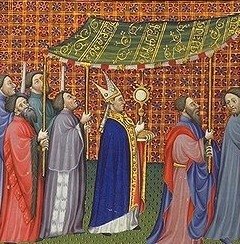 Next Sunday is the celebration of the Solemnity of the Body and Blood of Christ. You can read a complete commentary on the Gospel here.
51 I am the living bread that came down from heaven; whoever eats this bread will live forever; and the bread that I will give is my flesh for the life of the world.” 52 The Jews quarreled among themselves, saying, “How can this man give us (his) flesh to eat?” 53 Jesus said to them, “Amen, amen, I say to you, unless you eat the flesh of the Son of Man and drink his blood, you do not have life within you. 54 Whoever eats my flesh and drinks my blood has eternal life, and I will raise him on the last day. 55 For my flesh is true food, and my blood is true drink. 56 Whoever eats my flesh and drinks my blood remains in me and I in him. 57 Just as the living Father sent me and I have life because of the Father, so also the one who feeds on me will have life because of me. 58 This is the bread that came down from heaven. Unlike your ancestors who ate and still died, whoever eats this bread will live forever.” (John 6:51-58) Continue reading
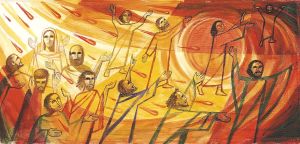 Next Sunday is the celebration of the Solemnity of the Most Holy Trinity. You can read a complete commentary on the Gospel here.
Holy Trinity Sunday is celebrated on the first Sunday following Pentecost in most of the liturgical churches in Western Christianity. It is a solemn celebration of the belief in the revelation of one God, yet three divine persons. Yet, It was not uniquely celebrated in the early church! Continue reading
 Study of the Sacred Scriptures is a lifetime project. In a certain sense you can devote all your energies to the Gospels – or even just to one of them. There is so much richness and depth that it can leave you wanting more and more from the one book. And you might just not get around to the other books of the Bible. Sure, you might venture into the epistles of Paul, but never quite make it the other epistles, like the Epistle of Jude. Continue reading
Next Sunday is the celebration of Pentecost . You can read a complete commentary on the Gospel here.
19 On the evening of that first day of the week, when the doors were locked, where the disciples were, for fear of the Jews, Jesus came and stood in their midst and said to them, “Peace be with you.” 20 When he had said this, he showed them his hands and his side. The disciples rejoiced when they saw the Lord. 21 (Jesus) said to them again, “Peace be with you. As the Father has sent me, so I send you.” 22 And when he had said this, he breathed on them and said to them, “Receive the holy Spirit. 23 Whose sins you forgive are forgiven them, and whose sins you retain are retained.” (John 20:19-23) Continue reading
 Next Sunday is the celebration of Ascension Sunday in most dioceses of the United States. You can read a complete commentary on the Gospel here.
16 The eleven disciples went to Galilee, to the mountain to which Jesus had ordered them. 17 When they saw him, they worshiped, but they doubted. 18 Then Jesus approached and said to them, “All power in heaven and on earth has been given to me. 19 Go, therefore, and make disciples of all nations, baptizing them in the name of the Father, and of the Son, and of the holy Spirit, 20 teaching them to observe all that I have commanded you. And behold, I am with you always, until the end of the age.” (Matthew 28:16-20) Continue reading
 Next Sunday is the 5th Easter of Sunday. You can read a complete commentary on the Gospel here.
1 “Do not let your hearts be troubled. You have faith in God; have faith also in me. 2 In my Father’s house there are many dwelling places. If there were not, would I have told you that I am going to prepare a place for you? 3 And if I go and prepare a place for you, I will come back again and take you to myself, so that where I am you also may be. 4 Where (I) am going you know the way.” Continue reading
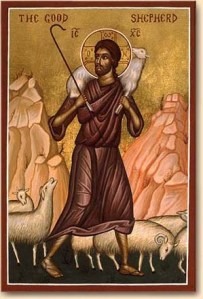 Next Sunday is the 4th Easter of Sunday. You can read a complete commentary on the Gospel here.
1 “Amen, amen, I say to you, whoever does not enter a sheepfold through the gate but climbs over elsewhere is a thief and a robber. 2 But whoever enters through the gate is the shepherd of the sheep. 3 The gatekeeper opens it for him, and the sheep hear his voice, as he calls his own sheep by name and leads them out. 4 When he has driven out all his own, he walks ahead of them, and the sheep follow him, because they recognize his voice. 5 But they will not follow a stranger; they will run away from him, because they do not recognize the voice of strangers.” 6 Although Jesus used this figure of speech, they did not realize what he was trying to tell them. 7 So Jesus said again, “Amen, amen, I say to you, I am the gate for the sheep. 8 All who came (before me) are thieves and robbers, but the sheep did not listen to them. 9 I am the gate. Whoever enters through me will be saved, and will come in and go out and find pasture. 10 A thief comes only to steal and slaughter and destroy; I came so that they might have life and have it more abundantly. (John 10:1-10) Continue reading
 This is the Third Sunday of Easter. The Gospel for today comes from Luke 24:13-35, the account know as “The Road to Emmaus.” Later today my homily on this gospel will be posted (1:00 pm Eastern), but in the meantime, I thought I would pass along the reflection from Bishop Barron: Continue reading
Happy Saturday! Again I offer up another video from the good people at BibleProject.com
This video traces the idea of humans as co-rulers alongside God, who are commissioned to develop the world and its resources and take it into new horizons. How has this human vocation been compromised by our selfishness and evil, and how did Jesus open up a new way of being human through his life, death, and resurrection?

