
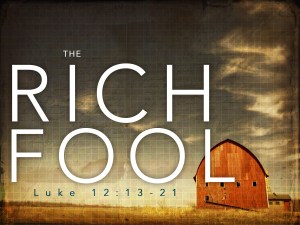
 This coming Sunday marks our journey in Ordinary Time, the 18th Sunday in Year C. You can read a complete commentary on the Sunday Gospel here.
13 Someone in the crowd said to him, “Teacher, tell my brother to share the inheritance with me.” 14 He replied to him, “Friend, who appointed me as your judge and arbitrator?” 15 Then he said to the crowd, “Take care to guard against all greed, for though one may be rich, one’s life does not consist of possessions.” 16 Then he told them a parable. “There was a rich man whose land produced a bountiful harvest. 17 He asked himself, ‘What shall I do, for I do not have space to store my harvest?’ 18 And he said, ‘This is what I shall do: I shall tear down my barns and build larger ones. There I shall store all my grain and other goods 19 and I shall say to myself, “Now as for you, you have so many good things stored up for many years, rest, eat, drink, be merry!” 20 But God said to him, ‘You fool, this night your life will be demanded of you; and the things you have prepared, to whom will they belong?’ 21 Thus will it be for the one who stores up treasure for himself but is not rich in what matters to God.” (Luke 12:13-21) Continue reading
 This coming Sunday marks our journey in Ordinary Time, the
  This coming Sunday marks our journey in Ordinary Time, the
  This coming Sunday marks our journey in Ordinary Time, the
  This coming Sunday marks our journey in Ordinary Time, the
  It was a simple email. The writer said that she was committed to reading and studying the Bible. For her first time through, she wanted to accomplish it in a two-year period. She had already researched the internet for Bible study plans and discovered there are tons of plans, lots of perspectives, and advice a plenty. So much so, it was hard to sort through it all. And such was the genesis of the email asking for advice on “the plan.”
  This coming Sunday marks the return to Ordinary Time, the
  I wonder how often we pay attention to the first reading. It is from the Old Testament, often filled with names that are hard to pronounce at best and impossible to remember – especially when it comes as a collection of names that are a chain of ancestors. One of the gospels for Christmas Eve (Mt 1:1-17) has a list of 42 generations, all of whose names are ancestors of Jesus. Could you name some of them other than King David and Mary’s husband Joseph? Jesus’ genealogy starts with Abraham – who appears in our first reading – and continues with Isaac, his son Jacob , and whose son Judah… ok, we know those names. And the genealogy then ventures into, what I suspect is largely unknown territory. We come across Hezron, Amminadab – and one of my personal favorites – Zerubbabel.
  From time to time people tell me that “this year I am going to get into the Bible!” Music to my ears! Their declaration is quickly followed by something akin to “So, what should I do?” Maybe next week I will take a shot at answering that question, but for now let me tell how not to read the Bible!
  1 ”(But) take care not to perform righteous deeds in order that people may see them; otherwise, you will have no recompense from your heavenly Father.2 When you give alms, do not blow a trumpet before you, as the hypocrites do in the synagogues and in the streets to win the praise of others. Amen, I say to you, they have received their reward.3 But when you give alms, do not let your left hand know what your right is doing,4 so that your almsgiving may be secret. And your Father who sees in secret will repay you.5 “When you pray, do not be like the hypocrites, who love to stand and pray in the synagogues and on street corners so that others may see them. Amen, I say to you, they have received their reward.6 But when you pray, go to your inner room, close the door, and pray to your Father in secret. And your Father who sees in secret will repay you.
