Peace be with you

This coming Sunday is the 2nd Sunday of Easter, Divine Mercy Sunday. The gospel is taken from John 20:19-31, the scene in the Upper Room on the evening of the Resurrection. . 

19 On the evening of that first day of the week, when the doors were locked, where the disciples were, for fear of the Jews, Jesus came and stood in their midst and said to them, “Peace be with you.” 20 When he had said this, he showed them his hands and his side. The disciples rejoiced when they saw the Lord. 21 (Jesus) said to them again, “Peace be with you. As the Father has sent me, so I send you.”

Continue reading

On the evening of the first day

This coming Sunday is the 2nd Sunday of Easter, Divine Mercy Sunday. The gospel is taken from John 20:19-31, the scene in the Upper Room on the evening of the Resurrection. Our gospel contains the second and third appearances of the risen Jesus in John’s gospel. These three appearances take place in Jerusalem.  There is a fourth and final appearance of Jesus later in a section referred to as the “Epilogue” of John.  This appearance is at the “Sea of Tiberias” in Galilee (John 21).

In the Johannine narrative our gospel occurs on what has been a full day: “On the evening of that first day of the week.”  It was just that morning that Mary Magdalene had visited the tomb and confessed, “They have taken the Lord from the tomb, and we don’t know where they put him” (20:2) – ironically echoing one the decisive misunderstanding of Jesus’ ministry: from where did Jesus come and where is he going (e.g. 7:33-36, 8:21-23).  Mary became the first disciple of the good news of the empty tomb conveying the word to Peter and “the one whom Jesus loved.” Slowly the implications of the empty tomb and the burial linens come to the disciples and they begin to understand – each in differing ways and to varying degrees. The disciple whom Jesus loved “saw and believed” (20:8), however “they did not yet understand the scripture that he had to rise from the dead” (v.9).

At this point, it is perhaps that their faith is as complete as faith in the empty tomb can be, but as many commentators have noted, to assign to the disciples a full belief in the Resurrection is to rush the story. Resurrection faith begins when Mary encounters Jesus in the garden and he is revealed as the Risen Christ and Good shepherd – he knows his sheep by name and they respond to his voice (10:3-4, 12,16, 24; cf Is 43:1). In telling Mary “stop holding onto me” (v.17) Jesus lets Mary (and the reader) know that the unfolding of the events of the hour are continuing.

In the course of these posts we will consider the key words/phrases of “peace”, “sent”, “he breathed on them and said to them, “Receive the holy Spirit”, “Whose sins you forgive are forgiven them, and whose sins you retain are retained.” and more


Image credit: Maesta altar piece, Duccio di Buoninsegna, 1308, Museo dell’Opera Metropolitana del Duomo, Siena | Public Domain

Easter Sunday – The Empty Tomb

While the details within and among the gospels vary, all record that Jesus’ body, after his death on the cross, was laid in a tomb provided by Joseph of Arimathea. All four gospels then come to their crowning point in the account of the Resurrection, but each in its own way. They all agree that women came to the tomb:

  • After the sabbath, as the first day of the week was dawning” (Matthew 28:1)
  • When the sabbath was over…Very early when the sun had risen, on the first day of the week” (Mark 16:1-2)
  • But at daybreak on the first day of the week” (Luke 24:1)
  • On the first day of the week…early in the morning, while it was still dark” (John 20:1)

All agree that the Sabbath was complete and it was the first day of the week – Sunday in the Christian reckoning. One might notice that the synoptic gospels (Matthew, Mark, and Luke) all report that the sun was rising in the dawn of this new day, however, John reports that it was still dark. One needs to remember that John uses “dark” to describe unknowing, unbelief and things similar rather than time of day. In the Johannine gospel “unknowing” is an apt description of Mary Magdalene and the disciples.

If you would like to read more about the Johannine narrative of Easter Mornring, click the button below


Image credit: Canva | George Corrigan | CC-0

Descent from the Cross

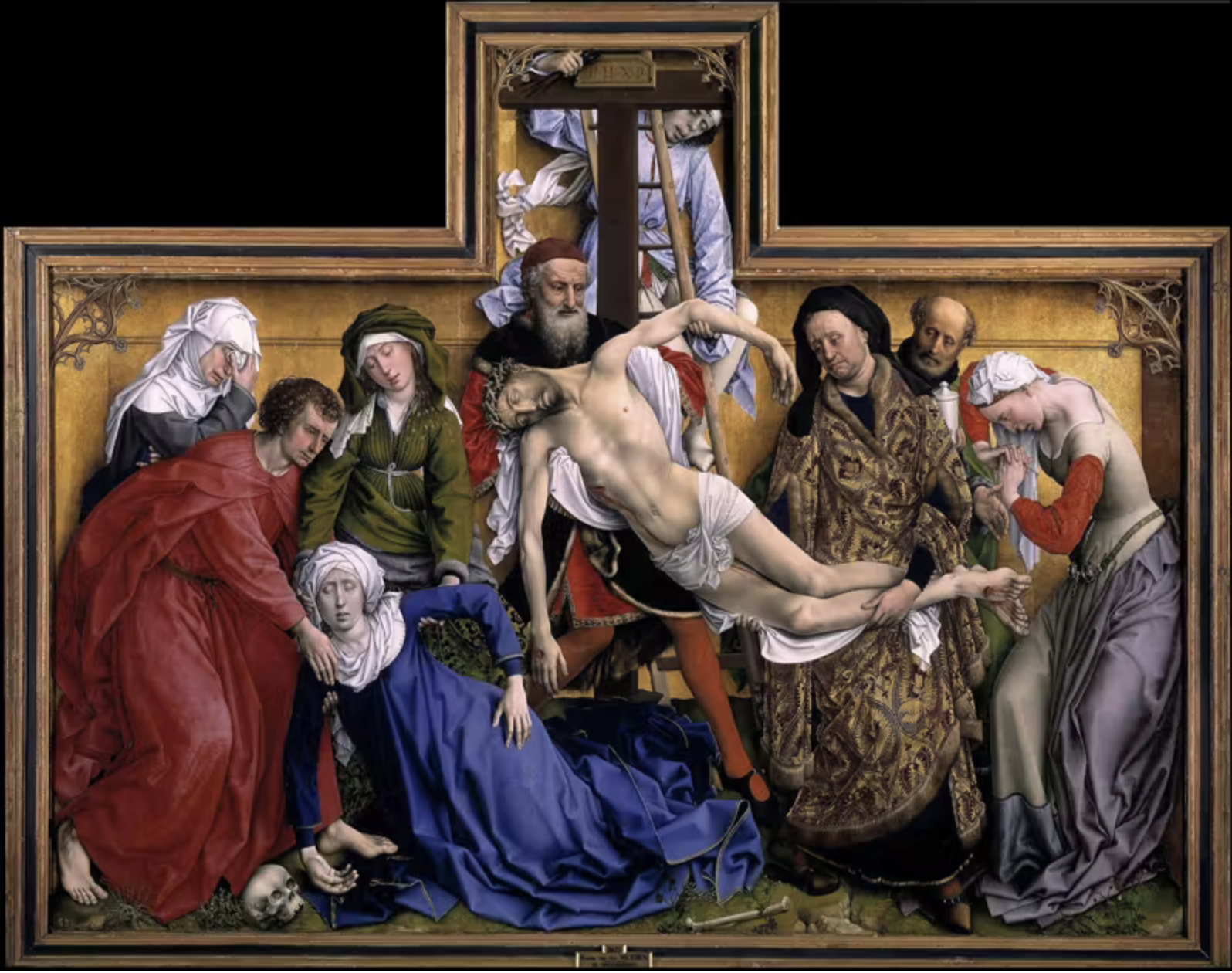
Museum of the Bible in Washington DC has a beautiful exhibition, Descent from the Cross. This exhibition explores how 21 artists across five centuries, multiple genres, and mixed media have visualized the scene in The Gospel of John, chapter 19, the moment Jesus is removed from the cross. This moment, traditionally called “Deposition” or “Descent from the Cross,” is not described in the Bible. There are no details explaining the process or who was present. Because of this, artists across the centuries have interpreted this emotional moment in unique and varying ways, each filling in the blanks with what they think might have happened. It has become a popular scene in art history, and thus a part of our shared visual language.

The earliest-known renderings of the scene appeared in the ninth century and soon became part of a cycle through the life of Christ and his passion, later known as the Stations of the Cross. But perhaps the most influential depiction was painted by Flemish master painter Rogier van der Weyden in 1435. The unique shape of the composition and the cramped “box” that the characters occupy create a theatrical look, like that of a stage play or a diorama. The sharp angles and rich details reflect the late Gothic, early Renaissance styles of northern Europe, and the crossbows seen in the corners honor the patron of this piece, the Leuven Guild of Archers.

Museum of the Bible

You can see the exhibit virtually at the Museum’s website by clicking the button below.


Image credit: Descent from the Cross | Rogier van der Weyden, ca. 1435 | Museo del Prado, Madrid | PD-US

The Gospel for Holy Thursday

The gospel reading for the Mass of the Lord’s Supper on Holy Thursday evening is always taken from the Gospel of John 13:1-15. This week I have been posting about the Passion, but here on Holy Thursday, rather than posting the biblical commentary over days, if you are interested to read short commentary on text, simply click the button below.


Image credit: Image credit: “The Last Supper,” by Ugolino da Siena, circa 1325-30, Italian. (Metropolitan Museum of Art) | Public Domain

Death on a Cross

Luke adds a poignant detail to his description of Jesus’ journey to the cross; with him march two criminals. Jesus, who had been described by his opponents as a “friend of tax collectors and sinners” (Lk 7:34), would not only live with such friends but die with them. 

32 Now two others, both criminals, were led away with him to be executed. 33 When they came to the place called the Skull, they crucified him and the criminals there, one on his right, the other on his left. 34 (Then Jesus said, “Father, forgive them, they know not what they do.”) They divided his garments by casting lots. 35 The people stood by and watched; the rulers, meanwhile, sneered at him and said, “He saved others, let him save himself if he is the chosen one, the Messiah of God.” 36 Even the soldiers jeered at him. As they approached to offer him wine 37 they called out, “If you are King of the Jews, save yourself.” 38 Above him there was an inscription that read, “This is the King of the Jews.” 

Continue reading

Condemned to Death

Up to this point in the narrative the chief priests, scribes, and leaders have been the ones who have been active throughout the arrest, hearing and trials of Jesus. While in the privacy of the Sanhedrin gathering, the charges brought against Jesus by this group were religious.  Once the assembly moved to the public forum involving Pilate, the charges became secular – “misleading our people; he opposes the payment of taxes to Caesar and maintains that he is the Messiah, a king.” (23:2)  In the start of this section, “the people” are now present. Previously the people have supported Jesus – what will they do now?

Continue reading

Jesus on Trial

Where in the scene of Peter’s Denial (Luke 22:54-65), the focus and center of the narrative was Peter, here the focus returns to Jesus. In this trial (hearing, meeting) by the religious authorities of Jerusalem, the role of Jesus as prophet and Messiah is at the forefront of the narrative. Jesus had foretold the primary events of this scene—both Peter’s threefold denial before the crowing of the cock (v. 34; vv. 56–61) and his own maltreatment (esp. 18:32; cf. 20:10–11 and 22:63–65).

Continue reading

Arrest and Denial

The Last Supper has concluded during which Judas’ betrayal and Peter’s coming denial were revealed. Jesus has offered some final words to the disciples (Luke 22:35-38).  From there the scene shifts to the Garden of Gethsemane and the “Agony in the Garden.” Suddenly the forces of the religious leaders burse onto the scene.

The arrest of Jesus leads into three successive and connected scenes: Peter’s denial (vv. 54-62), the mocking of Jesus (vv. 63-65), and the trial before the religious authorities (vv. 66-71). What is interesting is that in the midst of the Passion narrative of Jesus, there is the scene in all four gospels that concentrate on Peter and his response.  Luke’s account is unique in the following respects: sequence – in that the denials occur in the courtyard before the mocking and interrogation; structure – Luke does not connect the denial as a caused by the trial; and detail – such as the servant girl sitting at the fireside where there is light to clearly recognize Peter  – and most vividly, it is Luke that reports Jesus looked Peter “dead in the eye,” bring the full gravitas of the denials to Peter.

Culpepper (p.439) notes that failure comes in many forms – but that we can never fail God without also failing ourselves.  Conversely, in some sense when we fail ourselves we always fail God.  The call to faith, as Peter learns, can at times call us to reverse our natural impulse to self-preservation, security, etc., and to stretch to a high calling of faithfulness and commitment to others.  Failure can also be calculated as was Judas’ or can be spontaneous as was Peter’s. What is the difference in their failures? Where Judas contemplated his commitments and intentions, Peter did not.  Even as faithful as Peter’s intention, the failure to reflect and contemplate upon those commitments and intention was a failure that eroded the very intention.  In Luke’s hands, Peter’s failure becomes a lesson in discipleship.

54 After arresting him they led him away and took him into the house of the high priest; Peter was following at a distance. 55 They lit a fire in the middle of the courtyard and sat around it, and Peter sat down with them. 56 When a maid saw him seated in the light, she looked intently at him and said, “This man too was with him.” 57 But he denied it saying, “Woman, I do not know him.” 58 A short while later someone else saw him and said, “You too are one of them”; but Peter answered, “My friend, I am not.” 59 About an hour later, still another insisted, “Assuredly, this man too was with him, for he also is a Galilean.” 60 But Peter said, “My friend, I do not know what you are talking about.” Just as he was saying this, the cock crowed, 61 and the Lord turned and looked at Peter; and Peter remembered the word of the Lord, how he had said to him, “Before the cock crows today, you will deny me three times.” 62 He went out and began to weep bitterly. 63 The men who held Jesus in custody were ridiculing and beating him. 64 They blindfolded him and questioned him, saying, “Prophesy! Who is it that struck you?” 65 And they reviled him in saying many other things against him. (Luke 22:45-65)

The scene shifts. Those arresting Jesus bring him to the house of the high priest (22:54-65). Here he will be interrogated and beaten throughout the night (22:63-65). These scenes are not unknown in our own day.

Peter had followed Jesus to the courtyard of the High Priest’s house and mingled with the crowd around a fire built to cheat the cold night air (22:54-62). But Peter’s attempt to merge with the crowd fails; a maid recognizes him in the light of the fire: “This man too was with him.” Peter vigorously denies that he even knows Jesus. But a little later the danger comes again as another person recognizes him, then “an hour later,” another who catches Peter’s Galilean accent. Each time Peter, the leader of the twelve, denies that he ever heard of Jesus. 

In the Luke’s gospel, Peter’s denials are not intertwined with that of the trial.  While the Markan intertwining has more of a dramatic effect, the impact of Peter’s actions are no less impacting: Peter’s assertions of loyalty at the Last Supper (22:33) and his cowardice or fear in the courtyard stand in stark contrast. Jesus’ prophecy is coming true.  What is unique to Luke’s gospel is Jesus’ assurance that Peter would be reconciled and returned to heal his brothers (22:32).

The first readers of this gospel, Peter was known as the fearless leader and missionary of the Church. This scene must have been shocking especially given the unique elements. The scene is captured in that Peter and Jesus are within sight of each other: the warming fire and the knot of soldiers torturing Jesus are in the same courtyard. As the cock crows–the very signal that Jesus had foretold to Peter (22:34), Jesus turns and looks at his disciple. That gaze penetrates Peter’s heart; he remembers Jesus’ words, words warning of failure – and hopefully the promise of forgiveness – as he leaves the courtyard weeping in remorse.

Introduction to the Passion Narrative of Luke

Although the Passion narratives of all four Gospels are similar in many ways, there are also significant differences among them.  The majority of scholars hold that the Gospel of Luke is dependent upon Mark for the sequence of events in the Passion narrative. However,  Luke has incorporated other elements of the gospel story that he has received independent of Mark. Among the distinctive sections in Luke are:

  1. the tradition of the institution of the Eucharist (Luke 22:15-20);
  2. Jesus’ farewell discourse (Luke 22:21-38);
  3. the mistreatment and interrogation of Jesus (Luke 22:63-71);
  4. Jesus before Herod and his second appearance before Pilate (Luke 23:6-16);
  5. words addressed to the women followers on the way to the crucifixion (Luke 23:27-32);
  6. words to the penitent thief (Luke 23:39-41);
  7. the death of Jesus (Luke 23:46, 47b-49). 

On the whole, Luke stresses the innocence of Jesus (Luke 23:4, 14-15, 22) who is the victim of the powers of evil (Luke 22:3, 31, 53) and who goes to his death in fulfillment of his Father’s will (Luke 22:42, 46). Throughout the narrative Luke emphasizes the mercy, compassion, and healing power of Jesus (Luke 22:51; 23:43) who does not go to death lonely and deserted, but is accompanied by others who follow him on the way of the cross (Luke 23:26-31, 49).

If you would like to review a comparison of the Passion Narratives from the Gospels, click the button below.