
What Follows

This coming Sunday is the 5th Sunday of Ordinary Time, Year A. Our very short gospel passage (salt of the earth and light of the world) follows immediately after Matthew’s presentation of the Beatitudes (5:1-10) as part of the larger “Sermon on the Mount” as it is popularly known. It is a parallel text, in part, to Luke 6:20-49, the “Sermon on the Plain.” More importantly, this passage is part of the first of the five great discourses in the gospel. At a broad stroke, Matthew 5-7 are an expose of Jesus’ authoritative teaching; Chapters 8-9 are pericopes of his authoritative deeds.

With the chapters dealing with authoritative teaching, there are four primary themes that emerge (R.T. France, The Gospel of Matthew): 

5:3-16 distinctiveness of Christian discipleship
5:17-48 disciples: fulfilling the Law
6:1-18 disciples: true and false piety
6:19-34 disciples: trust in God over material security

The majority of Chapter 7 is given to providing contrasting examples of these, with the culmination in Matthew 7:28-29: “When Jesus finished these words, the crowds were astonished at his teaching, for he taught them as one having authority, and not as their scribes.

Although crowds are described at the beginning of Mt 5, the focus of this larger discourse is for the disciples who have already responded to Jesus (cf. 4:18-22) and now need to learn what life in the Kingdom really means. To understand the “Sermon on the Mount” as simply a general code of ethics, is to miss that Jesus is beginning to explicate the demands of the Kingdom that point towards a way of being in the world: “So be perfect, just as your heavenly Father is perfect.” (Mt 5:48)  This is held in contradistinction from a simplistic following of the Law (5:21-48).

One of the points, lost in translation, is that the meaning of “Blessed are….” in the Beatitudes are a bit more subtle than would appear at first glance. The Greek word used in makarios.  This does not mean “blessed by God” (bārûk in Hebrews, translated into Greek as eulogētos). The word “happy” in today’s English carries too much connotation of emotional and psychological well-being – and that is off the mark. The word “fortunate” gets closer, while some scholars the most idiomatic English expression which captures the sense in the Australian “good on yer.”  Makarios is a description of the circumstances of a good life; a life well lived – even if it proves to come at a cost.


Image credit: Sermon on the Mount (1877) by Carl Heinrich Bloch | Museum of National History | Frederiksborg Castle, Public Domain
Relationship of The Two Stanzas of the Beatitudes

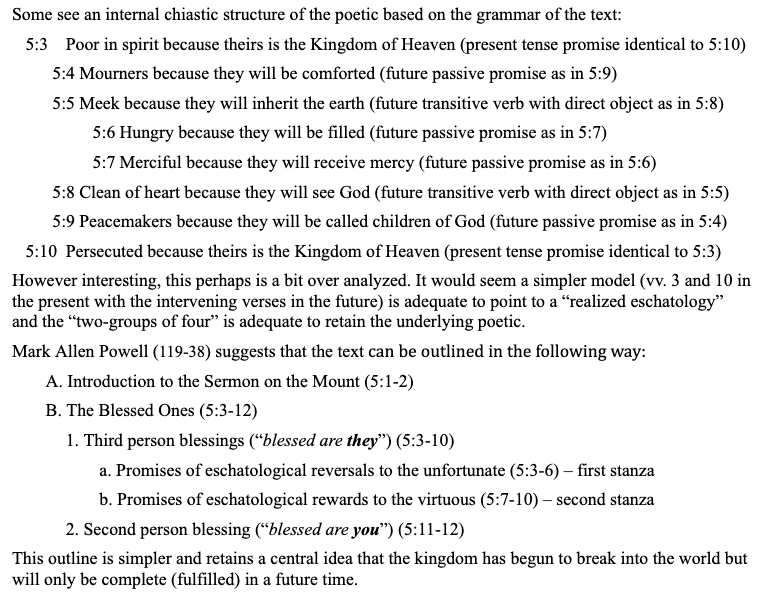
The people described in the first stanza are those who lack dikaiosynē. The people described in the second stanza are those dedicated to bringing dikaiosynē. Thus the people in the second part provide what the people are lacking in the first part. Ironically, by seeking to provide dikaiosynē, the virtuous may find themselves in the position of lacking dikaiosynē. With Jesus as an example: he proclaimed justice to those deprived of justice, and he became one who was unjustly executed.

Whether the coming of God’s kingdom is perceived as bringing reversal or reward depends only on the position that one occupies prior to its advent. God’s rule sets things right. Those for whom things have not been right are blessed by the changes it brings and those who have been seeking to set things right are blessed by the accomplishment of what they have sought. (Powell, 138).

The Final Blessing

11 Blessed are you when they insult you and persecute you and utter every kind of evil against you (falsely) because of me. 12 Rejoice and be glad, for your reward will be great in heaven.

The sudden shift to “you” must have been shocking to the disciples and other followers. Up until now in the gospel, the disciples have neither been the unfortunate in need of the eschatological reversal nor the virtuous waiting for the eschatological reward. They just followed Jesus, but sort of standing on the sidelines, watching the activities; listening to Jesus. They have been hearing about those other poor and virtuous souls and the blessings pronounced on them. Suddenly the word you involves the hearers. Suddenly Jesus’ words aren’t about those other people any more but me. Why would we be reviled and persecuted and lied about? Because you are committed to dikaiosynēand because of this commitment, you will end up in the position of those lacking dikaiosynē – being unjustly persecuted. However, we have already heard the blessings God has in store for such people. Will we believe those promises for ourselves or not? Will we believe that God will make all things right for us – whether reversal or rewards? If so, we can rejoice and be glad, knowing we have a great reward in heaven.


Image credit: Cosimo Rosselli Sermone della Montagna, 1481, Sistine Chapel, Public Domain 

The Second Stanza – Promises of Reward to the Virtuous

This coming weekend is the Fourth Sunday in Ordinary Time. The gospel is the beginning of Matthew’s well known “Sermon on the Mount.” In yesterday’s post we drilled deep into the nature of the first part of the Sermon known as the Beatitudes. In today’s post we considered the first stanza of the beatitudes (vv.3-6). Today we look at the second stanza (vv.7-10)

7 Blessed are the merciful,  for they will be shown mercy. 8 Blessed are the clean of heart, for they will see God. 9 Blessed are the peacemakers,  for they will be called children of God. 10 Blessed are they who are persecuted for the sake of  righteousness,  for theirs is the kingdom of heaven.

All the beatitudes in Matthew 5:7-10 are best interpreted as promising eschatological rewards to people who exhibit virtuous behavior. The second stanza does not, however, represent a logical departure from the thought that undergirds the first, for the virtues that are rewarded with blessings are ones exercised on behalf of the people mentioned in Stanza One. In other words the people whom Jesus declares blessed in 5:7-10 are those who help to bring to reality the blessings promised to others in 5:3-6. 

The merciful. “Mercy” (eleos) can have quite a broad range of meanings — which all involve concrete acts rather than just an attitude. It can mean “to forgive sins.” A related word (eleemosyne) refers to the giving of money to the poor (6:2, 3, 4). “Showing mercy” (eleeo) can mean “to heal those who are sick” (9:27; 20:30, 31) or “those possessed by demons” (15:22; 17:17). Twice in Matthew, Jesus quotes Hosea 6:6: “I desire mercy, not sacrifice.” In the first of these (9:13), he metaphorically illustrates mercy as being a physician to those who are sick (9:12). It is spoken in the context of eating with sinners and tax collectors (9:10-13). In the second instance (12:7), the context is feeding those who are hungry. As already illustrated by Joseph’s actions in the opening scene of the Gospel, Matthew does not understand “justice” and “mercy” to be alternatives (1:19; see also 20:1-16, esp. v. 4). In Matthew, Jesus is generally referring to concrete acts of mercy rather than a merciful attitude. 

Continue reading

The First Stanza – Promises of Reversals to the Unfortunate

This coming weekend is the Fourth Sunday in Ordinary Time. The gospel is the beginning of Matthew’s well known “Sermon on the Mount.” In yesterday’s post we drilled deep into the nature of the first part of the Sermon known as the Beatitudes. In today’s post we consider the first stanza of the the beatitudes (vv.3-6)

3 “Blessed are the poor in spirit, for theirs is the kingdom of heaven. 4 Blessed are they who mourn, for they will be comforted. 5 Blessed are the meek, for they will inherit the land. 6 Blessed are they who hunger and thirst for righteousness, for they will be satisfied. 

Powell states: “All four of the beatitudes in the first stanza may reasonably be interpreted as promising eschatological reversals to those who are unfortunate, and some of the beatitudes in this stanza can be reasonably interpreted only in this way” (122). With this approach, these are not virtues that one should aspire to, but they are circumstances in which people find themselves. 

Poor in spirit. The word ptochoi (poor) is used to translate Hebrew ʿănāwîm in the LXX, the dispossessed and abandoned ones in Israel. The phrase alludes to an Old Testament theme which underlies all the beatitudes, that of the ‘poor’ or ‘meek’ (‘ānî or ‘ānāw) who occur frequently in the Psalms and elsewhere (Isa. 61:1–2, alluded to in v. 4, and Ps. 37, alluded to in v. 5), those who humbly trust God, even though their loyalty results in oppression and material disadvantage, in contrast with the ‘wicked’ who arrogantly set themselves up against God and persecute his people. The emphasis is on piety and suffering, and on dependence on God, not on material poverty as such. 

Continue reading

Beatitudes: structure

This coming weekend is the Fourth Sunday in Ordinary Time. The gospel is the beginning of Matthew’s well known “Sermon on the Mount.” In yesterday’s post we covered the nature and alternative outlines of the Sermon. Today we go a little deeper into the nature of the first part of the Sermon known as the Beatitudes.

Internal Structure  – Altogether there are nine beatitudes in 5:3–12, the ninth (5:11–12) is really an expansion of the eighth (5:10). Some scholars opt for a structure with three sets of three, the first eight exhibit such a tightly knit parallel structure that it is more likely that we should understand them as two sets of four. This is most consistent with Hebraic poetry forms which seem to be the literary background of the Beatitudes. Still there is an internal consistency within each “stanza/verse” as seen in the form of each pronouncement:

Blessed are they who… (a quality/activity in the present tense)
for they will be…. (a verb in the future; except vv. 3 and 10)

This form is repeated each time with minor variations.  The first and last beatitude have the same ending: “for theirs is the kingdom of heaven.”


Image credit: Cosimo Rosselli |Sermone della Montagna, 1481, Sistine Chapel, Public Domain

Beatitudes: scripture, culture and theology

This coming weekend is the Fourth Sunday in Ordinary Time. The gospel is the beginning of Matthew’s well known “Sermon on the Mount.” In yesterday’s post we covered the nature and alternative outlines of the Sermon. Today we go a little deeper into the nature of the first part of the Sermon known as the Beatitudes.

Beatitudes are found elsewhere in Matthew (11:6; 13:16; 16:17; 24:46) and more frequently in Luke. They are based on a common form of expression in the poetic books of the Old Testament (e.g. Pss. 1:1; 32:1–2; 40:4; 119:1–2; 128:1), but nowhere in the Old Testament or other Jewish literature is there so long and carefully constructed a series as here. A beatitude (Latin) or makarism (Greek) is a statement in the indicative mood beginning with the adjective makarios, declaring certain people to be in a privileged, fortunate circumstance. It is not original to Jesus but occurs frequently in the OT as well as in non-Scriptural Jewish and other writings. Used here, the beatitudes reflect the Jewish use and setting: wisdom and prophecy. In the wisdom setting beatitudes declare the blessings of those in fortunate circumstances, based on observation and experience (e.g. Sir 25:7-9), and declare their present reward and happiness. In the prophetic setting beatitudes declare present and future blessings to those who are presently in dire circumstances but who will be vindicated at the coming of God’s kingdom (e.g. Is 30:18, 32:20; Dan 12:12). 

Continue reading

Sermon on the Mount: nature and outline

This coming weekend is the Fourth Sunday in Ordinary Time. The gospel is the beginning of Matthew’s well known “Sermon on the Mount.” In yesterday’s post we cover the context for the Sermon as well as some overarching views of the Sermon regarding its context and audience. Today we consider the nature and alternative outlines of the Sermon.

The Beatitudes, which begin the “Sermon on the Mount” have a tendency to lead readers/hearers of the text to assume that Matthew has constructed a general ethical code which forms the core message. Craig Keener (A Commentary on the Gospel of Matthew, 160) notes that there are more than thirty-six discrete views about the sermon’s message. He summarizes 8 of them:

  1. The predominant medieval view, reserving a higher ethic for clergy, especially in monastic orders;
  2. Martin Luther’s view that the sermon represents an impossible demand like the law; 
  3. the Anabaptist view, which applies the teachings literally for the civil sphere; 
  4. the traditional liberal social gospel position; 
  5. existentialist interpreters’ application of the sermon’s specific moral demands as a more general challenge to decision; 
  6. Schweitzer’s view that the sermon embodies an interim ethic rooted in the mistaken expectation of imminent eschatology; 
  7. the traditional dispensational application primarily to a future millennial kingdom; and 
  8. the view of an “inaugurated eschatology,” in which the sermon’s ethic remains the ideal or goal, but which will never be fully realized until the consummation of the kingdom.” 

It is perhaps the ethical view that is most common.  Many scholars trace this popular predominance to the influence of Russian novelist Leo Tolstoy whose literal interpretation of the ethical teachings of Jesus centered on the Sermon on the Mount (The Kingdom of God Is Within You). But this ethical reading alone does not do justice to the whole of Matthew’s text. Jesus is describing a standard that is nothing less than wholeness/completeness, being like God (5:48).  As St. Irenaeus wrote in the 2nd Century, “The glory of God is the human person fully alive.”

Continue reading

Sermon on the Mount – context and audience

This coming weekend is the Fourth Sunday in Ordinary Time. The gospel is the beginning of Matthew’s well known “Sermon on the Mount.” In today’s post we cover the context for the Sermon as well as some overarching views of the Sermon regarding its context and audience.

From the 4th through the 9th Sundays of Year A the Catholic Lectionary covers most of Chapters 5-7 of the Gospel according to Matthew – popularly known as the “Sermon on the Mount.” These verses are the first, the longest and the most carefully structured discourse in Matthew’s narrative. Roughly 27 percent of Matthew’s discourse is shared with Luke 6:20-49, a further 33 percent has parallels elsewhere in Luke, and 5 percent in Mark, while the remaining 35 percent is unique to Matthew. In Matthew it is a lengthy collection of authoritative teaching with a parallel of authoritative deeds following in Matthew 8-9. But the Sermon does not simply appear. Matthew has established the groundwork for its message.

By way of preparation for the Sermon on the Mount, Matthew has established Jesus’ superiority to John the Baptist (3:1–12), recounted the divine acknowledgement of Jesus as the Son of God (3:13–17), and shown what kind of Son of God Jesus is (4:1–11). The scene has been set: the Messiah had begun to preach in Galilee as Scripture foretold (4:12-17). The Son of God has begun to form a new messianic community via the calling of the four disciples (4:18-22).  

Continue reading

A Summary of Jesus’ Activities

This coming Sunday is the 3rd Sunday in Ordinary Time.  In the previous post we discussed the phrase: “the kingdom of heaven is at hand.” Today we summarize the gospel as a prelude to the Sermon on the Mount – the gospel for the 4th Sunday. 24 His fame spread to all of Syria, and they brought to him all who were sick with various diseases and racked with pain, those who were possessed, lunatics, and paralytics, and he cured them. 25 And great crowds from Galilee, the Decapolis,  Jerusalem, and Judea, and from beyond the Jordan followed him.

Although Jesus’ activity is confined to the region of Galilee, word of it spreads to the whole province of Syria. The outward movement of Jesus’ reputation as a teacher and healer results in the movement of many people toward him. People suffering from all kinds of diseases are brought to him, and they are cured (v. 24). People from every region of Israel except Samaria join the crowds that follow him (v. 25). Such people, along with the disciples, form the audience for the Sermon on the Mount.

Matthew 4:23–25 encapsulates the ministry of Jesus. It may be viewed as a concluding summary of Jesus’ early ministry in Galilee, or as the introduction to the Sermon on the Mount. It is noteworthy that 4:23 is repeated almost verbatim in 9:35. Both 4:23 and 9:35 are located just before major discourses of Jesus, and they serve to summarize his deeds as the context for his words. But there is likely more to the repetition than that. Taken together, 4:23 and 9:35 form an inclusio, a set of literary bookends, which summarize Jesus’ words and deeds at the beginning and end of two sections that present his words (Matt 5–7) and deeds (Matt 8–9) in detail. Significantly, both the words and deeds demonstrate Jesus’ Kingdom authority, an authority he passed on to his disciples. As his words and deeds proclaim and demonstrate the Kingdom, so will the words and deeds of his disciples (10:7–8; 24:14).

By way of preparation for the Sermon on the Mount, Matthew has established Jesus’ superiority to John the Baptist (3:1–12), recounted the divine acknowledgement of Jesus as the Son of God (3:13–17), and shown what kind of Son of God Jesus is (4:1–11). He has also explained why Jesus taught and healed in Galilee (4:12–17) and how he attracted an inner circle of disciples (4:18–22) and a larger circle of interested followers (4:23–25). The Sermon on the Mount (5:1–7:29) will reveal what a powerful teacher Jesus is.


Image credit: Detail  of Domenico Ghirlandaio: Calling of the First Apostles | 1481–82 | Sistine Chapel, Vatican | PD-US

The Kingdom of Heaven

This coming Sunday is the 3rd Sunday in Ordinary Time.  In yesterday’s post discussed some insights about fishing in the first century as well as being “caught” in our time. Today we will consider the phrase: “the kingdom of heaven,” a phrase unique to Matthew’s gospel. He often uses it in place of Mark’s “kingdom of God.” Perhaps, if we assume a Jewish background for Matthew, it is a way of avoiding saying and thus possibly misusing the name of God.

The expression appears twice in our reading: “kingdom of heaven is at hand” (v.17) and at the end of the passage. The work kingdom (basileia) can refer to the area ruled by a king; or it can refer to the power or authority to rule as king. We probably shouldn’t interpret the “kingdom of heaven” as a place — such as the place we go when we die; but as the ruling power that emanates from heaven. One commentator translates the phrase: “heaven rules”.

The verb eggizo (“at hand”) is difficult to translate in this passage. It means “to come near”. It can refer to space, as one person coming close to another person; or to time, as “it’s almost time”. The difficulty is with the perfect tense of the verb, which usually indicates a past action with continuing effects in the present. For instance, the perfect: “He has died” or “He has been raised” or “I have believed” can also be expressed with the present: “He is dead” or “He is raised” or “I am believing”. When we say with the perfect tense that “The kingdom of heaven has come near.” That implies that the kingdom is near or even that it arrived. Its “time has come” or “is now”. Given the ambiguity of the perfect tense and the translation in the preceding paragraph, we might say: “Heaven’s rule has arrived and is arriving.”

And what is the proper response to that arrival? In a chapter called “Worship,” Mark Allan Powell in God With Us: A Pastoral Theology of Matthew’s Gospel, states:

Still if worship is an appropriate response, it is not the ideal one. For Matthew, the ideal response to divine activity is repentance. . . . Indeed, Jesus never upbraids people for failing to worship or give thanks in this gospel (compare Luke 17:17-18), but he does upbraid those who have witnessed his mighty works and not repented (11:20-24). We know from Jesus’ teaching in Matthew that people can worship God with their lips even when their deeds demonstrate that their hearts are far from God (15:3-9). Thus, the responsive worship of the crowds in 9:8 and 15:31 is commendable but will be in vain if performed with unrepentant hearts. [pp. 41-42]

What should be our response to the coming of heaven’s rule? Surprisingly, it is not worship or praise, but repentance. Perhaps this is the big problem with the coming of the Kingdom or the coming of Jesus at Christmas or Palm Sunday (or even “praise services”?) – we are satisfied to celebrate and praise, rather than repent.


Image credit: Detail  of Domenico Ghirlandaio: Calling of the First Apostles | 1481–82 | Sistine Chapel, Vatican | PD-US