Many years ago I was driving to a client site along with one of their information technology managers who, as it happens, was English and a graduate of Oxford. In the course of the conversation I asked what his area of study was. He replied American history. At which point my heart swelled with All-American pride. I asked him why he chose American history and he replied, “Well, your country is not that old and so I didn’t think there would be that much to learn.”
He understood that our history is that we were an immigrant nation that had our fill of monarchies and royal families and wanted nothing to do with kings and royal courts of privileged men and women of lands and titles such as prince, duke, barons and viscounts. Out with the kings and in with the story of democracy! We have our flaws and perhaps democracy is not a good form of government, but it is better than any other form that has been tried. In any case, we are not a people who desire kings and such. Quite the opposite.
The Hebrews had their own experience with those who would be king. Pharaoh of Egypt was a king by any other name and the Lord God needed to set his people free from such tyranny. And so the Israelites, led by Moses, journey to a land promised to their ancestor Abraham – notice neither of them was a king. The people settled in the land among other tribal people: Canaanites, Amorites, Jebusites, and other “ites.” Over the next two hundred years the Hebrews, who apparently were not that good at organizing themselves, found themselves beleaguered and set upon by the other tribes. At which point they cried out to God for rescue and God raised up among them Judges. Not legal scholars, but war leaders. But after 200 years of ups and downs with Judges, they decided they needed to get permanently organized. And so they turned to the last Judge, the prophet Samuel and asked him to request that God give them a king so that they could be like the other nations. You can read the dialogue in 1 Samuel 7. It is a story of “be careful what you ask for.” You might think, well, King David was good, right? Certainly better than the other 19 kings of Judah. Let’s just say they fattened themselves at the expense of their flock. Such is perhaps the nature of earthly kings.
We are a nation whose very foundation includes “no more kings.” At the same time, we are faithful people. Sons and daughters of Abraham and Sarah. People who celebrate Christ the King, Jesus who is the culmination of the House of David, fully divine, fully human, raised from the dead who now sits at the right hand of God the Father – the Lord of Lords and King of Kings. As the gospel reading makes clear, the One who sits on the throne of judgment. But what is the basis and character of that judgement?
As St. Paul describes to the people in Corinth: “the work of each will come to light, for the Day will disclose it. It will be revealed with fire, and the fire [itself] will test the quality of each one’s work” (1 Cor 3:13). It depicts the great day of Yahweh spoken of by the Old Testament prophets, the day of judgment, which can be a time of either gloom or joy – sheep or goats, heaven or perdition. For “the work of each will come to light, for the Day will disclose it” Such is the basis, but what is the character of that judgement?
Apart from this day when we celebrate The Solemnity of Our Lord Jesus Christ, King of the Universe, we really do not have any Sacred Scripture that depicts Jesus as a king, certainly not an earthly king with whom we might be familiar. But we abound with pastoral images, especially the Good Shepherd.
Today’s first reading is from the prophet Ezekiel who describes how the Kings of Israel and Judge were tasked with shepherding the flock, the people of God. But instead the “.. sheep became plunder … food for wild beasts, for lack of a shepherd, because my shepherds did not look after my sheep, but pastured themselves and did not pasture my sheep…I myself will come and pasture my sheep.” Jesus is the Lord God who came himself to be the Good Shepherd. The One who knows us and calls us by name, seeks the lost and vulnerable, provides nourishment and rest – bread from heaven and living water, meeting our physical and spiritual hunger, and protects the flock even when there is a cost. Even unto death.
The One who told the apostles on Easter Sunday evening in the locked Upper Room, “…just as the Father has sent me, so I send you.” And so we are sent to be for others what Christ is for us.
And now we understand the King of the Universe we worship and honor on this day.
And now we begin to more fully understand our baptismal anointing as priest, prophet, and king. As priests called to worship. Prophets to proclaim the Word of God into a waiting world. Kings to be good shepherds of our own flocks leading them to green pastures, knowing each by name, providing nourishment and rest, and extending protection.
We are commissioned to be good shepherds to our biological family, our parish family, and the family made up of the immigrants, aliens, strangers, widows, and orphans. The least of our brothers and sisters. So at the end of days, “the work of each will come to light, for the Day will disclose it.”
On that great Day, may the King of Kings, the Good Shepherd, say to us all, “Well done my good and faithful servant. Come share your master’s joy.”
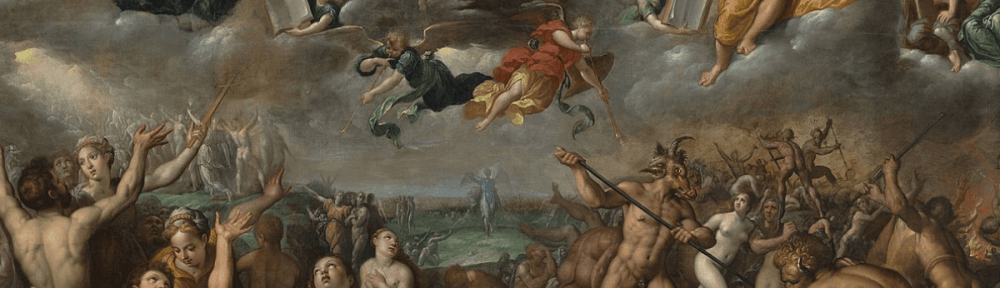
Image credit: Jacob Adriaensz Backer: Last Judgment (Matthew 25:31-33), National Museum in Warsaw, PD-US
Discover more from friarmusings
Subscribe to get the latest posts sent to your email.

