The New Creation Week. Many scholars have noted that repeats the theme of Creation as he begins the narrative of the Gospel. Where the synoptic gospels focus on the events at the beginning of Jesus’ public life, John seems to assume that the reader is familiar with those accounts and calls our attention to the ways in which people respond in faith to him – yet, at the same time, unlike the other gospel writers, places the beginning events on a timeline. The beginning is the testimony of John the Baptist (v.15) On the “next day” (John 1:29), the Baptist testifies to the more powerful, promised baptism of the Son of God. Continue reading
Category Archives: Scripture
Cana: context
1 On the third day there was a wedding in Cana in Galilee, and the mother of Jesus was there. 2 Jesus and his disciples were also invited to the wedding. 3 When the wine ran short, the mother of Jesus said to him, “They have no wine.” 4 (And) Jesus said to her, “Woman, how does your concern affect me? My hour has not yet come.” 5 His mother said to the servers, “Do whatever he tells you.” 6 Now there were six stone water jars there for Jewish ceremonial washings, each holding twenty to thirty gallons. 7 Jesus told them, “Fill the jars with water.” So they filled them to the brim. 8 Then he told them, “Draw some out now and take it to the headwaiter.” So they took it. 9 And when the headwaiter tasted the water that had become wine, without knowing where it came from (although the servers who had drawn the water knew), the headwaiter called the bridegroom 10 and said to him, “Everyone serves good wine first, and then when people have drunk freely, an inferior one; but you have kept the good wine until now.” 11 Jesus did this as the beginning of his signs in Cana in Galilee and so revealed his glory, and his disciples began to believe in him. (John 2:1-11) Continue reading
Baptism of the Lord: final thought
The Theology of History. It is interesting to note that Luke relates no encounter between Jesus and John. In fact, before we are told about Jesus’ baptism, we are informed that John has been put in prison! A traditional way of understanding this order of events is that Luke (the rhetorical historian) divides history into three separate and distinct eras. The first is the time of the prophets, which includes John the Baptist. That era ends with the imprisonment of John. John will no longer be in the picture. After that, the time of Jesus begins with a statement in our text about: (1) the opening of the heaven, (2) the coming down of the Holy Spirit in a visible form (dove); and (3) heavenly speech. This era of Jesus ends with his ascension — related only in Luke & Acts. Jesus will no longer be in the picture. After that, the time of the Holy Spirit (or the Church) begins with a statement in Acts 2:1-4 about (1) something coming “from heaven,” (2) the coming down of the Holy Spirit in a visible form (tongues of fire), and (3) heavenly speech. Continue reading
Baptism of the Lord: Father
A Voice From Heaven. The voice in Luke, as in Mark, speaks directly to Jesus. We overhear the words. In Matthew’s account of the baptism and all three accounts of the transfiguration, the voice speaks to those around Jesus: “This is my son….”
What does it mean to be the “Son of God?” Luke provides answers to this in the larger context. The baptism in Luke is followed by a genealogy which ends with “son of God.” This is followed by the temptation story where the devil tries to help Jesus get a “better” understanding. Twice he states: “If you are the Son of God” (4:3, 9). Continue reading
Baptism of the Lord: Spirit
“the Holy Spirit descended upon him in bodily form like a dove”
Only Luke includes the phrase “in bodily form”. Jensen (Preaching Luke’s Gospel) makes the point that “Bodily descent has the character of permanence. The Spirit not only descended upon Jesus; the Spirit of God came in bodily form and it will remain upon Jesus.” He makes a contrast between Jesus and Israel’s “charismatic judges” on whom the Spirit of God descended temporarily. Continue reading
Baptism of the Lord: gathered
15 Now the people were filled with expectation, and all were asking in their hearts whether John might be the Messiah. 16 John answered them all, saying, “I am baptizing you with water, but one mightier than I is coming. I am not worthy to loosen the thongs of his sandals. He will baptize you with the holy Spirit and fire……. 21 After all the people had been baptized and Jesus also had been baptized and was praying, heaven was opened 22 and the holy Spirit descended upon him in bodily form like a dove. And a voice came from heaven, “You are my beloved Son; with you I am well pleased.” Continue reading
Baptism of the Lord: context
In our celebration of the Baptism of the Lord, we draw an excerpt from the Gospel of Luke (3:15-16, 21-22) which describes, in minimal terms, the baptism of Jesus by John the Baptist.
15 Now the people were filled with expectation, and all were asking in their hearts whether John might be the Messiah. 16 John answered them all, saying, “I am baptizing you with water, but one mightier than I is coming. I am not worthy to loosen the thongs of his sandals. He will baptize you with the holy Spirit and fire……. 21 After all the people had been baptized and Jesus also had been baptized and was praying, heaven was opened 22 and the holy Spirit descended upon him in bodily form like a dove. And a voice came from heaven, “You are my beloved Son; with you I am well pleased.” Continue reading
More than Just Three Kings Day
January 6th is the day we typically call “Three Kings Day,” more formally known as The Epiphany. Epiphany is derived from a Greek word ἐπιφάνεια, epiphaneia, meaning “manifestation,” and refers, generally, to Jesus being manifested to the gentile visitors from the East. But in truth it is more complicated than that. What is striking is that there are a variety of liturgical celebrations and dates that are all part of our rich Catholic tradition surrounding “Epiphany.”
Lazrus: dialogues
Act 3 – The Dialogues
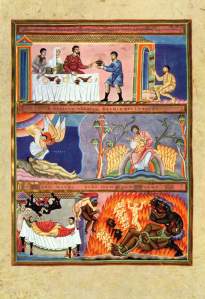
To a first century hearer of the parable, the fates of the two would have been surprising for it went against the grain of the common wisdom: blessings in this life were a sign of God’s favor while illness, poverty, and hardship were a sign of God’s curses. Yet the one well “blessed” in his lifetime is now tormented in the netherworld (see the Note on 16:23 below) where he can see Lazarus and Abraham across the great chasm that divides them (v.26). Continue reading
Lazarus: the reversal
Culpepper well describes this parable as a drama in three acts (Luke, 316):
- Act 1 – a tableau during which the characters are introduced and their way of life is described, but nothing happens
- Act 2 – the rich become poor and the poor become rich as each character has died and received their eternal reward
- Act 3 – narration give way to dialogue, but between the rich man and Abraham, in three exchanges:
- about the finality of judgment
- about the witness of Moses and the prophets
- about the blindness that prevents even the Resurrection from leading to conversion