
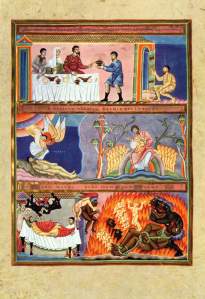
 19 “There was a rich man who dressed in purple garments and fine linen and dined sumptuously each day. 20 And lying at his door was a poor man named Lazarus, covered with sores, 21 who would gladly have eaten his fill of the scraps that fell from the rich man’s table. Dogs even used to come and lick his sores. 22 When the poor man died, he was carried away by angels to the bosom of Abraham. The rich man also died and was buried, 23 and from the netherworld, where he was in torment, he raised his eyes and saw Abraham far off and Lazarus at his side. 24 And he cried out, ‘Father Abraham, have pity on me. Send Lazarus to dip the tip of his finger in water and cool my tongue, for I am suffering torment in these flames.’ 25 Abraham replied, ‘My child, remember that you received what was good during your lifetime while Lazarus likewise received what was bad; but now he is comforted here, whereas you are tormented. 26 Moreover, between us and you a great chasm is established to prevent anyone from crossing who might wish to go from our side to yours or from your side to ours.’ 27 He said, ‘Then I beg you, father, send him to my father’s house, 28 for I have five brothers, so that he may warn them, lest they too come to this place of torment.’ 29 But Abraham replied, ‘They have Moses and the prophets. Let them listen to them.’ 30 He said, ‘Oh no, father Abraham, but if someone from the dead goes to them, they will repent.’ 31 Then Abraham said, ‘If they will not listen to Moses and the prophets, neither will they be persuaded if someone should rise from the dead.’” Continue reading
Lazarus: context
Reply
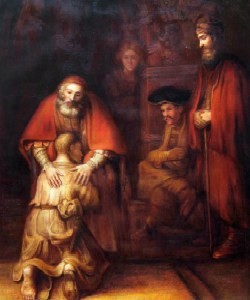 The Homecoming of the Son and Welcome by His Father. Tashjian notes “As Westerners we cannot really understand what the father has done unless we put ourselves in the context of Eastern culture and way of thinking. The son had dishonored his father and the village by taking everything and leaving. When he returns in tattered clothes, bare-footed and semi-starved, he would have to get to the family residence by walking through the narrow streets of the village and facing the raised eyebrows, the cold stares, the disgusted looks of the town people. So when the son is still far off, before he has entered the outskirts of the village, the father sees him and decides immediately what he must do. In compassion for his son and to spare him the pain of walking through the gauntlet of the town alone, he runs to him, falls on his neck, and kisses him.”
  Joy in heaven and on earth? A present participle generally denotes action that occurs at the same time as the main verb. The main verb in the first conclusion (v. 7) is estai a future = “There will be”. The main verb in the second conclusion (v. 10) is ginetai a present = “There is”. So, when a sinner repents, at that moment there is joy in heaven. Will there be joy on earth, then seems to be Jesus’ question.
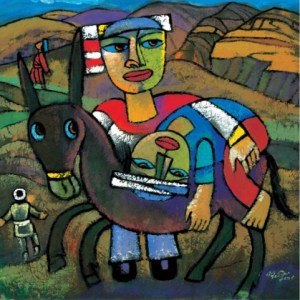 The Samaritan. A Samaritan was the last person who might have been expected to help – actions which reveal more than simple help, but a great deal of compassion. He attended to the beaten man. Wine would have been used for cleaning the wounds (the alcohol in it would have had an antiseptic effect). Oil, i.e. olive oil, would have eased the pain. The two appear to have been widely used by both Jews and Greeks. Perhaps a touch of irony is included as oil and wine were commonly used in Temple sacrifice. The wounded man was too weak to walk, so the Samaritan set him on his own beast (which meant that he himself had to walk), and so brought him to an inn. There he took care of him. The Samaritan did not regard his duty as done when he had brought the man to shelter. He continued to look after him.
