
 In the epic novel The Lord of the Rings, the elves of Lothlorien admit that they are losing their forest lands. But they battle on. The describe their struggle as “fighting the long defeat.” This is source of the comment made by Paul Farmer, who has fought a “losing battle” for health care for the poor. In Tracy Kidder’s biography of Farmer called Mountains Beyond Mountains, Farmer says, “I have fought the long defeat and brought other people on to fight the long defeat, and I’m not going to stop because we keep losing… I actually think sometimes we may win… So, you fight the long defeat.”
Reminds me of the persistent widow. Continue reading
 In the first reading, we hear the end of the story of Naaman, a Syrian general, who has just been cured of his leprosy. But we don’t get to hear the start of the story. It turns out that when Naaman comes to Israel he encounters the prophet Elisha. Naaman has come bearing all manner of riches and gifts, but Elisha wants none of it. He simply instructs Naaman to wash seven times in the Jordan. Pretty simple and ordinary, yes?
  During WWII there was a platoon of Army Rangers deployed well behind enemy lines on a critical mission during the European campaign. A single sniper bullet had killed one of the platoon members. The mission had to continue, but they just could not leave their friend as a stranger in a strange land, buried in an unmarked grave that they might never again find. They remembered a small Catholic church in the area. So, under the cover of the moonless night, they approached the church and rectory, and knocked on the door. After a while a single light came on in the house. Eventually, the door cautiously opened, and the parish priest even more cautiously greeted them.
 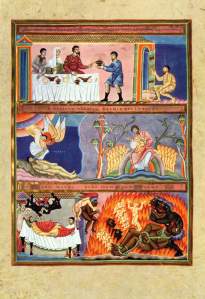 “…between us and you a great chasm is established to prevent anyone from crossing who might wish to go from our side to yours or from your side to ours.…” Such are words spoken about Lazarus and the rich man, traditionally known as Dives. The words describe their fates in the afterlife: Lazarus comforted by Abraham while Dives languishes in a hellish afterlife.
 In Jesus’ time, large agricultural operations such as the one described in our gospel parable were rarely run by the owner or the family, such things were left to the steward to oversee. The steward had the full faith and backing of the owner to operate the business. The steward would sell the oil and wheat production for cash, trade, or in exchange for promissory notes. The bartering that preceded the execution of the promissory note was classic commodity bargaining: I will give you so many measure of oil now, and at this future date you will repay with a higher measure of oil. There were two thing buried in the difference between the higher amount and the original amount: profit for the owner and commission for the steward. That was the way things worked.
 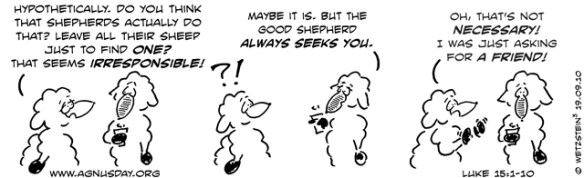 The Parable of the Lost Sheep – you’ve heard it countless times before and have taken in just as many homilies. I suspect the “take away” from the parable and the homily was focused on the shepherd – as it should be. I will simply say that indeed Jesus is the Good Shepherd and is relentless in search for and finding us. No matter how far we have strayed or what we have done, Jesus will find us and ever offer to take us up on his shoulders and bring us home. Always. That my friends, is as good a Good News as you can get. People of God, can I get an “Amen!”
 In this day and age, we receive all manner of evites: to meetings, parties, events and more. Upon receiving the evite are we excited? Were we just hoping for a day or evening off? Does this seem more obligation than interesting? Do we have to rearrange schedules? Are hoping something more exciting comes along? We have choices – delete, never open, don’t answer, answer with regrets, or accept. And then come all the consequences of all those choices we make, intended or no. Does all this seem like a phenomenon of the internet age? Not really. It is as old as time and part of the gospel.
 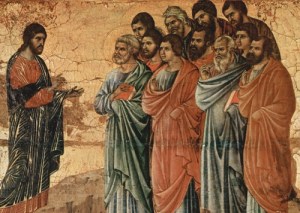 “For everyone who exalts himself will be humbled, but the one who humbles himself will be exalted.” Not my favorite verse in Scripture because of they way I think we tend to hear the word “humble.” I suspect a lot of people hear “get too arrogant, prideful or presumptuous – you’ll be put in your place and get what’s coming to you.” Merriam Webster defines humility as freedom from pride or arrogance. That seems a little thin; it tells us what humility is not and by implication tells us what not to do in life…but…
  In the first reading, it has been about 40 years since the armies of Babylon captured, destroyed and burned Jerusalem. The Prophet Isaiah is speaking to people who have lived their life in exile with only the stories of the Jerusalem-that-used-to-be as solace. A people that are wondering if they will ever be saved from exile. Will God rescue them as He did when he led the people out of exile and slavery in Egypt those many years ago?
  I have two words for you this morning: “thermometer” and “thermostat.” Regular, routine, and household words we rarely give a second thought to: “thermometer” and “thermostat.”
 friarmusings