
 I have been leading Bible studies for a long time now. I think the first one was in 1984. When I think back, it seems to me, that each time we study St. Luke’s account called the “Road to Emmaus” the same basic questions arise. “How could these two people, clearly disciples, people who may have followed Jesus for maybe three years – having seen the miracles, the mighty works, heard the preaching, seen Lazarus raised from the dead, and heard Jesus proclaim that he would be put to death and then rise – how could they then hear the reports of the empty tomb and then walk away in a slow descent into despair? Don’t they get it? How could they not get it? Where is their faith?” Continue reading
Turning out well
Reply
 Here is the opening of Pope Francis’ homily on Divine Mercy Sunday. The
 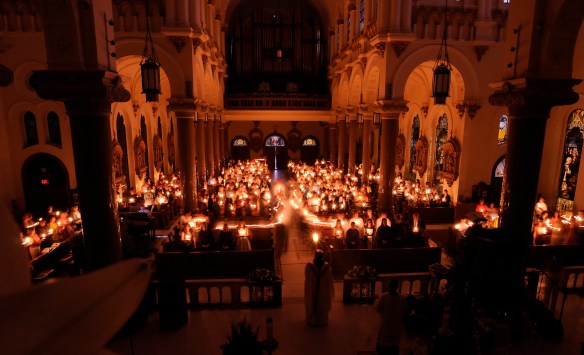 This Easter Vigil, the “homily” is presented in a different way. We chose to have an introduction before each Old Testament Reading that began to thematically weave together the homily message and then conclude during the homily proper. The picture above is our church during the procession of light. A reminder of the richness of the Vigil liturgy.
  Even though the entertainment business does not often seem to overtly share my religious sentiments, it at least pays attention to the religious calendar. I have noticed that almost everyday one of the cable or streaming services is offering the movie, The Ten Commandments, the 1956 American epic religious drama film produced, directed, and narrated by Hollywood legend Cecil B. DeMille. The film stars Charlton Heston in role of Moses, Yul Brynner as Pharoah, Edward G. Robinson as Dathan, and a host of other film stars from the 1950s. It was critically acclaimed, won tons of awards, and was one of the most financially successful films of all times, grossing approximately $122.7 million (equivalent to $1.23 billion in 200). The film is based on Prince of Egypt by Dorothy Clarke Wilson, Pillar of Fire by J.H. Ingraham, On Eagle’s Wings by A.E. Southon, and the Book of Exodus. All evidence indicating that this crew of people knew how to present a good story. A story of faith for me, but a story with epic scenes, even a classic chase scene as Pharaoh’s army chases the escaping daughters and sons of Israel. Good stuff.
  Back in the day, two friends and I started a business. The company was a good mix of skills, dispositions, and work ethic. One of the partners, Jack, was the best project manager I ever encountered. His staff loved him and the clients always wanted to know if Jack was managing their particular project. We had one client in the mid-west that made a very large contract contingent on Jack being the manager. That was fine. Jack had a demand of his own – and it was non-negotiable. The client waivered, but Jack held firm. He was clear, convicted, and certain: no matter what, he would be attending the Summer Olympics and the World Track and field championships. That was his non-negotiable: his vacation.
  #AloneTogether. #SocialDistancing. #StayAtHome – these are just some of the many “hashtags” being used online in the various text messaging applications currently in vogue. It is the year 2020 and here on the 5th Sunday in Lent much of the world is “sheltering in place” in order to slow the spread of a coronavirus, Covid-19. On Thursday morning there were 471,802 cases worldwide – but then that is a count of test-confirmed cases. A day later the count surpassed 500,000.
 What a difference a day makes. Wednesday, I woke up with a full day of ministry awaiting. Lots of people calling, emailing – all asking “Are we going to shut down? Will the Bishop suspend Masses? What’s going to happen now?” Today I awake wondering what I will do with all the time on my hands. Not that there aren’t a lot of things to do, but the rhythm of the day is changed. Changed dramatically. What a difference a day makes.
 The Gospel of John is a wonderful text at every level of reading and understanding. It is poetic, it has amazing narratives such as the Samaritan Woman at the Well (
 In our well-known account of the Transfiguration, Peter simply says, “Lord, it is good for us to be here.” Of course, he could mean Mount Tabor all in and of itself. It has an amazing 360-degree view of the Jezreel Valley, the mountains of Samaria, Mount Carmel, the Golan Heights, Mt Gilead, Mt Horeb, the whole of Galilee, all as far as the eye can see. On a clear day it is where heaven and earth meet. There atop a mountain, the place where man has gone to meet God, where human and divine touch, the meeting place of the temporal and the eternal. Matthew, Mark and Luke describe the miraculous event of the Transfiguration, as does 2 Peter 1. We celebrate the event that was the revelation of Jesus’s divine nature, exalting him above the Law/Moses and all the prophets/Elijah, foreshadowing his death, and prefiguring his Resurrection. Maybe Peter understood what was unfolding or maybe he was flummoxed and all he could come up with was “…it is good for us to be here.” I am not sure I would have understood what I was seeing much less think of something to say.
  friarmusings