There is one verse in today’s first reading that almost takes us by surprise. The prophet Jeremiah says: “They will in those days no longer say, ‘The ark of the covenant of the LORD!’ They will no longer think of it, or remember it, or miss it, or make another.” (Jer 3:16) If you were an Israelite hearing those words for the first time, they would have been shocking.
The Ark of the Covenant was the holiest object in Israel. It held the tablets of the Law given to Moses. It was the sign of God’s covenant and the symbol of his presence among his people. It accompanied Israel through the wilderness, stood in the Holy of Holies in the Temple, and reminded the people that God dwelt in their midst. So why would Jeremiah say that one day people would no longer even speak about it? Certainly not because the Ark was unimportant. It was profoundly important.
But it was never the destination. It was always a sign pointing to something greater.
Jeremiah goes on to say: “At that time they shall call Jerusalem the LORD’s throne.” Notice the movement. God’s presence is no longer focused on a single sacred object. It begins to embrace an entire people. That promise prepares us for the Gospel where Jesus tells the parable of the sower and explains that the seed is the word of God. The question is no longer, “Where is the Ark?” but, “Where will the Word take root?”
Some hearts are like the path. The Word never enters. Some are rocky. The Word begins to grow but has no roots. Some are crowded with thorns. The cares of life choke it. But some hearts are good soil. There the Word takes root where it grows and bears fruit thirtyfold, sixtyfold, and a hundredfold.
The Ark represented God’s presence. Jesus wants God’s presence to dwell in the human heart. The New Covenant is not centered on an object but on lives transformed by the living Word. That is why Jeremiah can say there will be no need to make another Ark. The sign points to a greater reality which when it arrives, the sign has fulfilled its purpose.
Most of us have things that help us draw close to God: a favorite Bible with worn pages, a rosary that has accompanied us through years of prayer, a crucifix hanging in our home, a church where we have celebrated baptisms, weddings, funerals, and countless Masses. These are precious gifts. They shape our memory and nourish our faith. The Church treasures sacred objects because they point us toward the sacred mysteries they represent.
But Jeremiah gently reminds us that even the holiest objects are never the goal. Their purpose is to lead us into a living relationship with God. Jesus tells us where that relationship finally takes root: not in wood overlaid with gold, not in stone buildings, not even in beautiful religious objects but in the human heart.
The true question is not whether we possess holy things. The true question is whether God’s Word has found good soil within us. Has it made us more patient? More forgiving? More generous? More faithful? More like Christ? Because in the end, the most sacred place on earth is not simply a beautiful church or a treasured religious object. The most sacred place on earth is a heart where Christ is welcomed, cherished, and allowed to bear fruit.
Today, as we receive the Lord in the Eucharist, let us ask for the grace to become that good soil, to allow his Word to sink deeply into our lives, so that God’s presence may not only dwell among us, but truly dwell within us.
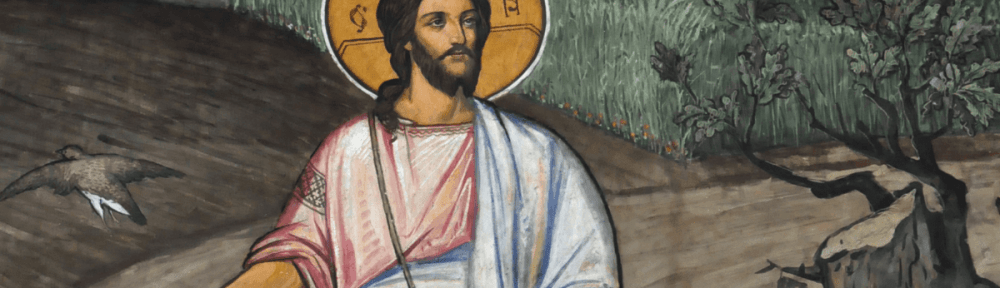
Image credit: Christ’s Appearance to Mary Magdalene after the Resurrection | Alexander Ivanon | Russian Museum | PD-US
Discover more from friarmusings
Subscribe to get the latest posts sent to your email.

