
 The Gospel reading for Palm Sunday of the Lord’s Passion is quite lengthy and so will not be included here. It can be found at the USCCB website:
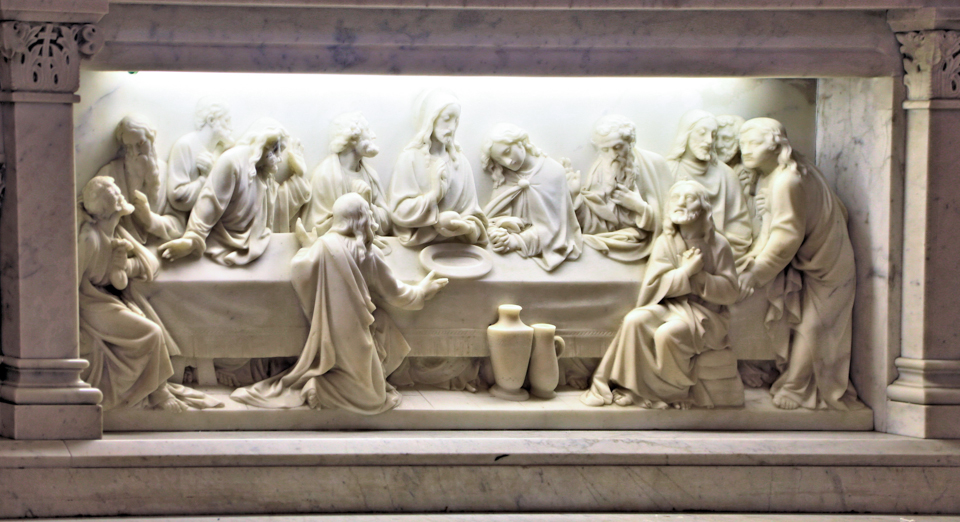
Jesus Inaugurates the Eucharist (26:26-30a) As Joachim Jeremias and other scholars have shown in looking at all the received Eucharistic traditions (Paul in 1 Corinthians and the synoptic gospel writers), Jesus follows the form and outline of the Passover Seder. The thanksgiving over the bread and the cup recorded in vv. 26 and 27 will therefore be a regular part of the main section of the Passover meal (making this the third of the four cups of the Passover), and we may reasonably assume that Jesus used the traditional words of thanksgiving. But it worthwhile to point out that said the blessing refers to blessing God, not blessing the bread. Continue reading
 “And he was transfigured before them; his face shone like the sun and his clothes became white as light.” (Mt 17:2) Transfigured, metamorphoo – to change the visible appearance; I used to think that maybe Epiphany would have been a better title for what happened on the mountain top. Epiphany meaning the revealing or the unveiling. Then again, I don’t think the full glory of God was revealed; just a single layer was pealed back. Perhaps transfigured is the better word. How much more could the apostles have seen and heard – and, more importantly, to begin to comprehend? The Book of Exodus 33:20 says that if we saw God face-to-face we would not survive the encounter. It would be too much for our mortal being. So, maybe it is better that only a single layer was peeled back.
  And sin entered the world. In the second reading, St. Paul is pretty clear that sin entered the world through Adam and Eve. Did you ever stop to think about what exactly was the first sin? Maybe it is as simple as disobedience. “The LORD God gave the man this order: You are free to eat from any of the trees of the garden except the tree of knowledge of good and evil. From that tree you shall not eat; when you eat from it you shall die.” (Gen 2:6-7) That seems awfully clear… lots of trees, lots of fruit, help yourself, but not from that one tree. Awfully clear and awfully tempting. We get to listen to Eve’s thoughts as Satan tempts her: “The woman saw that the tree was good for food, pleasing to the eyes, and desirable for gaining wisdom” (Gen 3:6) I suspect I had many the same thoughts when as a child, I stood before the open refrigerator door staring longingly at the last piece of key lime pie – so good, so pleasing to the eye… and there was mom talking from the next room, “Have a piece of fruit. It’s good for you.” You can guess how that story ends. In my case, it was clearly disobedience, but I am not so sure about Adam and Eve.
  About five years ago a man named Jonah Sachs wrote an insightful book titled “The Story Wars.” The subtitle is telling: “Why those who tell – and live – the best stories will rule the future.” A part of the book deals with the 2004 presidential campaign – George Bush vs. John Kerry. After the resounding Republican victory, a democratic strategist, the very colorful James Carville simply noted that the Republicans had crafted a well-received story: the world is a dangerous place and we Republicans will protect you and your loved ones. On the other hand, the democrats had no story at all, only a litany “We’re for clean air, better schools, more health care.” Carville asks would you rather commit your life for a story to believe in or a long list of complaints and problems?
  “…be perfect, just as your heavenly Father is perfect…” That seems like a tall order, trying to be perfect. And if you think of it as being without flaw, spot, or blemish, then you are correct. It is above our pay grade. But then again, “be perfect” does not seem like a suggestion. It appears it is a command from Jesus.
 Commandments, rules, and laws – our readings offer a lot to think about. When I was 5 years old, I followed (mostly) the rule: “Don’t cross the street by yourself”, even as I wanted to explore the world across the road. When I was 25 years old, I understood that those rules were for my welfare, health, and protection. There were also rules to shape me to be a good person: “You have to share your things with your friends.” Hopefully, when we are older we don’t think about those things, they are ingrained, and they are part of the good person we have become.
 Currently, I am reading “The History of Florida” by Michael Gannon, a professor emeritus at the University of Florida. The book is a monographic sweep through Florida history from the pre-Columbian landscape, the settling by native peoples, the arrival of the first European explorers, the history of ethnicity and immigration, and to the changing landscape of life and people who form the great state we live in. So far I have also learned an amazing amount by the early Franciscan missionaries in Florida and Georgia in the 16th and 17th centuries. It put me in a “historical mindset” this week.
  We are challenged – or we should be – when the prophet Isaiah tells us: “It is too little, the LORD says, for you to be my servant…. I will make you a light to the nations, that my salvation may reach to the ends of the earth.” A servant can be present, silently present, taking it all in, but never part of the conversation. Yes, we are called to be servants, but we are also called to be more. Called to moments in our lives, when the virtues already shine through, but we also called to testify. Called to testify as did John the Baptist, “Now I have seen and testified that he is the Son of God.” And not in whispered voices, but loud and proud in the public square. We are called to testify!!
