“You are the light of the world. A city set on a mountain cannot be hidden. Nor do they light a lamp and then put it under a bushel basket; it is set on a lampstand, where it gives light to all in the house. Just so, your light must shine before others, that they may see your good deeds and glorify your heavenly Father.” (Mt 5:14-16)
“Salt” and “Light” are overlapping images. Both metaphors stand or fall together as they emphasize
identity: not merely what disciples do, but what they are
mission: disciples exist for the sake of the world
distinctiveness: disciples must be different from the world
effect: disciples are meant to transform their environment
A disciple who is not “salty” cannot shine; a disciple who does not shine has no salt.
Yet they are different. Salt works quietly; light works visibly. Salt transforms from within, preserving what would decay, purifying what is corrupt, and giving flavor to what is bland. It works silently and imperceptibly, yet powerfully. Light is public, visible, and unmistakable. Light transforms from without, revealing what is hidden, guiding those in darkness, and manifesting truth. Salt is a subtle influence; light is a visible witness.
Salt is the depth of discipleship; light is its expression. A disciple must be transformed (salt) before he or she can transform others (light). Salt without light risks being hidden holiness and missing the opportunities to evangelize. Light without salt risks being hollow activism. A person might appear active but lack interior holiness.
Salt and Light together form a balanced identity: a holiness that shines and a witness rooted in integrity. Together they can take the mission of the Church to the ends of the earth.
Image credit: Sermon on the Mount (1877) by Carl Heinrich Bloch | Museum of National History | Frederiksborg Castle, Public Domain
After the First World War Japan experienced a political shift as liberal and democratic thinkers and politicians gained popularity. While there are many reasons for the shift, at the popular level it was clear that the winners of the war were the liberal democracies triumphant over the militaristic nations. At the same time there were currents within the Imperial Japanese Arm (IJA) that felt such a move might imperil the nation. While the political arm of the nation sought to form foreign relations, take their cooperative place in the world order of nations, the military continued to operate out of the long-held view that Japan needed a strategic buffer of allies or controlled lands that placed China and Russia at arm’s length. In addition, Japan was not able to feed its own population and as such was dependent on imports of food especially from Korea and Manchuria. Nor did Japan have room in the home islands for its burgeoning population; the late 19th and early 20th century saw extensive migration of Japanese citizens to these lands. Lands that were rich in resources needed for the continued industrialization of Japan, especially its heavy industries. The IJA saw it as their role to ensure the strategic and tactical future of Japan regardless of changes in the internal political landscape.
Other posts in this series address have (or will) speak to the interservice rivalry between Army and Navy as well as the factional divides within each service. The reasons for these fracture lines include budgetary competition, difference in strategic vision, loyalty stretched to ultranationalism, and even what we might understand as end-of-the-world religious movements. Coupled to this is a divide between the old guard senior officers and the more radical junior officers; a division that was connected to trends in the national education that increasingly emphasized national destiny, racial superiority, and loyalty to the Emperor-and-the nation (the kokutai). The result was a military and nationalist movement that came to believe radical action was needed to keep the civil government “on the right track.”
It is important to keep in mind, unlike the U.S., the Japanese military had no civilian controls. They reported directly to the Emperor. This connection inspired and followed an emperor-centric ideology that also found a populism in non-urban areas that also held hostility towards capitalism and Western influences. If violence was necessary to keep the nation on the true, destined path, it was the sacred duty of the military to “correct” the civil government – at least in the eyes of the more radical elements, especially within the IJA. Assassination became a recurring political tool.
Setting the Stage at Home
The era of assassinations began at a key juncture of Japanese history. Prime Minister Hara Takashi was assassinated on November 4, 1921, amid growing backlash against political party government and perceived political corruption in early Taishō-era Japan (Hirohito’s father as Emperor). As Japan’s first commoner prime minister and leader of the Seiyūkai party, Hara symbolized the rise of parliamentary politics, which alienated conservative elites, ultranationalists, and sections of the military who believed political party rule weakened imperial authority and national unity.
Hara’s pragmatic policies such as restraint in military expansion, moderation in foreign affairs, and cautious handling of universal male suffrage angered extremists who viewed him as insufficiently patriotic or decisive. His reliance on party patronage and ties to bureaucratic and business interests also fueled public resentment, especially in the aftermath of the Rice Riots (1918), which exposed social inequality and government indifference to popular suffering.
The assassin, a right-wing railway switchman, acted independently but was motivated by a broader climate of anti-party sentiment, nationalism, and disillusionment with democratic politics. Hara’s murder reflected a widening crisis of legitimacy for parliamentary government and foreshadowed the increasing political violence and erosion of civilian control that would mark Japanese politics in the 1920s and 1930s. The event shocked the Taishō democracy system but it continued on.
On the International Stage
Zhang Zuolin was a Manchurian warlord and leader assassinated on June 4, 1928 by elements of the Kwantung Army (Japan’s standing army in southern Manchuria). Although Zhang had long cooperated with Japan and protected its interests in Manchuria, by the late 1920s he appeared unable to halt the advance of Chiang Kai-shek’s Nationalist China forces that sought to reestablish Chinese control in the area. Japanese officers feared that Zhang might accommodate the Nationalists or lose control of Manchuria altogether, threatening Japan’s strategic, economic, and military position in the region.
Acting without authorization from Tokyo, radical Kwantung Army officers assassinated Zhang by bombing his train. It was hoped that his death would justify direct Japanese military intervention or allow the installation of a more compliant Manchurian ruler. Instead, the plot backfired: Zhang’s son, Zhang Xueliang, consolidated power and soon aligned Manchuria with the Nationalist government. The assassination exposed deep divisions between Japan’s civilian government and its military, demonstrated the growing autonomy of field officers, and foreshadowed the later escalation of Japanese aggression in Manchuria, culminating in the Mukden Incident of 1931. It also showed the lack of will for the Japanese Courts to punish those responsible.
Prime Minister Tanaka Giichi and the civilian cabinet were outraged once it became clear that officers of the Kwantung Army had acted without authorization. Tanaka promised the Emperor a full investigation and punishment of those responsible, recognizing the act as a grave breach of civilian control and international law. However, Tanaka failed to follow through. Faced with resistance from the Army General Staff and fear of provoking a political crisis, no meaningful disciplinary action was taken. When Tanaka later attempted to revive the issue, he lost imperial confidence and was forced to resign in 1929, weakening civilian authority further.
Army leadership protected its own. While some senior officers privately acknowledged the recklessness of the act, the institutional priority was to avoid setting a precedent that officers could be punished for “patriotic” actions. The perpetrators were neither court-martialed nor seriously reprimanded. Many younger officers interpreted the outcome as proof that bold action would be tolerated or even rewarded if framed as serving national interests.
The lack of any punishment sent a dangerous signal: the military could act independently of the civilian government with impunity. This episode directly encouraged later acts of insubordination, most notably the Mukden Incident (1931). In hindsight, Japanese historians often identify this incident as the turning point in the erosion of constitutional government and the rise of military dominance in policy-making.
The League of Blood Incident
The League of Blood Incident was a series of political assassinations in early 1932 carried out by ultra-nationalist extremists who believed Japan was being betrayed by corrupt political, financial, and party elites. Rooted in the ideological climate of the late Taishō and early Shōwa (Hirohito) periods, the violence reflected deep frustration with parliamentary democracy, capitalism, and perceived moral decay – a theme recurring for the better part of a decade.
The central figure, Inoue Nisshō, a religiously-inspired nationalist preacher, promoted a radical vision that fused emperor-centered loyalty, agrarian idealism, and spiritual renewal. He and his followers believed that the continuing problems, outlined above, were caused by a small group of powerful politicians and business leaders who had subordinated the national spirit to selfish interests.
The assassinations of former Finance Minister Inoue and Mitsui Corporation director Dan Takuma were intended to awaken the nation through “one man, one killing”, provoking a moral and political rebirth so as to purify the nation under direct imperial rule. The perpetrators expected punishment but sought martyrdom to inspire others.
Although the conspiracy was limited in scale, public sympathy for the defendants and relatively lenient sentences revealed widespread disenchantment with party politics and contributed to the normalization of political violence. The incident further weakened civilian government and foreshadowed the more extensive military-driven radicalism that followed later in the 1930s.
The May 15th Incident
The May 15th Incident was an attempted coup and political assassination carried out on May 15, 1932, by radical Imperial Japanese Navy junior officers, aided by army cadets and civilian ultranationalists. It culminated in the assassination of Prime Minister Inukai and marked a decisive blow against the political parties that dominated government in Japan.
The incident grew out of intense dissatisfaction with parliamentary politics, which many young officers viewed as corrupt, weak, and dominated by self-interested party leaders and zaibatsu elites (large corporations, oligarchies, industrialists), failing the nation. Many officers also resented the 1922 naval arms limitation treaties, which they believed dishonored Japan and undermined national security.
The plotters were influenced by emperor-centered nationalism, agrarian populism, and the belief that direct imperial rule, free from parties and capitalism, was necessary for national renewal. They claimed loyalty to the Emperor while rejecting the constitutional system that mediated imperial authority through civilian institutions. The assassins expected that killing the prime minister would spark a popular uprising or force a political realignment. Instead, while the coup failed militarily, the public and judicial response was strikingly lenient, with widespread petitions pleading for mercy. This reaction legitimized political violence as patriotic action and effectively ended party-led cabinets, accelerating the rise of military influence in Japanese governance throughout the 1930s.
The May 15th Incident reflected the collapse of faith in democratic politics and demonstrated how unchecked radicalism within the armed forces fatally undermined civilian rule.
February 26 Incident
The 1936 incident was an attempted military coup launched by radical Imperial Japanese Army junior officers associated with the Kōdōha (Imperial Way) faction. They too were motivated by a belief that Japan was in an unresolved moral and political crisis. The officers sought to overthrow the existing government and initiate a “Shōwa Restoration” under direct imperial rule of Hirohito, the Shōwa Emperor. The roots of the incident were almost identical to the May 15 incident. Some four years later there was not sufficient change and so arose the belief that only violent action could purge selfish leaders and restore national unity.
The rebels held to a more intense emperor-centered mysticism and as such rejected constitutional governance in favor of what they believed was a purer, moral form of imperial authority. Finance Minister Takahashi and former Prime Minister Saitō were chosen for assassinaton was they were held to symbolize fiscal restraint, moderation, and compromise with civilian politics that endangered the nation. Also killed was the Inspector General of Military Education. Unlike earlier incidents, the coup failed because the Emperor explicitly condemned it, ordering loyal forces to suppress the rebels. The conspirators were executed but not for murder. The charge was insubordination.
The fallout from this was pivotal: political parties were sidelined; the Courts became reluctant to harshly punish defendants who claimed loyalty to the Emperor, even when their acts were illegal; the military was able to exercise even greater degree of autonomy from civil government and civil courts. Paradoxically, all this served to strengthen military dominance in national decisions.
The After Effects
Many historians conclude that after this period leaders made conscious choices under coercive pressure, shaped by the lesson that resisting radical nationalism could be fatal. Political violence worked not because it happened constantly, but because it had happened before and everyone remembered. This milieu had a lasting effect in several key policy areas.
Civilian leaders became hesitant to challenge IJA and IJN initiatives. As a result, budgets were rarely cut and the earlier violence ensured some degree of compliance without the application of current lobbying or force. Civilian cabinets increasingly deferred to military demands to preserve political survival. This fear-driven deference directly enabled escalation in Manchuria, North China, and later full-scale war with China in 1937 as unauthorized military actions in China were often retroactively approved rather than punished. There was a general reluctance (…tending towards inability) to restrain the military.
And “the military” was too often junior officers making field decisions. Aggressive expansion was framed as unavoidable once initiated by field officers. Looking back, historians describe this as a shift from policymaking to policy ratification. This was an ongoing dynamic in China and continued into the war even after the U.S. entered the conflict.
Over time, both civilian and military officers who favored diplomacy or fiscal restraint were marginalized, transferred to “backwater” assignments or removed from office. There was a fear of being labeled “weak” or “unpatriotic” unless one fell inline with the more nationalistic voices. The art of moderation or compromise was slowly eroded. The most immediate effects were a hardening of foreign policy and institutionalization of military autonomy from civilian control
In 1900, a government ordinance (not part of the Meiji Constitution) required that the Army and Navy Ministers be active-duty generals or admirals. Up to this point, this gave the services an effective veto over cabinet formation, since they could refuse to nominate an officer. That was relaxed in 1913 to allow retired officers to fill those roles – but the service still exerted strong influence. After the February 26 Incident (1936), the military successfully pressured the government to restore the active-duty requirement. From this point forward the Army and Navy could, and did bring down cabinets by withholding nominees requiring the Emperor to appoint a new Prime Minister to form a new cabinet. This became a key mechanism by which the military dominated Japanese politics without disturbing the constitutional order.
The service Ministers were not the chiefs of the services. The leading general and admiral reported directly to the Emperor thus enabling other means of strong influence. In the 1940s a special council, sometimes called the “War Cabinet” or the “Supreme War Council” consisted of the two service ministers, two service chiefs, the Foreign Secretary, and War Minister (often also a military officer). From 1941 on, this became the de facto cabinet. It shows how over a 20 year period the military came to dominate all aspects of Japanese life.
Later historians will argue that, before Pearl Harbor, there was a moderate wing of the government that could be reasoned with to avoid U.S. participation in the already ongoing war in Asia-Pacific. It seems to me a difficult argument to make if one understands the hardening of control by the military and nationalist parties.
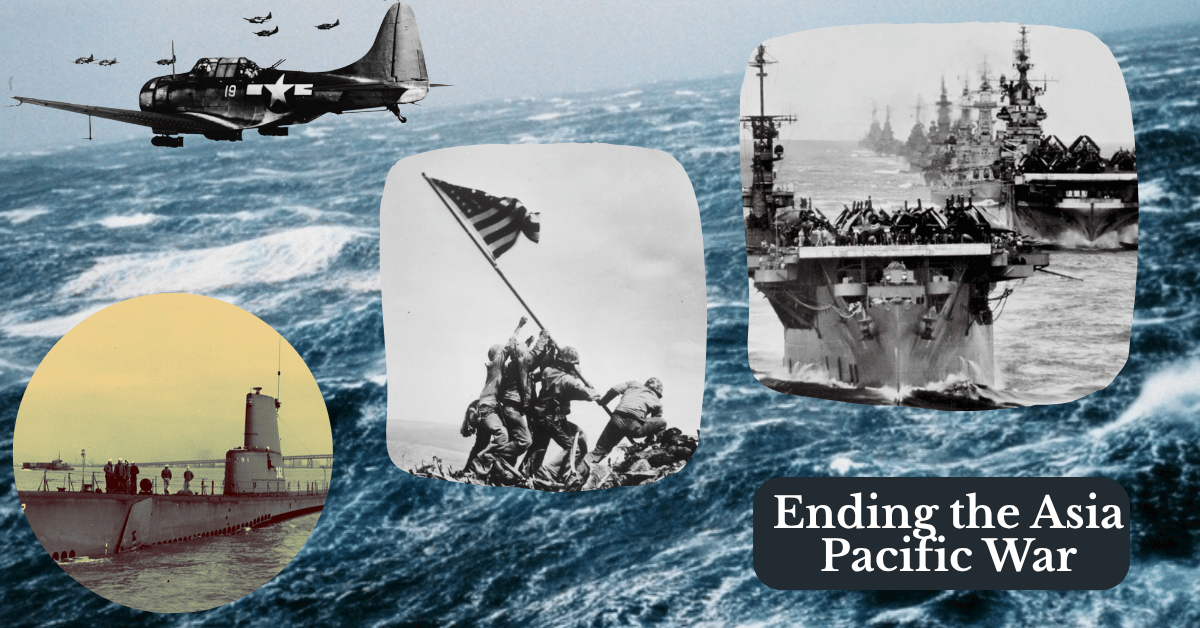
Image credit: various photographs from Naval Aviation Museum, National World War II Museum, and US Navy Archives.
“You are the light of the world. A city set on a mountain cannot be hidden. Nor do they light a lamp and then put it under a bushel basket; it is set on a lampstand, where it gives light to all in the house. Just so, your light must shine before others, that they may see your good deeds and glorify your heavenly Father.” (Mt 5:14-16)
In Scripture, light symbolizes God’s presence (Ex 13:21; Ps 27:1), God’s wisdom and law (Ps 119:105), revelation of truth, joy and salvation, and the mission of Israel (Isa 42:6; 49:6). In the Gospel of John, Jesus is explicitly called “the light of the world” (John 8:12). Matthew applies that same imagery to Jesus’ disciples. That alone is a striking theological claim.
Matthew highlights that the light of the disciples is derived, not inherent. They share in the Light of Christ. Since Jesus proclaims Himself the true light (cf. John), the Church becomes the reflection of Christ’s light, a visible continuation of His mission, and a community whose holiness reveals the presence of Christ. This interpretation connects closely to the idea of the Church as the body of Christ (cf. 1 Cor 12).
The previous posts have focused on the Japanese military in the period 1905-1930. After the conclusion of the Russo-Japanese War in 1905, the Imperial Japanese Army (IJA) was implanted in Korea (annexed in 1910) and in Manchuria with control of vital sea ports of Liaodong and the connected South Manchuria Railroad. This was the foundation of Japanese settlement in those areas and the start of exporting resources and food supplies to the home islands. This was part of Japan’s strategic buffer, but when Japan became dependent on the exports, the strategic buffer needed to expand, giving additional mission focus to the IJA to move south/southwest into China and northwest toward Inner Mongolia.
The Imperial Japanese Navy (IJN) enjoyed a period of extended accomplishments, namely, the defeat of the Russian Imperial Fleet at Port Arthur and most importantly at the Battle of Tsushima. The First World War expanded their mission as an ally of the British, securing Britain’s trade routes from the Pacific into the Indian Ocean, even supplying a destroyer flotilla to Mediterranean service. The goal of maintaining a first-world fleet ran headlong into the realities of post-war financial constraints. The goal became to reach an arms limitation treaty with Britain and the United States that limited their fleets to a size that Japan could proportionally build for themselves. The U.S. initiated Washington Naval Conference was the answer to Japan’s need – as described in the previous post.
Back Home in Japan
Now, if you consider these three treaties, it does not look like Japan came out all that well. It did not get the 10:7 naval tonnage ratio it wanted – but got close. Japan did get the commitment from the U.S. not to build west of Guam or the Philippines. Japan lost the China port/area of Shandong taken from the Germans during the war, but then it got formal recognition of dominance in Manchuria – which it already had. And…formal commitment to the China Open Door policy was a draw at best.
But Japan did get the one essential element it wanted: avoidance of a naval arms race in the Pacific against a country it had no hope of matching – the United States. But also inherited something it did not want: deep division within the Navy’s officer corps. For that we need to drop back in time and “into the weeds.”
The key Japanese figures in this mini-drama are:
Hara Takashi, the Prime Minister of Japan who was in favor of arms limitation talks as a means of helping steer the nation into a peacetime economy.
Vice Admiral Katō Tomosaburō, a career naval officer, hero of Tsushima, who had fleet commands before becoming Navy Minister in 1915. He was a realist understanding that an arms race with the United States was to be avoided, but defense of Japan and her holdings was also a goal
Admiral Katō Kanji, the chief naval aide. He represented the “fleet faction” that strongly favored Japan’s naval power, contrasting with Katō Tomosaburō’s support for avoiding an arms race.
Hara promised to give Katō Tomosaburō the political “air cover” he needed to make the best decision for Japan as the circumstances allowed. Hara was assassinated before Katō reached Washington DC. During the Conference, Kanji the aide, maintained separate cable communications with others of a group that would come to be known as the “fleet faction.” They were against the entire idea of the Washington Conference. His goal was to foster opposition and dissent within the ranks of naval officers, something heretofore unknown.
Unbeknownst to Katō and Kanji, all the cables to/from Washington were being read by the United States as the diplomatic code had been broken for some time. Japan was at a distinct disadvantage in negotiations and forced to make decisions that Katō believed were the best to be obtained but sure to bring dissension on the home front.
Upon return home Katō became Prime Minister but died in 1923 but was able to instill commitment to the treaties within the Navy Ministry. Kanji served as the Chief of the Navy General Staff. He was able to foster a cadre of naval officers opposed to the treaties. The split of the IJN into the Treaty Faction and the Fleet Faction after the Washington Naval Conference had deep, long-lasting ramifications that extended far beyond naval policy. It reshaped Japanese civil–military relations, weakened moderate leadership, radicalized strategic thinking, and contributed directly to the collapse of the interwar international order in East Asia.
Fallout of the Naval Factions
The Treaty Faction accepted the 10:6 ratio as a realistic acknowledgment of Japan’s industrial limits and the impossibility of winning a naval arms race with the U.S. and Britain. It believed security lay in diplomacy, alliances, and high-quality fleets with well trained sailors. They were dominant in the early 1920s naval leadership.
Fleet Faction rejected the ratio as a humiliation and proof of the systematic racial prejudice against Japan that would always foster an Anglo-American alliance for Japan’s national inequality. This faction argued for unfettered fleet expansion and a posture of preparedness for war with the U.S. They gained support among younger officers, hardline nationalists and sections of the Army.
One of the key fallouts was the shift of Navy planning to be more ideological than technical. From the civilian perspective they used to be able to count on naval strategies as expert-driven, now they were sure and both sides were directly appealing to the Emperor, using the press and public opinion to promote their views. Not that the civilians had much control other than budgetary, but the once disciplined Navy was becoming less governable and more like dealing with the Army.
The Fleet Faction was more effective and practiced at framing the issues for public consumption. They framed treaties as a national humiliation, evidence of Western racial exclusion, and a betrayal by elites. The line of argument greatly resonated with the public after news of the 1924 Immigration Act became known. The net result was that naval issues were now linked to nationalist ideology. Disagreement became a question of loyalty and compromise was recast as treason.
This factional rivalry distorted naval development and planning. Where the Treaty Faction favored balanced fleets with an emphasis on quality, training, and technology, the Fleet Faction advocated for bigger battleships as a means of an outward show of symbolic parity and national pride. The Fleet Faction remained fixated on the Mahanian “decisive battle”. In the short term (with long term implications) this led to an often incoherent strategy and compromised on design with an overconcentration on capital ships.
One of the great ironies of the naval war in the Pacific was that there never was the great “decisive battle” between the great battleships. Japan committed itself to the super battleship Yamato and her sister ship, the Musashi. Both were sunk. Meanwhile the most effective naval component of Japan’s fleet were the small ships, especially the destroyers and their long lance torpedoes.
By the 1930s the Treaty Faction leaders were marginalized; some were assassinated or silenced. More and more younger officers gravitated toward the Fleet Faction. Slowly institutional memory of restraint was lost. In a way there was a cross-service convergence of attitude that reinforced a militarist dominance that undermined moderates in both services. All this encouraged a worldview of inevitable conflict. The Navy’s traditional role as a moderating influence weakened.
Japan did not attend the 1930 London Naval Conference and in 1935 tendered its resignation from the 1922 treaties – although by then it had long abandoned treaty limitations in its building program.
Within the Japanese Navy, acceptance of war with the U.S. moved from being plausible to being inevitable. This would eventually morph the Mahanian idea of the decisive battle to one of preemptive strike. All of this diverted attention to the problem of logistics and economic sustainability in a short-term war or a long-term war.
The map above shows the maximum extent of the Japanese Empire in June 1942. Before the war, almost 70% of all merchant ships carrying supplies to Japan were not Japanese-flagged merchants; the majority were actually British flagged. Japan’s emphasis on combat ships and the focus on battleships as a symbolic pride of the nation, failed to pay attention to the basics. At the start of the war, Japan had only 8 fleet oilers. This would be the achilles heel that US unrestricted submarine warfare would exploit.
The Treaty Faction had been correct on the fundamentals: Japan could not outbuild the U.S. and a protracted war meant defeat. But being right was not politically survivable in the late 1920s and early 1930s. The Fleet Faction won the institutional battle even though it would lose the war to come. The “split” transformed the IJN from a professional, coalition-capable force into a polarized institution increasingly driven by ideology rather than strategy, with consequences that became tragically clear in 1942 and beyond.
Image credit: various photographs from Naval Aviation Museum, National World War II Museum, and US Navy Archives.
This coming Sunday is the 5th Sunday of Ordinary Time, Year A. Our very short gospel passage includes the well known verse:“You are the salt of the earth.” (Mt 5:13) Why Salt? In the first century, salt was much more than a seasoning. It symbolized preservation (for meat and fish), purification – salt was added to sacrifices (Lev 2:13); Covenant fidelity (cf. Lev 2:13: “you shall not let the salt of the covenant… be lacking”, Num 18:19; Ezra 4:14); Wisdom in Jewish literature (m. Sotah 9:15) as well as Greco-Roman literature; and, value as salt was sometimes used as a form of payment. Jesus’ metaphor would have carried all these resonances for His listeners as the description of the role of a disciple is teased out.
The symbol of salt as a preservative point to the role given to all disciples to prevent moral decay within the community. Many Church Fathers and modern commentators see salt as that which keeps the world from corruption. St. John Chrysostom wrote that Christ’s disciples preserve the world from “rotting in sin” by their teaching, holiness, and example. Thus, Christians living the Beatitudes that precede this verse, are the moral and spiritual agents that keep humanity from sliding into corruption. If they lose their distinctiveness, the world suffers.
Pointing to the role salt has in flavoring food is to be understood as the task to bring out the “flavor” of God’s kingdom by their joy and authenticity giving others a “taste” of God. Christians witness to God’s kingdom by: living the Beatitudes; embodying mercy, justice, and purity of heart; and revealing the joy and freedom of life with God. The idea is that Christian life should make God desirable not bland or burdensome.
As a covenant symbol disciples make God’s covenant present. “All your grain offerings you shall season with salt. Do not let the salt of the covenant… be lacking.” (Leviticus 2:13) In this light Jesus’ followers are the living sign of God’s covenant—a holy people whose presence points to God’s fidelity and holiness, keystones of what it means to be the people of God.
Salt was used medically and ritually. Elisha purified water with salt (2 Kings 2:19–22). Thus, disciples are to be agents of healing, instruments of reconciliation, and purifiers of the “bitter waters of the world” through mercy and truth.
In both Jewish and Hellenistic literature, “salt” could symbolize wisdom. St Paul makes the connection explicitly: “Let your speech always be gracious, seasoned with salt…” (Col 4:6) Writ largers, the Sermon on the Mount itself embodies divine wisdom; disciples who internalize it become a source of true wisdom in society.
St. Augustine held salt to symbolize wisdom and also the sharpness of correction in that disciples teach the world and correct it with the truth. St. Jerome viewed salt as tied to righteousness: “We season the world with the justice of God.” St. Bede understood salt to represent the apostles’ doctrine, preserving the Church from error.
The Catechism echoes these themes: Christians, united to Christ, have a mission to transform the world and witness to the kingdom (cf. CCC 782, 2044–2046). Most Catholic commentators emphasize
distinctiveness: disciples must stand apart by holiness,
mission: the Church’s presence prevents moral decay and nurtures life, and
witness: the life of the gospel gives “flavor” to the world.
But if salt loses its taste, with what can it be seasoned? It is no longer good for anything but to be thrown out and trampled underfoot. (Mt 5:13). This is a warning to the disciples
Disciples, if they are true to their calling, make the earth a purer and a more palatable place. But they can do so only as long as they preserve their distinctive character: unsalty salt has no more value. Strictly, pure salt cannot lose its salinity; but the impure ‘salt’ dug from the shores of the Dead Sea could gradually become unsalty as the actual sodium chloride dissolved. In any case, Jesus was not teaching chemistry, but using a proverbial image (it recurs in Bekhoroth 8b). The Rabbis commonly used salt as an image for wisdom (cf. Col. 4:6), which may explain why the Greek word represented by lost its taste actually means ‘become foolish’. (Aramaic tāpēl, which conveys both meanings, was no doubt the word used by Jesus.) A foolish disciple has no influence on the world.
Thus the warning: if disciples compromise the gospel, dilute the faith, or cease living the Beatitudes, they lose their effectiveness. This is just one of Matthew’s Gospel warnings about the danger of discipleship without authenticity.
Image credit: Sermon on the Mount (1877) by Carl Heinrich Bloch | Museum of National History | Frederiksborg Castle, Public Domain
Today’s readings place before us two parents, two children, and two very different outcomes of love.
In the first reading, we hear David’s cry — raw, unfiltered, and devastating: “O my son Absalom! My son, my son!” This is love stripped of dignity and defense. David’s grief is not only for a dead son, but for a relationship that was broken beyond repair when his son led a revolt against his father and king. Absalom’s life ends in violence and rebellion, and David is left with the agony of knowing that love alone could not save him.
This is the risk and tragedy of love; real, sincere, and yet powerless in the face of human freedom. David loved Absalom deeply, but Absalom chose a path that led to death. Scripture does not soften this moment. It allows grief to be heard in all its weight. It gives us pause to remember the risk and tragedy of the loves in our life, sometimes powerless before freedom.
The Gospel holds up another parent, another child, and another expression of love. Jairus comes to Jesus not as a ruler, but as a father who kneels. His day job is one punctuated by control and force, but his love leads him to surrender and trust. Even when he is told that his daughter has died, Jesus speaks words that change everything: “Do not be afraid; just have faith.”
The story of Jairus and his daughter is a love story that does not end in lament, but in life restored. Jesus takes the child by the hand and gives her back to her family. What King David could not do, bring his child back, Jesus does with the gentle authority of the Good Shepherd.
The contrast is not meant to judge David or glorify Jairus. It reveals something deeper: love alone is not enough unless it is entrusted to God. Love that clings, controls, or acts apart from God can break our hearts. Love that kneels, trusts, and places itself in God’s hands becomes a channel of life.
These readings speak honestly to our own experiences. We know both kinds of love. We have loved and lost, prayed and wept, trusted and waited. Sometimes, like David, we carry grief that will not be undone in this life. And Scripture does not rush us past that pain. But the Gospel insists on this hope: God’s final word is not tragedy, but life. Even when restoration does not come as we expect, Christ enters every loss, every death, and every broken relationship.
From tragic loss to restored life is the path Jesus walks. And he invites us to walk it too, loving deeply, trusting humbly, and believing that no love given to God is ever wasted. We are invited to place before the Lord both our laments and our hopes, trusting that the God who weeps with us is also the God of Life.
Image credit: The Daughter of Jairus (La fille de Zäire) | James Tissot, 1894 | Brooklyn Museum of Art | PD
In the previous post, it was noted that at the end of the First World War the Imperial Japanese Navy (IJN) had expectations but were realistic. They expected that their coalition work with the British in the Indian Ocean, Mediterranean, and taking on maritime security in the Pacific had earned them recognition, respect and parity with the western navies. They had just successfully operated as a “global navy.” They also recognized that maintenance and expansion of their fleet was directly tied to shipyard capacity, raw materials and industrial throughput. These were industrial limits impossible to ignore and were not limitations on either British or the Americans.
Japanese Naval Planning
The nation of Japan continued to struggle financially with the burden of Russo-Japanese war debt, expenditures on military replenishment, expenses on the build up and securing their footholds in Manchuria, Korea, and Liaodong. At the same time, like all nations post-WW1, there was a desire to return to a consumer economy after the deprivations of the war years.
The Navy’s planning division began to look ahead a decade to see what would be needed in the 1930s in order to support nascent plans for a Japanese-led Asia prosperity zone. The conclusion was that the Navy required two fleet groups, each consisting of 4 battleships and 4 heavy cruisers. Thus was born the 8-8 plan. The basis of the plan was the theory of sea power of Alfred Thayer Mahan which was the foundation of both Japanese and American naval strategy. One of the central theses of Mahanian thought was the “decisive battle” after which “control of the sea” would automatically default to the winner. The Japanese had to control the Western Pacific.
The problem was that in 1918-1919 Japan was experiencing a post-WW 1 economic depression making their 8-8 fleet plan financially impossible. Nishihara Hajime, Vice Minister of Finance noted to the Navy Minister Kato that not only would the capital budget for new construction consume 20-30% of the national budget, the outyear expenses for maintenance, operations, etc, for a fully operations 8-8 fleet would extend the budgetary consumption at similar percentage rates. It was not viable or sustainable. And the problem with that was the overall naval strategy was based on several premises:
The U.S. would not construct any fortifications/bases west of the Philippines or Guam.
So that in the event of a US-Japan conflict, the U.S. fleet would have to cross the Pacific for any hostile action against Japan.
Based on Mahan’s theory, the U.S. would lose 10% of its force effectiveness for every 1,000 miles of steaming – so after 3,000 miles of Pacific transit, the U.S. fleet would effectively be 70% of its original force structure.
Japan was in a position that it needed to understand what it could afford to build and maintain a 10:7 ratio of naval combatants. In other words, the two nations that had access to raw materials, finances, and shipyard capacity to outbuild Japan – they needed to be constrained to a limitation that fit within Japan’s strategic plan.
Forestalling an Arms Race
Meanwhile, there were growing tensions in East Asia over an unstable China, Japanese occupation of Shandong (former German territory), Manchuria, and more. Leaders in the international community sought to prevent the possibility of another war. Rising Japanese militarism and an international arms race heightened these concerns. Within the United States there were congressional calls for the U.S. to engage Britain and Japan in naval arms limitation negotiations.
In what must have seemed like a godsend to the Japanese in this era of growing tension, in 1921, U.S. Secretary of State Hughes invited nine nations to Washington, D.C. to discuss naval reductions and the situation in the Far East. This gathering is known as the Washington Naval Conference which produced three treaties: the Five-Power Treaty, the Four-Power Treaty, and the Nine-Power Treaty. Not terribly imaginative, but nonetheless descriptive.
The Five-Power Treaty, signed by the United States, the United Kingdom, Japan, France and Italy was the cornerstone of the naval disarmament program. It called for each of the countries involved to maintain a set ratio of warship tonnage which allowed the United States and the United Kingdom 500,000 tons, Japan 300,000 tons, and France and Italy each 175,000 tons. If you do the math the ratio between US/Britain and Japan was 5:3 (10:6 equivalent and not the 10:7 Japan desired)
In the Four-Power Treaty, the United States, France, the United Kingdom, and Japan agreed to consult with each other in the event of a future crisis in East Asia before taking action. This nullified the Anglo-Japanese Treaty of 1902, freeing Britain from coming to the aid of Japan in the event of war.
The Nine-Power Treaty, marked the internationalization of the U.S. Open Door Policy in China. The treaty promised that each of the signatories (the United States, the United Kingdom, Japan, France, Italy, Belgium, the Netherlands, Portugal, and China) would respect the territorial integrity of China. The treaty recognized Japanese dominance in Manchuria but otherwise affirmed the importance of equal opportunity for all nations doing business in China.
Japan and China also signed a bilateral agreement, the Shandong Treaty, which returned control of that province and its railroad to China. Japan had taken control of the area from the Germans during the First World War and maintained control of it over the years that followed. Combined with the Nine-Power Treaty the effect was meant to reassure China that its territory would not be further compromised by Japanese expansion. All of these treaties were set to expire in 1936.
The treaties of the Washington Naval Conference stabilized naval competition but ignored land-based conflicts. Rising Chinese nationalism with its own imperial privileges and Japanese ambitions. Manchuria remained unresolved as Soviet reemergence added strategic anxiety for Japan. Meanwhile, Western powers lacked capacity or will to enforce the system they had just created. East Asia was not at peace, it was balanced as long as there was restraint from all parties, but ready to topple once the first party was willing to move unrestrained.
Image credit: various photographs from Naval Aviation Museum, National World War II Museum, and US Navy Archives.
This coming Sunday is the 5th Sunday of Ordinary Time, Year A. Our very short gospel passage (salt of the earth and light of the world) follows immediately after Matthew’s presentation of the Beatitudes. Verses 11-12 (not part of the Sunday gospel) are often called the 9th beatitude because of the opening phrase. But where vv.3-10 describes the good life, these verses bring it into contrast and begin to describe the cost (v.11) and remind the listener that you are simply joining a long tradition. The prophets who earlier proclaimed the kingdom and its demands were also persecuted.
Just as the prophets stood out and apart from “business as usual,” so too will the disciples who have committed themselves to Jesus. Here and in the next few verses the “you” that appears is always plural. The concern here is that the Christian community stand out, appear different, and become an alternative to the larger society. In Matthew’s account, the famous tune, “This Little Light of Mine” would read “This Little Light of Ours.” The community of disciples are called to be collective light and salt.
The salt/light metaphors (and possibly ‘city on the hill’) are only effective signs of the Kingdom to the extent with which the community is willing to use them, to bring them to bear. Salt, no matter how pure and tasty, if left in the cellar is not much use. A light locked away inside, will not illuminate anything in the world. In part, a goal of discipleship is to be noticed, to stand out, to be more than a curiosity, to be significant; in other words, to be distinctive and to be involved. The dangers of being a community too comfortable, too scared, or too closed off is seen in the Book of Revelation’s letter to the community of Laodicea: “To the angel of the church in Laodicea, write this: ‘The Amen, the faithful and true witness, the source of God’s creation, says this: “I know your works; I know that you are neither cold nor hot. I wish you were either cold or hot. So, because you are lukewarm, neither hot nor cold, I will spit you out of my mouth.”’” (Rev 3:14-16)
Image credit: Sermon on the Mount (1877) by Carl Heinrich Bloch | Museum of National History | Frederiksborg Castle, Public Domain
The Feast of the Presentation is, at first glance, a quiet scene. There is no miracle, no crowd, no proclamation from heaven. Like faithful, observant parents, another young couple brings a child to the Temple, offers the sacrifice of the poor, and blends into the ordinary rhythm of religious life. And yet, in the quiet of this setting, today’s readings tell us that everything depends on what kind of hearts are present in that moment.
In the first reading Malachi asked a piercing question: “Who will endure the day of his coming?” Who will be steadfast? Who will persevere waiting for what has been promised and hoped for, the coming of the Lord? And then the Lord comes to his Temple. Not with spectacle, but with the power to open and purify: “not [to] help angels but rather the descendants of Abraham.” The promised coming of the Lord was always a gift, but it is also a test: not of strength or knowledge, but of openness.
Simeon and Anna show us what open hearts look like. They have waited a lifetime. Simeon has lived with a promise that remained unfulfilled year after year. Anna has spent decades in prayer and fasting, largely unnoticed. Their faithfulness is quiet, patient, and unspectacular. They do not demand that God act on their timetable. They simply remain available with open hearts. And because they wait with open hearts, they recognize what others miss. That the long awaited Messiah arrived not as king or conqueror, but as a child. In that child, no doubt one of many that day, Simeon sees the salvation he has longed for. Waiting has sharpened his vision, not dulled it.
The king or conqueror works and lives at a distance. The Letter to the Hebrews reminds us God does not save from a distance. His only Son shares fully in our flesh and blood, entering weakness, suffering, and time itself. But such divine humility can only be received by hearts that are open and willing to be changed by what God has revealed. A closed heart demands certainty, control, and familiarity. An open heart allows God to arrive in unexpected ways.
The danger, of course, is that waiting can go wrong. It can harden into resignation or indifference as people go through the motions – slowly the heart closes. The Temple was full of people that day yet only a few truly saw. This feast gently asks us: What kind of waiting shapes our faith? Do we wait with expectation, or with guarded hearts? Have we allowed disappointment or fatigue to seal us off from surprise? Is God already present to us but unrecognized?
Simeon’s long faithfulness has taught him trust. He does not cling. He does not demand more signs. He receives, blesses, and lets go. Today we ask for that same grace: hearts that remain open, patient, and receptive; hearts refined in hope not by control. So those who wait with love will recognize the Lord when He arrives into the quiet of our lives.
Image credit: Giotto di Bondone, Presentation of Christ in the Temple | Lower Church in the Basilica of San Francesco, Assisi | PD-US
The first concerns itself with the international situation, particularly in regard to China. The second deals specifically with Japan and how this conflict affected it. At the time, World War I was widely regarded within Japan as “an opportunity that comes once every thousand years” because it produced assured profitability for the nation and for its industries, unprecedented industrial and financial opportunity, and minimal obligation and commitment. Japan, before 1914, was poor. The country was obliged to import British and German steel because it was cheaper than steel made in Japan, and there were very few shipyards that could build steel vessels of any size. It was not until 1905 that Japan laid down a battleship built with home-produced steel. As late as 1914 state spending, especially on the armed services, remained very low because of the debt that had been accumulated in the Russian war. A mark of the narrow margins on which Japan was forced to operate was the fact that before 1914 the greatest annual profit recorded by its largest shipping company, Nippon Yusen Kaisha, was about 6 million yen.
With the start of the war all the European powers were diminished in terms of Pacific presence and merchant traffic and trade. Merchant shipping, other than Japan’s, virtually disappeared from the Indian and Pacific oceans during this war. A mark of the impact of World War I was the fact that in 1918 Nippon Yusen Kaisha ran a profit of 86 million yen. In the course of World War I, Japanese shipping came to dominate Pacific routes, even dominating U.S. trade on the Pacific Coast – a fact that caused concerns in the U.S. and led directly to building the Mare Island shipyard and a post-war effort to reestablish U.S. trade and shipping in the Pacific.
Japan: post-war
Japan’s post-war economic policy shifted to focus on development of the civil sector, enhancement of light industry, and improvement of the economic lives of ordinary citizens. However, good intentions aside, the nation experienced a sharp economic downturn after its wartime boom, characterized by speculative bubbles bursting in 1920, leading to bank failures, widespread bad loans, and a chronic depression throughout the 1920s. A key event was the Great Kantō Earthquake (1923) which devastated Tokyo and surrounding areas, leading to huge reconstruction efforts and “earthquake bonds issued by the Bank of Japan to help overextended banks. This intervention, intended to rescue solvent but illiquid banks, was abused by already distressed institutions, accumulating a series of bad loans. When the government proposed redeeming the earthquake bonds in 1927, rumors of bank insolvency spread, causing nationwide bank runs and failure of major banks (the Shōwa Financial Crisis). Throughout this period there were shortages, price rises, and food riots especially in the 1920 crisis. The IJA was called in to quell the riots which hurt the army’s relationship with the civilian population in the home islands.
In parallel to this, encouraged by their far ranging naval activities during the war, Japan found itself with only one western power against which they could compare themselves: the United States. The Imperial Defense Policy statement of April 1907, was rewritten to change the most likely military opponent from Russia to the United States. It sanctioned the decisive battle doctrine, which stressed the importance of acquiring big ships with big guns through a program for the construction of eight 20,000-ton battleships and eight 18,000-ton battle cruisers. This was known as the 8:8 program.
The IJN proposal came during the war years but the Japanese Diet (house and senate equivalent) refused to authorize more than one battleship and two battle cruisers. This came at the same time when the United States was vociferously claiming the right to build a fleet “second to none.” Within the US, naval leaders proposed a theoretical threat of Germany in the Atlantic and Japan in the Pacific (as well as a German-Japanese alliance). This was the warrant for a two-ocean navy. The goal was less national defense than to protect overseas trade. Tohmatsu and Willmott note: “The least that could be said about such logic was that it grasped at the exceedingly unlikely in order to justify the manifestly unnecessary.”
Both countries had building programs that planned large increases in combatants by 1925, but the U.S. was capable of building far more than Japan because of its industrial capacity and financial strength. But in fact neither country was financially capable of implementing such grandiose plans. In Japan there was not enough capital, access to lines of credit, plus the ongoing financial problems. In the U.S. there was too much national debt associated with WW1 and a growing isolationist movement in Congress.
All of this led to the Washington Naval Conference of 1922. The simplest description of the conference: it was complicated. The agreements concluded at Washington were important because they provided the basis of how Japanese-American relations could be stripped of hostility and ill-intent. They halted what promised to be a disastrous naval race in the Pacific and put in its place arrangements for the scrapping of many existing warships and limitation of the size of fleets that could be retained. When allied with the ban on Britain fortifying any base beyond Singapore and on the Americans beyond the Hawaiian Islands, the agreements created a balance in the Far East – not only militarily but also commercially.
Japan’s acceptance of such arrangements was the result of a singular balanced vision championed by one person: Admiral Kato Tomosaburo, the Navy minister. He held that the only eventuality that could be worse for Japan than an unrestricted naval construction race with the United States would be war against that country. An unrestricted naval race could only result in the inevitable and irreversible erosion of Japan’s position relative to the United States because of the industrial power of the U.S. Kato believed that as a consequence, Japan had to seek security through peaceful cooperation and diplomatic negotiations rather than through international rivalry and conquest. While the IJN itself saw its role as a deterrent and, in the event of war, defensive, individuals such as Kato saw Japan’s best interest served not by confrontation and conflict with the United States but by arrangements that limited American construction relative to Japan and that provided the basis of future U.S. recognition and acceptance of Japan’s regional naval and commercial positions. The next post takes a “deeper dive” into the details of all the treaties that emerge from the Washington Conference.
The Next Generation
Germany’s loss in WW1 was seen as victory of democracy over militarism and came as a considerable surprise to many Japanese, especially those associated with the Imperial Army. But, for much of the 1920s there was no major military commitment that involved substantial taxation and financial sacrifice. The 1920s held out hope for the triumph of liberal democracy within Japan and the prospect of a better future.
But Japan had no long-term legacy of such a form of government. It is one thing to model your military on western models, but governance is a different matter. The Meiji Constitution’s implementation of parliamentary representation, separation of powers and independence of the judiciary, and accountability under the law, were relatively new – all still within the generation of the people whose culture and frame was the Tokugawa Shogunate. There was no more than a single lifetime of support and investment in them on the part of society.
The 1920s saw the passing of the genro, or elder statesmen, who had led the country since 1868 – and especially since 1898 when many significant changes were implemented. These men, in a sense, were not only the living memory of Meiji, but were the “glue” that held the reforms together and steered national and regional interests to a common goal. Their passing created a collective gap in leadership that the next generation prime ministers could not fill. What was lost was moderation and continuity of memory.
As Japan worked to transition politically, financially and culturally, the 1920s – despite its problems – was one of peace and slowly improving conditions. But there was a different sense within the Imperial Japanese Army (IJA). There were three overseas military commitments in this decade. The first was the intervention in the Russian civil war, which in effect ended in October 1922 when Japanese forces finally withdrew from Soviet mainland territory. The second was a deepening Japanese army involvement in China’s civil wars, most notably after 1926. The third, directly related to the second, was IJA operations inside Manchuria.
Notably, during IJA involvement in China’s civil war and Manchuria, the Japanese military was without guidance from Tokyo and as such set their own rules of engagement, as they decided which side to back in which province or area, and to do so without reference or consultation with Tokyo. The habit, once acquired, was never broken.
In 1924, the Prime Minister reduced the size of the IJA, involuntarily moving officers and senior enlisted personnel into retirement or simply discharged from the military. But for their loyal service many were directed into the state education administration in positions of supervision for a newly introduced scheme of compulsory military training for children. This was especially true outside urban areas and resulted in an imposition of military values on far less well educated children with little job prospects. When we arrived in the 1930s these youths found opportunity in military service as the IJA was expanded – and the veteran’s association became a powerful political voice in the nation..
By the time we reached the 1930s, the IJA had developed a culture of insubordination within the army. The most notable trait was gekokujo, the manipulation of senior officers by their subordinates. Among the most radical/nationalistic members of the IGA this led to the phenomenon of “government by assassination” as cabals of junior officers (colonel and below) assassinated civil leadership leading to the setbacks of nascent parliamentary democracy. Although the Japanese Constitution was amended in 1936 to mandate that four of the six key cabinet positions be occupied by active duty military personnel. By the late 1920s and early 1930s it was a practice politically necessary to form governments under the Prime Minister. The Meiji era civilian control of the military was eroding and beginning to exist in name only. Increasingly the real power belonged to the IJA and IJN.
The Rise of Nationalism
The 1930s saw a marked rise in nationalism within Japan. It is a complex topic whose details are too complex for this series particularly to attempt to explain in terms of cause and effect. But there are “snapshots” that mark the changes.
Prior to 1933 Japanese schoolbooks made reference to non-Japanese western historical figures associated with democratic movements in history, e.g. Washington and Lincoln. After 1933 virtually all western society references were removed. Key figures were replaced by Japanese national heroes. If there were mention of westerners, they tended to be famous military leaders such as Admiral Nelson or Napoleon Bonaparte. Overall the tone of the school curriculum became increasingly nationalistic and strident.
By 1936 the books that taught children to read were no longer based on nature and the richness of Japanese animal life. In their place came topics of the Emperor, soldiers, duty, loyalty to the nation and service/sacrifice. Even cartoon strips were not immune. The Japanese equivalent of Felix the Cat, a dog named Norakuro, joined a regiment of dogs in the army because in the country of the Sheep (Manchuria), the latter had been obliged, because of the aggressiveness of the Pigs (the Chinese), to call in the Dogs (the Japanese), which had chased out the Pigs and created a haven for the Sheep and the Goats (the Mongolians). And in the future the Dogs would have to stand guard because the Pigs had tried to enlist the support of the Bears. Significant? Make of what you will, but it and many other examples begin to paint a picture. Clearly something was afoot that made for a fundamental change of attitudes within Japanese society.
One example can be seen in the expected behaviors of soldiers. Thousands of Japanese soldiers taken prisoner during the Russo-Japanese war of 1904–05 when they were repatriated were seen as heroes and honored. Almost three decades later, in the course of the fighting at Shanghai in January 1932, the Chinese took prisoner a severely wounded and unconscious Japanese officer. He recovered and was exchanged, but he killed himself because of the dishonor he felt for having been made a prisoner. Only after his suicide did the national praise him because he had embraced real Japanese values. In the same conflict three soldiers blew themselves up during the fighting at Shanghai to provide a key action in the battle. They were afforded a degree of national veneration because they had embraced the honorable value of self-sacrifice. It was never determined if the action was accidental or intentional in fact, but it was clear how it was promoted.
Change was afoot across Japanese society.
What were the root causes? While arguable – and scholars all have different takes on the question – a short list of “what” generally includes:
The Great Depression’s economic devastation, the perceived failures of democracy, a rising belief in Japanese racial superiority, and military leaders’ desire for expansion to secure resources and power. These are some of the factors that led to a surge in ultranationalism, militarism, and imperialist ambitions that challenged both Western influence and Japanese civilian government.
The economic crises associated with the Great Depression. As elsewhere, following the 1927 banking crisis, the 1929 stock market crash devastated Japan’s export-dependent economy, causing widespread poverty, especially in rural areas, making radical, immediate solutions attractive.
Civilian governments struggled to handle the economic collapse, leading many to view democracy as weak and ineffective, paving the way for authoritarianism. It must be remembered that the Shogunate period and the local authoritarian leaders were only a few decades past. There was a romanticizing of the “good years” when leaders were strong.
The military, particularly the army, presented itself as the solution, gaining influence through successful campaigns (like invading Manchuria in 1931) and advocating for expansion as a path to economic security and national strength.
From all this a virulent nationalism emerged. The idea – already and always present – was promoted that the Japanese people were racially superior and divinely destined to lead Asia, with emperors as direct descendants of the Sun Goddess. In essentially one lifetime, national sentiment moved from the isolationist period of the Tokugawa Shogunate to a globalist vision of Japan’s destiny. Nationalists argued that imperialist expansion was necessary to overcome overpopulation and resource scarcity, providing Japan with economic security and a greater role on the world stage.
On the far right was the drum beat of the ultra-Nationalist Movements. They denounced democracy, big business, and Western influence, advocated a return to traditional values, loyalty to the Emperor, and warrior/samurai ethics. They were not restrained in the use of political violence and assassinations.
These are some of the factors combined to hollow out democratic institutions and shift Japan toward a militaristic, expansionist path by the mid-1930s, setting the stage for further aggression in Asia and another step to the broader Asia-Pacific War.
Image credit: various photographs from Naval Aviation Museum, National World War II Museum, and US Navy Archives. Source reference: Gathering Darkness: The Coming of War to the Far East and the Pacific, 1921-1941 by Haruo Tohmatsu and H.P. Willmott (War and Society Book 3)


 friarmusings