Time and Indulgences

We continue our series of posts in anticipation of All Souls Day.

Growing up in the mid-20th century I clearly remember the nuns leading us in prayers and rosaries for “the poor souls in purgatory who have no one to pray for them.” Which is actually a quite lovely idea and really addresses the idea of the communion of saints, living and deceased. But I also clearly remember being told “this rosary will shorten the sentence in purgatory by 30 days.” As a third grader I thought “OK.” Seemed like a pretty good bargain. When one begins to understand all the above, you have to wonder, where and when did indulgences begin to be described in terms of “days” or “years” and such?

One needs to remember that in the early Church, penances were very public and were prescribed for a set period of time. For example, spend Sunday morning outside the church dressed in sack cloth and ashes for 1 year. An indulgence, even then an act of piety, could reduce the penance by (e.g.) 30 days. It wasn’t a reduction of the time in purgatory (as if that even had a meaning), but a reduction of time in this life when the penitent was “apart” from the believing community. As the Sacrament of Confession moved to a private setting, so too did the penances, and yet the language of time endured. Slowly the connection to penance was lost and starting in the early medieval period, indulgences began to be described in terms of “days,” “quarantines,” or “years” and slowly, misguided priests and religious began to connect indulgences with chronological time in purgatory.

By the late Middle Ages and into the modern era, people began thinking that saying a certain prayer automatically subtracted X days from purgatory. This contributed to superstition and misunderstanding — and was a factor in the abuses that provoked the Protestant Reformation. The Council of Trent strongly condemned the abuses surrounding indulgences, corrected abuses, but the language was embedded in the popular imagination as was the connection to purgatory.

The 20th-Century brought reform. Pope St. Paul VI, in 1967, issued the apostolic constitution Indulgentiarum Doctrina, a watershed in indulgence theology but really just a reaffirmation of what it was always meant to be. The Pope abolished the “days and years” system, noting that it was misunderstood and misused and left the faithful thinking it was some kind of “works salvation” by which they could earn (or worse be owed) the grace of purification. It was at that time that the Church reduced all indulgences to two categories: Plenary (full remission) and Partial (remission in part). It was done hoping that an emphasis shift away from “measuring time” to encouraging the faithful to perform works of devotion, penance, and charity with sincere faith would return indulgences to their original meaning and purpose.


Image credit: All Souls’ Day | Jakub Schikaneder, 1888 | National Gallery Prague | PD-US

Treasury of Merit

The Church teaches that it offers the grace of Indulgences from the “treasury of merit,” also called the “treasury of the Church.” This refers to the spiritual reservoir of merit accumulated through the infinite merits of Jesus Christ, especially through His Passion, Death, and Resurrection; the superabundant merits of the Blessed Virgin Mary, who is considered sinless and full of grace; and the merits of the saints, who lived lives of heroic virtue that manifested God’s grace into the world. These “merits” are not material or monetary, but spiritual benefits—graces that can be applied to others by the Church.

What gives the Church the “authority” to dispense the merits to others?

  • Christ promised his Church the power to bind and loose on earth, saying, “Truly, I say to you, whatever you bind on earth shall be bound in heaven, and whatever you loose on earth shall be loosed in heaven” (Matt. 18:18). As the context makes clear, binding and loosing cover Church discipline, and Church discipline involves administering and removing temporal penalties. 
  • One could also look to Matthew 16:19 where Peter is told by Jesus, “I will give you the keys to the kingdom of heaven. Whatever you bind on earth shall be bound in heaven; and whatever you loose on earth shall be loosed in heaven.” 

Most would look at those two verses and offer, “…OK, but that applies just to Sacramental Confession, right?” Sacramental Confession is the priest (the Church) acting as “sacramental steward” for God’s forgiveness. Let’s be clear. The priest does not forgive sins. He absolves which is the earthly action, the announcement, of the grace of God’s forgiveness.  Indulgences operate on the same principle. The Church sees itself as a steward of these spiritual goods, able to apply them for the benefit of souls.

“OK, but when did Jesus bless one person based on the merits of another? “And there people brought to him a paralytic lying on a stretcher. When Jesus saw their faith, he said to the paralytic, “Courage, child, your sins are forgiven.” (Mt 9:2) It wasn’t the faith of the paralytic, it was the faith of his friends. The merits of others were a gift to the paralytic. The “treasury of merit” is a gift by which God uses the Church when He removes temporal penalties. This is the essence of the doctrine of indulgences. 


Image credit: All Souls’ Day | Jakub Schikaneder, 1888 | National Gallery Prague | PD-US

August 1945 – What is at stake

Having described the actual history of August 1945 in the previous post, it is time to consider our counter-factual: what if the US and Allies did not possess atomic weapons and did not expect to possess them any time in the immediate future? How does the Asia-Pacific War come to an end?

But then we need to be sure we are talking about the same war. Here is the most commonly offered timeline:

  • September 1, 1939 World War II began in Europe with Germany’s invasion of Poland
  • September 3, 1939 France, Britain, Australia, and New Zealand declared war on Germany 
  • September 6, 1939 South Africa declared war on Germany
  • September 10, 1939 Canada declared war on Germany
  • May 10, 1940 the Netherlands, officially neutral to this point, declared war after German troops invaded.
  • July 10, 1940 Italy, an Axis ally, declared war on Britain and France after seeing German success. It is generally thought Mussolini felt it was an opportune moment to enter the war on Germany’s side, believing France was on the verge of defeat and that Italy could secure a place at the eventual peace negotiations with minimal cost.
  • June 22, 1941 Germany declares war on Russia and begins the invasion. Russia did not technically declare war … They were busy fighting against a blitzkrieg. 
  • December 7, 1941 Japan declared war on the United States (but failed to deliver the diplomatic message prior to the Pearl Harbor attack)
  • December 8, 1941 Japan attacked Singapore, Hong Kong and Malaya. Diplomatically no message was delivered to Britain who learned about the attack via military channels. In Japan the information was printed in the newspapers.
  • December 8, 1941 the United States, Britain, Australia, Canada, New Zealand and the Netherlands declared war on Japan after the Pearl Harbor attack. Interestingly the following countries also declared war on Japan that same day: Cuba, Costa Rica, Guatemala, Panama and the Dominican Republic.
  • January 11, 1942 Japan declared war on the Netherlands the same day it launched its invasion of the Dutch East Indies
  • May 22, 1942 Mexico declares war on Japan, Germany and Italy. Thousands of Mexican citizens enlisted in the US armed forces but most notably the Mexican Expeditionary Air Force’s Escuadrón 201, also known as the “Aztec Eagles,” fought alongside the U.S. in the 1944 and 1945 Philippines Campaign.
  • August 8, 1945 – late to the battle, Russia declared war on Japan. Russia’s goal was control of the inland sea, warm water ports, Manchuria, Korea and possibly the resource rich Hokkaido.

With that all the major combatants were formally engaged in World War II. At least these are the dates that are given from a western perspective. When did it all end?

  • September 3, 1943, the Italian government formally agreed to an armistice with the Allies although the German-backed Italian Social Republic in northern Italy continued fighting until April 29, 1945. 
  • May 8, 1945 Germany unconditionally surrendered its military forces to the Allies
  • August 15, 1945 Japan announced it accepted the unconditional surrender terms (with one condition – maintenance of the kokutai). The formal surrender was signed September 2, 1945. 

Six years and 1 day after the start, it was finally over – at least from a western perspective.

Continue reading

Indulgences

Let’s be clear: an indulgence is not a permission to commit sin.  It is not a permission to indulge in some behavior that would ordinarily be considered sinful.  It is not something that you pay for to get forgiveness. The Catholic Church teaches that indulgences are a means by which the faithful can obtain the remission of the temporal punishment due to sin, the guilt of which has already been forgiven. This teaching is rooted in the Church’s understanding of the interconnectedness of sin, repentance, and the effects of sin on the soul and the community. The Catechism of the Catholic Church provides a thorough explanation of indulgences, particularly in Paragraphs 1471-1479.

An indulgence is a “remission before God of the temporal punishment due to sins whose guilt has already been forgiven [emphasis added], which the faithful Christian who is duly disposed gains under certain prescribed conditions through the action of the Church which, as the minister of redemption, dispenses and applies with authority the treasury of the satisfactions of Christ and the saints.” (CCC 1471)  An important point is that an indulgence does not apply to an eternal punishment (perdition; hell) but only to the temporal punishment for sins that have already been forgiven. And you may have noticed that indulgences are not limited to being applied to the faithful departed, but can be received by the living if disposed under the prescribed conditions.

Continue reading

August 1945 in History

We are at a point in the series at which we should depart from history and consider the counter-factual that no atomic weapons were yet available to the United States and the Allies, nor would they be for the foreseeable future. But before we take that departure, let us consider the actual events of the first 15 days of August 1945 so we might gain insight into the forces and currents within and outside of Japan. 

The atomic weapon was successfully tested on July 16, 1945, ten days before the Potsdam Declaration. President Truman was briefed of the test’ success. The USS Indianapolis departed from Hunters Point, San Francisco carrying the weapon that would be dropped on Hiroshima on July 16th, delivering the weapon to Tinian on July 26th. The sequence of external events unfolded as follows:

  • August 6, an atomic weapon is dropped on Hiroshima
  • August 8, near midnight, the Soviets declare was on Japan
  • August 9, an atomic weapon is dropped on Nagasaki
  • August 15, the Emperor announced his Seidan, “sacred decision,” that Japan accepts the provisions of the Potsdam Declaration. 
Continue reading

Temporal Punishment

The phrase “temporal punishment” sits at the heart of indulgences and purgatory, but it is often poorly understood. In Catholic theology, “temporal punishment” refers to the consequences of sin that remain even after the guilt of the sin has been forgiven. The Catechism of the Catholic Church (CCC 1472) offers that sin has a double effect: separation from God but also the disorder that sin leaves in its wake. 

By analogy, this can be seen in your having broken a window in the family house (the sin). You confess your sin and the parents “forgive” you – but there is still the matter of the broken window that needs to be fixed, to make the window whole again (or to borrow from Leviticus, to be made pure). The “punishment” is that you have to fix the window. I am sure that a modern communications specialist or public affairs professional would find a different term than “temporal punishment,” but we have what we have. Fixing the window is only “temporary” in that it will take a limited amount of time, but it will be time away from being with friends or family or doing something enjoyable. In that sense it can seem like a punishment. But hopefully the youthful you will not just remedy the broken window, but take the time to reflect and find true sorrow for the “sin” and a deeper appreciation and love for all that the parents provide for you, at no cost to you. This last part is the “purification” and helps you to take a more full place in the family. The window is just a window. When will the “temporal punishment” be over? When you have processed the whole event (and hopefully the window is fixed.)

Temporal punishment is understood as the necessary purification for the disorder caused by sin, which can be addressed either in this life through acts of penance, prayer, and good works, or in the afterlife in the purifying process in Purgatory where one “lets go” of the last vestiges of a life not fully given over to love. Like in life, we might need help.

If you are 10 years old and break a window, I doubt you know how to replace the pane of glass (or even the whole window!). You’re going to need a little help. That is where mom or dad (…and these days YouTube) step in. In our analogy, this is where the prayers of the living for the faithful departed come in. 


Image credit: All Souls’ Day | Jakub Schikaneder, 1888 | National Gallery Prague | PD-US

Purgatory

We continue our series of posts in anticipation of All Souls Day.

I suspect that how people imagine Purgatory is mostly formed by images from the Italian poet Dante’s description in his work Purgatorio, the second part of his work The Divine Comedy. Whether one has read the work or not, the result is the idea that Purgatory is a place of punishment for sin because redemption and salvation are somehow incomplete. Many people carry the idea of a fiery, but temporary punishment because of their reading of 1 Cor 3:13-15. It is a misreading of the passage, but nonetheless, the images endure in the imagination.

None of that is the teaching of the Catholic Church.

Continue reading

The Foundation

The gospel for today’s Feast of St. Simon and Jude is the simple list of the Apostles as given in the Gospel of Luke. Early Christian writers and later stories link Simon and Jude as missionary partners, evangelizing together in Persia (modern Iran) or Mesopotamia (modern Iraq) where they suffered martyrdom together. For this reason, their feast days were merged very early on.

On this feast day, my attention was drawn to the first reading: “So then you are no longer strangers and sojourners, but you are fellow citizens with the holy ones and members of the household of God, built upon the foundation of the apostles and prophets, with Christ Jesus himself as the capstone.” (Eph 2:19-20)  Specifically, I thought about the way St. Paul used the term foundation. In 1 Cor 3:11, St. Paul writes: “for no one can lay a foundation other than the one that is there, namely, Jesus Christ.” And what are we to make of Matthew 16:18 – “And so I say to you, you are Peter, and upon this rock I will build my church, and the gates of the netherworld shall not prevail against it.”  That sounds pretty foundational.

It caught my attention because of the way different Christian denominations understand and misunderstand the Scriptural use of the same word as well as the broader metaphor of “building” the spiritual life in Christ. Consider 1 Peter 2:5 – “...like living stones, let yourselves be built into a spiritual house to be a holy priesthood to offer spiritual sacrifices acceptable to God through Jesus Christ.” The “spiritual house” clearly needs a foundation.

In New Testament writings we see the foundation described in Ephesians as  the Apostles (New Covenant witnesses of Christ’s resurrection) and the Prophets (usually understood either as Old Testament prophets or Christian prophets active in the early Church).  In this view the foundation represents the historical and revelatory basis upon which the Church is built. Christ is the keystone or cornerstone, the essential aligning and sustaining element. The Apostles and Prophets are the human instruments through whom the divine revelation and structure of the Church are communicated.

Other scripture points to Christ as the only foundation: “According to the grace of God given to me, like a wise master builder I laid a foundation, and another is building upon it. But each one must be careful how he builds upon it, for no one can lay a foundation other than the one that is there, namely, Jesus Christ.” (1 Cor 3:10-11) Here, Christ himself is the sole and irreplaceable foundation and the subsequent building (the Church’s growth and ministries) is built upon that foundation. Whereas Ephesians emphasizes apostolic tradition and continuity, Corinthians stresses Christ’s primacy.

In the letter to the Hebrews we read: “Therefore, let us leave behind the basic teaching about Christ and advance to maturity, without laying the foundation all over again: repentance from dead works and faith in God, instruction about baptisms and laying on of hands, resurrection of the dead and eternal judgment.” (Heb 6:1-2). Here, the foundation is doctrinal, not personal. It refers to the basic tenets of Christian faith and practice. The metaphor casts the foundation as the core teaching that allows growth toward spiritual maturity.

In the Book of Revelation we read: “The wall of the city had twelve courses of stones as its foundation, on which were inscribed the twelve names of the twelve apostles of the Lamb.” (Rev 21:14)  This usage takes the eschatological image of the new Jerusalem as permanently built upon the apostolic foundation. Christ is the Lamb, but the Apostles are the named foundational stones — indicating the enduring authority and witness of apostolic teaching in the Church’s eternal form.

What does this all mean? It is what the Catholic Church has always proclaimed: the ultimate foundation of the Church is Christ Himself — the one in whom revelation, salvation, and unity originate. In his human lifetime Jesus was the means of communication, the teaching, eschatological fulfillment and “continuity.” After his death and resurrection, the foundation in the world rests on the teachings and story of Jesus, but now continuity is dependent upon the sure transmission of the faith via the Apostles and those appointed by them. This apostolic foundation refers to the instrumental mediation of the revelation of Jesus. They are the foundation through whom Christ’s word and authority are transmitted. They are the foundation in witness and structure.

The Church is the sure means by which you “...like living stones, let yourselves be built into a spiritual house to be a holy priesthood to offer spiritual sacrifices acceptable to God through Jesus Christ.” 


Image credit: Flevit super illam (He wept over it) | Enrique Simonet (1892) | Museo del Prado, Madrid | Wikimedia Creative Commons | PD-US

Japan and the Soviets Before the War

The Japanese-Soviet story is more detailed than discussed in this series to this point. It is important to understand the “history” between these two Asiatic imperial powers. In the series to date, we picked up the “story” when the Soviets announced that they would not renew the neutrality pact with Japan in April 1945, giving the required one year notice that by April 1946 the pact would lapse. As previously noted, the Soviets were already transferring soldiers, transportation, armaments and ammunition to their “Eastern Front” – meaning Mongolia and Siberia. This was in accord with the February 1945 promises made to the Allies at the Yalta Conference when they promised to declare war on Japan within 3 months of Nazi Germany’s surrender. And all the while Japan was attempting to recruit the Soviets to represent Japan and broker an end to the war (detailed in Japanese-Soviet Diplomacy).

But why did Japan enter into a neutrality pact with the Soviets in the first place? Weren’t the Soviets part of the Allied war effort against the Tripartite Pact of Germany-Italy-Japan? Yes, but conflict with Japan and Russia (and then later the Soviet Union) had history in each country’s expansionist interests. Those interests included Korea, Manchuria, and Inner Mongolia. 

An Imperial Collision in Asia

The Russian Tsars always held a vision of a “Greater Russia” that extended from west to east. With the completion of the Trans-Siberian Railway in the late 19th century, Russia sought economic and strategic footholds in Manchuria and Korea. This meant they needed ice-free ports on the Pacific (Port Arthur, later Dalny) to replace Vladivostok, which freezes in winter. At the same time, they saw the decline of the Qing dynasty and unrest in China as an opportunity to expand influence.

After the Meiji Restoration (1868), Japan rapidly modernized and adopted imperial strategies modeled on Western powers. For Japan the interest was raw materials, food imports to the home islands, and “room to grow” for the Japanese people. Japan needed to secure resources and strategic depth for its new industrial power. Korea was vital to its national security—“a dagger pointed at the heart of Japan” (per a common Meiji slogan) but strategic depth and raw materials widened the ambitions to Manchuria and beyond.

In 1895, Russia, Germany, and France forced Japan to return the Liaodong Peninsula to China after the Sino-Japanese War (a peninsula to the west of the Korean peninsula containing Port Arthur). For Japan this was a humiliation with its victory over China nullified by European imperial powers, especially Russia. The dagger was “twisted” in the wound three years later when Russia leased the returned territory from China in 1898, establishing Port Arthur as a naval base. To make matters worse during the Boxer Rebellion (1900), under the pretext of restoring order, Russia occupied Manchuria and was slow to withdraw. At the same time Russia began asserting control over northern Korea, despite earlier informal understandings that Korea would remain in Japan’s sphere.

Over the next several years tensions rose between the two nations, diplomacy started, stopped, stalled and fueled the rising tensions. Of primary importance to Japan was the formal recognition of its national interests and its preeminent role in the Asian world with an equal footing to European colonial powers. Japan proposed recognition of Russia’s dominance in Manchuria in exchange for recognition of Japan’s dominance in Korea. Russia refused, offering instead to make Korea a neutral buffer and demanding Japan stay north of the 39th parallel which allowed Russian continuing control over Port Arthur.

Russian diplomacy stalled negotiations while the Russians expanded troop presence in Manchuria. Japan interpreted this as an attempt to exclude it entirely from the Asian mainland. After months of fruitless negotiation, Japan broke off talks. Without a declaration of war, the Japanese Navy launched a surprise attack on Port Arthur (Feb. 8, 1904). Japanese victory at the  naval battle of Tsushima in 1905 ended the war. In the subsequent treaty Japan gained recognition of their special interests in Korea (which they annexed in 1910), southern Sakhalin Island, and lease rights to Port Arthur and the South Manchurian Railway. This was the first time an Asian nation defeated a European one in modern warfare. It changed the hierarchy of imperial power in the Asia Pacific region, established the Japanese military as the embodiment of the Japanese ideals and virtue, and fed the view of Japan’s destiny as leader, not just of the Asia Pacific but of the “eight corners of the world.”

Japanese-Soviet Conflict in the 1930s

By 1931 Japan sought to expand its dominance in Manchuria and northern China for economic and strategic security. Japan’s Kwantung Army seized Manchuria and established the puppet state Manchukuo. The Soviets, weakened by internal purges and economic strain, avoided open conflict but reinforced defenses in the Far East in order to preserve its influence in Mongolia. Both sides increased military presence along the Manchurian–Mongolian frontier. Another imperial collision was inevitable – only the scale of the collision was in question.

By 1935 small scale conflicts and cross border actions ratcheted up tensions in the region, so much so that by 1936 Japan signed the Anti-Comintern Pact with Nazi Germany identifying the Soviet Union as a common ideological enemy. In 1937 the Second Sino-Japanese War was fully underway. While the Soviets were not actors in the conflict, they were essential suppliers of arms, ammunition and airplanes to the Chinese forces – both Nationalists and Communists.

In 1938 there were growing border conflicts that led to a large-scale battle along the Manchukuo border with Mongolia. The action was initiated by the Japanese but Soviet–Mongolian forces decisively defeated the Japanese Sixth Army. This was a key moment in the years before the attack on Pearl Harbor. The Japanese Army recognized the limits of land war against the Soviets and as a strategic consequence the Army (Kwantung faction) was humiliated allowing the Navy to gain influence. 

The Strategic Fallout

The result was a Japanese strategy focused on expansion toward Southeast Asia and the Pacific instead of northern expansion into Siberia. As for the Soviets, they undertook a “wait and see” attitude as the rise of Nazi Germany complicated their western borders. In August 1939 the Soviets agreed to the Molotov-Ribbentrop Pact with Nazi Germany. This pact guaranteed that neither country would attack the other, and for the Soviets was a strategic piece to avoid a two-front war. This was followed by the Soviet–Japanese Neutrality Pact (April 13, 1941) in which both sides pledged mutual neutrality and respect for territorial integrity of Mongolia and Manchukuo – the other piece the Soviets needed to avoid a two front war. But it also served the same purpose for Japan as it pursued its plans to expand into Southeast Asia and the Pacific.  

Four Years Later – August 1945

With Nazi Germany defeated, the Soviets were not at war. All was quiet of their Western front facing Europe – the first Berlin crisis was almost 3 years away. All was busy on their Eastern front facing Japanese occupied Manchuria and Korea as Soviet troops, tanks, artillery, and supplies amassed opposite the Japanese Kwantang Army – once the pride of the Imperial Japanese Army, but not a shell of its former self with its resources transferred to fighting the allied advance in the Central and Southwest Pacific.

The Soviet’s imperial aspirations in the East had not changed since the 19th century – their 1945 entry into war against Japan was the fulfillment of a promise to the U.S. and Britain and a reason to do what they always intended to do: occupy Manchuria and Korea. In history, they took advantage of the bombing of Hiroshima and formally declared war just hours before Nagasaki. Historians seem united in their view that it was a rushed decision as regards timing because they wanted to declare war before Japan surrendered. Otherwise, their August Storm plan was pointed at the last week in August.

As mentioned in a previous post the outcome in Manchuria was not in question. The odds and manpower were overwhelmingly in the Soviet’s favor. The Soviets captured about 2.7 million Japanese nationals with 1/3rd of them civilian. The dead and permanently missing numbered ~470,000.

Beginning immediately after the surrender, the NKVD (Soviet secret police) organized the mass transfer of Japanese POWs to labor camps across the USSR. Between 500,000 and 600,000 Japanese soldiers and officers were deported to Siberia, the Urals, Kazakhstan, and other regions as slave labor. The Soviet reasoning for the internment was framed as legitimate war reparations—compensation for Japanese aggression in 1904–1905 and in the 1930s.  While in the gulag-like conditions, between 50,000 and 100,000 died from conditions of forced labor, poor nutrition, disease, and other causes. Repatriation of soldiers began in late 1946 with the release of 400,000 POWs and continued off and on until the mid-1950s. In the end, tens of thousands were never accounted for.

Around 1.5 million civilians were stranded in Manchuria. Thousands were killed in the chaos following Japan’s surrender due to Chinese revenge attacks, bandit raids, and Soviet troop abuses (looting, executions, and rape, particularly in the first weeks). Women and children were especially vulnerable. There are remembrances and contemporary Japanese accounts that speak of mass assaults and suicides. Repatriation of civilians began in late 1946 and continued until the mid-1950s. 

These numbers are the history and most view that our counter-factual history would have turned out the same way. The primary question that is unanswerable is whether the Japanese would have invaded Hokkaido – would the allies let them? – and would the Soviets have advanced to northern Honshu? It is clear that the Soviets did not have amphibious capability to sustain an invasion.

That being said, it is hard to know the effect of the Soviet declaration in our scenario. There are historians such as Tsuyoshi Hasegawa’s [Racing the Enemy: Stalin, Truman, and the Surrender of Japan (2005)] that hold, absent atomic weapons, the Soviet invasion into Manchuria would have galvanized the Imperial Japanese Army to overthrow the home government, declared martial law, and continued the war – not only waiting for the invasion of Kyushu but unleashing widespread warfare in part of Southeast Asia where their armies still maintained control. There is no feasible way to estimate the increase in civilian deaths except to note that the already horrific numbers of lost non-Japanese Asian lives (and Japanese lives) would only become horrific at a new level.


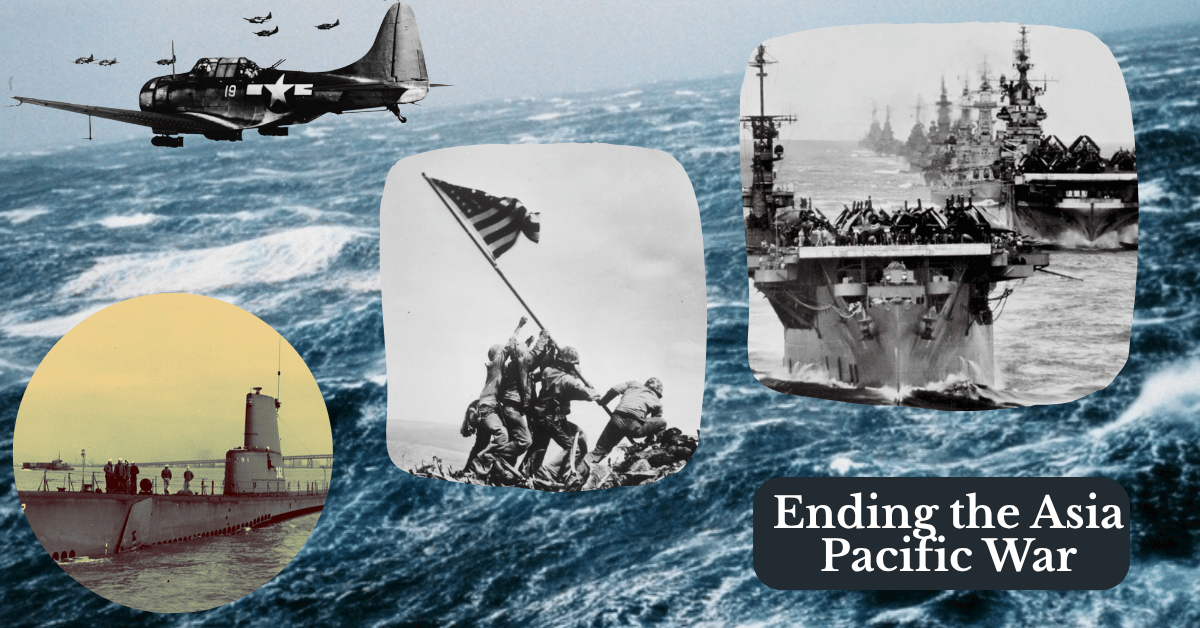
Image credit: Image credit: various photographs from Naval Aviation Museum, National World War II Museum, and US Navy Archives. 

Holiness

A good place to begin our exploration of All Souls is to start with the concept of Holiness. If you’d like to take a 6-minute detour, take a moment to watch this video on Holiness which traces the scriptural roots of holiness, explaining how “becoming holy” is more than living a moral life, but a process of preparation for entering into the presence of God in the eternal Temple of Heaven. In speaking of the heavenly city and its eternal Temple, Scripture tells us that “nothing unclean will enter it” (Rev 21:27). In the biblical tradition, “unclean” (or impure) is not limited to sin. The Old Testament lists non-sinful things that can cause one to become ritually impure. What is common to the list is that they are things of “death” that reflect the incompleteness of the world and of people. When St. Matthew writes, “So be perfect, just as your heavenly Father is perfect” (Mt 5:48) he is speaking of a wholeness, a completeness that carries no trace of corruption or death; a state ready to enter into the heavenly Temple. The Catholic Church teaches that Purgatory is a state/”process” of purification to become truly holy by ridding oneself of the last impure vestiges of our temporal life. If you are 99% generous, there remains 1% selfish which you need to let go.

Continue reading