
 Over the last several weeks we have been considering what awaited the men who came to join Francis of Assisi and this growing fraternity of believers seeking to follow Christ more fully in the world. We had mentioned there were no rules, regulations, or even a formation program; there was only Francis and the other brothers. But what drew the men to want to “come and see?” Undoubtedly, as today, a complex of reasons, but key among those reasons was Francis of Assisi’s reputation for holiness and miracles.
Francis’ reputation for holiness began at home among the brothers, not necessarily in the public square. The more “public” Francis was still a few years down the road when the reluctant saint began to be called more often to speak and appear and to increasingly gain public exposure. In the beginning, it was his brothers who experienced the holiness of Francis. First and foremost, Francis was a compassionate brother – especially for those who were tempted, spiritually troubled, or depressed. The medieval age was a time when these things were attributed to diabolical powers. Francis had a special gift for consoling those who suffered from such illnesses. Perhaps it stemmed, not only from the grace of God, but also arising out of Francis’ own experience of these same aliments.
 Saint Jerome believed that the zoology of his time taught that there were 153 different kinds of fish; and the number, as a result, reflected universality. Jerome was probably incorrect about the zoologists of his own day, but his idea about universal symbolism was probably correct. Augustine of Hippo argued that the significance lay in the fact that 153 is the sum of the first 17 integers with 17 representing the combination of divine grace (the 7 gifts of the Spirit) and law (the Ten Commandments). Augustine goes farther and notes that “153” is the “triangular number.” He arrives at this conclusion noting that 153=1!+2!+3!+4!+5! (math refresher: factorials). When the factorials are arranged (see diagram), one sees an image of the Trinity. (Sorry: I was an undergraduate math major , and just had to include this…!)
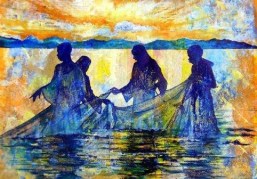 1 After this, Jesus revealed himself again to his disciples at the Sea of Tiberias. He revealed himself in this way. 2 Together were Simon Peter, Thomas called Didymus, Nathanael from Cana in Galilee, Zebedee’s sons, and two others of his disciples. 3 Simon Peter said to them, “I am going fishing.” They said to him, “We also will come with you.” So they went out and got into the boat, but that night they caught nothing. [from
  “The Catholic Church in the United States is an immigrant Church with a long history of embracing diverse newcomers and providing assistance and pastoral care to immigrants, migrants, refugees, and people on the move. Our Church has responded to Christ’s call for us to “welcome the stranger among us,” for in this encounter with the immigrant, the migrant, and the refugee in our midst, we encounter Christ” so writes the US Catholic Conference of Bishops. As well, in these days one walks into a political maelstrom that echoes the deep political divide. One only need read the news to read about the events unfolding at our southern border – and depending on the source you use you will get a certain slant on the events as “crisis”, “humanitarian disaster”, with blame assigned to past or current administrations.
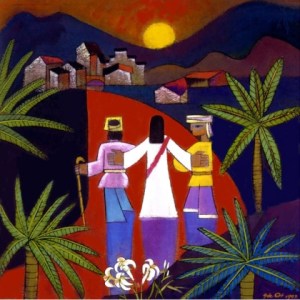
  In the Lucan recounting of the events of the Passion, Death, and Resurrection of Jesus, our story occurs on the evening of Easter Sunday. The women have found the tomb empty, there have been encounters with the Resurrected Jesus, and the news is spreading among the small group of faithful. But not all have heard – not the two disciples on the “Road to Emmaus” (24:17) – yesterday’s gospel. The first verse of
  In the gospel of Luke, what is the most important city? If the number of times mentioned is the criteria, then Jerusalem is the answer, being mentioned more than 90 times in the Gospel of Luke and Acts of the Apostles. I imagine there are all kinds of “what is Luke’s favorite…” questions, but an insightful one come from Fr. Bill McConville OFM. Fr. Bill has a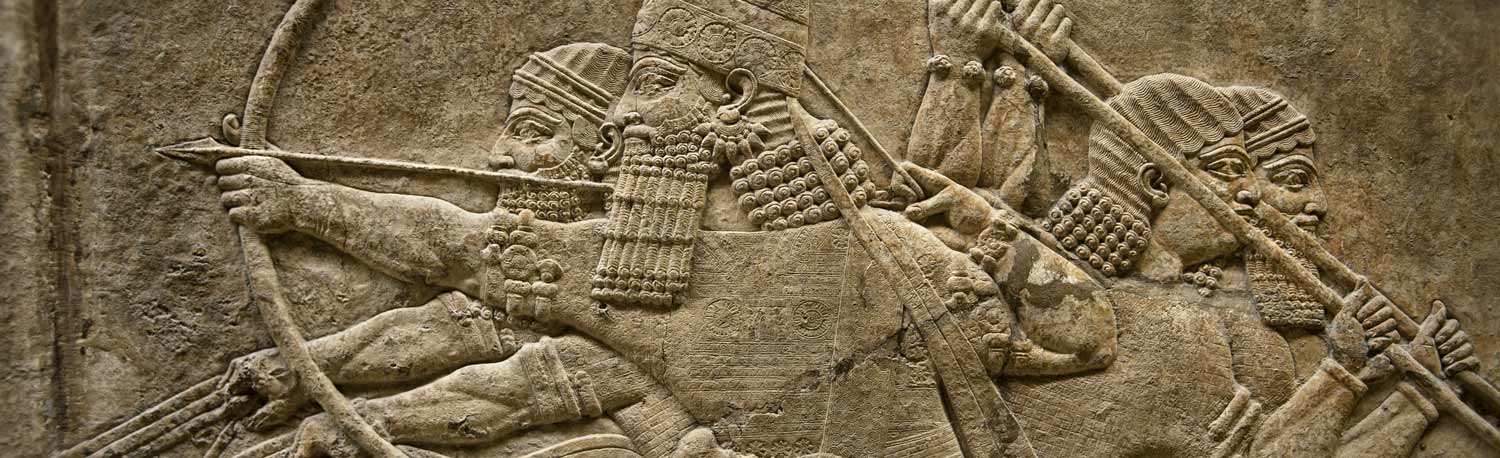
 This is the year in which we primarily read from the Gospel of Mark – at least on Sundays. But since it is the shortest of the gospels, we supplement it with a lot from the other three gospels. Like
  While reading the morning news I noticed an article that talked about the role that industrial mobilization has played in combating the coronavirus pandemic. Industries from the pharmaceutical companies, logistic and delivery organizations, manufacturers of syringes/swabs/alcohol pads/etc., refrigeration companies… and the list is quite long. The article compared the response of US industry to that of the mobilization that was such a key role in the Allied victory of World War II. The article implied that US auto companies produced cars one day and tanks the next. Were it that easy.
 friarmusings