
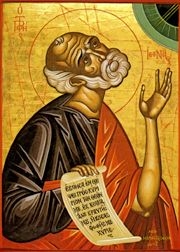
 The American poet and Presbyterian minister, Thomas John Carlisle, wrote a short collection of poems in a volume, “You, Jonah” – a poetic commentary on each chapter of the Book of Jonah. Here is one of his poems, rather summarizing the book to this point:
“I know a better way to circumvent your silly streak of mixing love with righteous judgment,
All I need to do is take the next flight west beyond Your jurisdiction.
This will give you time for sober, second thoughts to swear off this kick of simpleminded kindness. Inside the monster I was as low as I could get when I remembered God,
odd, that my distress impressed me with His apparent absence
when his premised daily presence hadn’t meant a blessed thing.
Finding myself in that hole with my soul fainting and rolling with the swell of my swollen ego.
It was a good enough to kill me.
Good.
Instead, I saw stars in the dark and started home on a welcome water spout.”
 One of the most common things one hears in the Sacrament of Reconciliation is the sin of gossip. It has been said that the act of gossip is like buying a chicken in the marketplace, feathers and all, and then walking through town, plucking the feathers one by one. As a priest, how do I direct a person to undo all the damage caused by gossip. It is akin to asking the person to return and pick up all the feathers. Such is the nature of gossip and its redress.
 When last seen Jonah had just hit bottom, swallowed alive. Up to this point, despite lots of opportunities, Jonah had not prayed, even when commanded by the ship’s captain in the midst of the raging tempest at sea – even as all the crew around him offered prayers to a pantheon of gods. But now it is different. He is alone, his choices and their consequences have “consumed” him, and … and what?
 I have written about calumny as sin, which it is indeed as noted in the Catechism of the Catholic Church. There are times I wonder if a “lack of curiosity” is very distant cousin. This would be a place for a “wink” emoji, but I will easily resist such temptations.
 Sunday next is the
  Today’s gospel is short, sweet with many good points. Let me muse upon just one: “Be merciful, just as your Father is merciful.” One way to consider this admonition is to ponder what are the consequence of withholding mercy.
 Did you know that our Christian brothers and sisters proclaim the gospel of the Transfiguration on the Sunday before Lent while we hear it this 2nd Sunday of Lent? For them it is the end of the liturgical season of Epiphany that starts with the first revelation of the Christ child to the world and end with the account of the divine glory of God being revealed in the person of Jesus. There is a lovely symmetry to that. On the first Sunday in Lent, both traditions proclaim Jesus’ temptation in the desert – and with the exception of this Sunday, both traditions proclaim the same Gospels for the remainder of Lent.
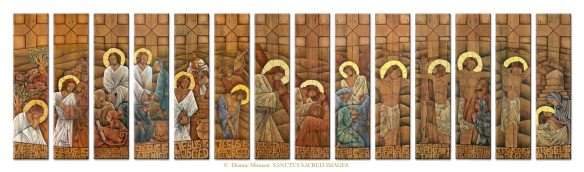 The Traditional Stations of the Cross have long been celebrated in many forms with the 14 Stations familiar to us a relatively recent form. Several of the stations arise from long-held traditions among the Christians of the Holy Land, but they are not necessarily Scriptural. In 1991, Pope John Paul II instituted a form of the Stations that are based solely on Scripture. This too forms a wonderful means of reflecting upon the events of the Holy Week which put the love of Christ in the forefront of our hearts and minds.
  Tomorrow is the
  friarmusings