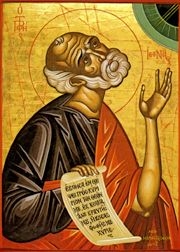
 Before we dive into the Book of Jonah, we need to understand what we are reading, in other words, the literary genre. Why? Simply put, you read a newspaper differently than a novel. You read poetry different than history. It is good to understand what the literary genre of Jonah is because there are many different literary types in the OT, including laments, love songs, parables, apocalypses, and histories. Jonah is generally included with the so-called “Minor Prophets” such as Joel, Obadiah and Micah, so perhaps it straight-up prophecy?
The opening of the book is classic: “This is the word of the LORD that came to Jonah, son of Amittai” (Jonah 1:1; also again in 3:1). This is the classic introduction of a prophetic work. Consider the Book of Micah that immediately follows Jonah in your Bible. Micah is seven chapters of his poetic word oracles, speeches and accounts of visons. But Jonah is not a collection of poetic word, visions, etc. It is a narrative.
Continue reading →

 In most commentaries there are discussions focused on the unity of composition (i.e., were there later editors?), date and purpose of the writing, questions of text preservation (consistency among known copies), underlying theology, and the “Sign of Jonah” from
  Ash Wednesday, the first day of the penitential season of Lent in the Catholic Church, is always 46 days before Easter Sunday. It is a “movable” feast that is assigned a date in the calendar only after the date of Easter Sunday is calculated. How is it calculated? I’m glad you asked.
 In
In  Lent is a penitential season when we’re encouraged to receive the Sacrament of Reconciliation: to go to confession. Some people look forward to doing this – others, not so much! Many just don’t think they need to go – for lots of reasons. Don’t plan to celebrate the sacrament this Lent? Here are a dozen reasons you can choose from!
 Today’s
  Do you know the book of Jonah? Everyone knows the story, right? Jonah was a disobedient prophet who rejected his divine commission, tried to run away, was cast overboard in a storm and swallowed by a great fish, rescued in a marvelous manner, and returned to his starting point. Lots of people know this much of the story. But that is the briefest of summaries of just the first chapter. The summary above does not include a lot of information and perspective from the beginning verses. It ends up missing the point and trajectory of the first chapter and the whole book itself. There are three more chapters after the great fish and the subsequent rescue – and a lot more to know about the Book of Jonah.
 In today’s
  “He shall dwell apart, making his abode outside the camp” – frightening and dreadful words. Spoken to leprous people in the wilderness, a people on the Exodus betwixt and between the slavery of Egypt and the promised land of Palestine. Words that ban, isolate, shun, and place someone beyond the connection to the community. These are words spoken to loved ones that pushed them from the routine of life into the wilderness. In modern life, we have our own words or lack of words that push people into a more modern wilderness where our loved ones are ghosted, cancelled, deleted, blocked and isolated – all this is a time when we all feel the effects of pandemic fatigue. Perhaps “outside the camp” sounds tempting during these safer-at-home days of the covid-19 pandemic. But this is different.
 friarmusings