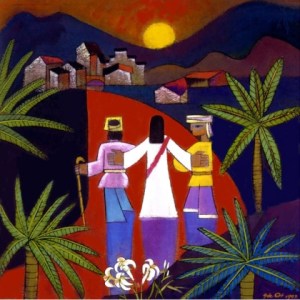
 This coming Sunday is the 3rd Sunday in Easter, Year B. You can read an complete commentary on the reading here:
35 Then the two recounted what had taken place on the way and how he was made known to them in the breaking of the bread. 36 While they were still speaking about this, he stood in their midst and said to them, “Peace be with you.” 37 But they were startled and terrified and thought that they were seeing a ghost. 38 Then he said to them, “Why are you troubled? And why do questions arise in your hearts? 39 Look at my hands and my feet, that it is I myself. Touch me and see, because a ghost does not have flesh and bones as you can see I have.” 40 And as he said this, he showed them his hands and his feet.
41 While they were still incredulous for joy and were amazed, he asked them, “Have you anything here to eat?” 42 They gave him a piece of baked fish; 43 he took it and ate it in front of them. 44 He said to them, “These are my words that I spoke to you while I was still with you, that everything written about me in the law of Moses and in the prophets and psalms must be fulfilled.” 45 Then he opened their minds to understand the scriptures. 46 And he said to them, “Thus it is written that the Messiah would suffer and rise from the dead on the third day 47 and that repentance, for the forgiveness of sins, would be preached in his name to all the nations, beginning from Jerusalem. 48 You are witnesses of these things. 49 And (behold) I am sending the promise of my Father upon you; but stay in the city until you are clothed with power from on high.” Continue reading →


 This coming Sunday, the 4th Sunday of Easter, is known as “Good Shepherd Sunday,” because of the gospel that is proclaimed:
 A while back I read a classic summer beach novel – you know the ones: easy to read, entertaining, no heavy lifting required … and no I don’t remember the title. But I remember this, there are good guys being chased by bad guys. The good guys are only armed with their wit, imagination, guile, luck, and their paranoid friend who believes every conspiracy theory is true. The premise is that everything in the world has a radio frequency identification (RFID) chip embedded in it. When the good guys decide to use cash only so that they stay off the grid, it doesn’t matter because their credit cards and driver’s licenses have RFID chip that, although still unused in their wallets and purses, are detected by the RFID scanner at the checkout counter. As the novel races along the bad guys track the good guys via RFID. The good guys keep emptying their lives getting rid of toll road passes, cell phones, driver’s licenses, credit cards, passports, access badges for work, the groceries and clothes they just purchased for cash… and still the bad guys keep coming. Holy guacamole! There is no place to hide! The bad guys can pick then out of a crowd of a gazillion people. As we read, we cheer for the good guys, we get involved, as if we really and deeply know them. It is as though we can really see them!
 By the spring of 1213, four years after the founding of the “order,” Francis’ reputation had risen to the attention of the Italian aristocracy – not just in Assisi but throughout central Italy. The order was beginning to attract men from the higher social classes. Sons of merchants like Francis, sons of the landed wealthy, sons of ruling households, men with established careers in law, music and the arts, and also ordained priests. They joined the already formed group of men from middle and lower backgrounds in muddling through what it meant to follow Christ in the manner of Francis. G.K. Chesterton’s later definition of the Catholic Church – “here comes everybody” – was being lived out in Francis’ day.
  “So now I tell you, have nothing to do with these men, and let them go. For if this endeavor or this activity is of human origin, it will destroy itself. But if it comes from God, you will not be able to destroy them; you may even find yourselves fighting against God” (Acts 5:38-39)
 On a rather regular basis, I am asked via email about the Sacrament of Reconciliation (Confession) and forgiveness of sins. The questions that I am thinking of are mostly from folks who are firmly entrenched in their Christian faith in the Protestant or Reformed tradition. But increasingly these days, inquiries also come from Catholics. Sometimes they are not really questions at all. They are invitations for me to debate them as they wish to free me from the errors of my Catholic beliefs or free the Catholic from the need to go to the Sacrament of Reconciliation. The question is always some variation of “how can priests forgive sins” when – and here are the variations in their logic – (a) there is no such thing as priest, there is only Jesus as High Priest, (b) only God can forgive sins, (c) people only have one mediator, jesus Christ, and therefore one need only ask Jesus for forgiveness, (d) Scripture never talks about confessing sins to a priest, ….and I think that covers the common debate topics.
 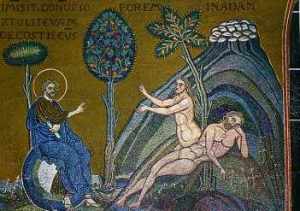 Adam is created as God’s first-born son. He’s also conceived as a priest. In
  friarmusings