
 If the 4th Gospel is indeed more about how God reveals God’s self in the person of Jesus, then we need to realize that Jesus was not born into a time of theological vacuum. Jewish theology was robust and with a history of succeeding and competing rabbinic schools. The followers of Jesus and the people of his time were Jews who were raised and lived this theology. It provided the framework for their daily lives and shaped their expectations about the Messiah, the Anointed One, who was to come. Among the gospels, John’s is the writings whose work expresses the fulfillment of those expectations and provides the theology for those that would follow Jesus. The basis of the theology is evident from the opening: John 1:1 “In the beginning was the Word, and the Word was with God, and Word was God…” Continue reading
Testimony: memra
Reply

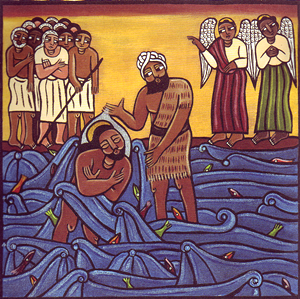
 John the Baptist is a crucial figure in the history of revelation and redemption. In retrospect, his appearance in the wilderness was the most important event in the life of Israel for more than three hundred years. The absence of a prophet throughout this period had been interpreted to signify that the prophetic task was accomplished. Yet all clung to the hope that the “faithful prophet” would appear, the Prophet like Moses, whose coming would signal the events of the “last days” (Deut. 18:15–19; 1 Macc. 4:42–46; 14:44). The very fact of John’s appearance was an eschatological event of the first magnitude, and signified that the decisive turning point in the history of salvation was at hand. It was John, the preacher of radical repentance, who initiated the messianic crisis. To speak of the gospel of Jesus is to speak of the good news which began with John.
 I like words, their origin (or etymology if you prefer) and the ways in words affect people – and people affect words. Such as the word “peruse” which people understand to mean “glance over, skim,” etc. Yet originally the word means (and I would argue still does) to read completely and in exacting detail. Another interesting word whose meaning has done an about face is “egregious.” Today it means to be conspicuous or flagrant – and almost always in a negative sense. Yet the origin of the word from the Latin ex-“out of” and greg- “flock” to give us egregius “illustrious” or in a more modern sense, “outstanding.” Somewhere in the late 16th century the word was increasingly used in an ironic sense, until that usage became it every day meaning.
  friarmusings