 25 There was a scholar of the law who stood up to test him and said, “Teacher, what must I do to inherit eternal life?” 26 Jesus said to him, “What is written in the law? How do you read it?” 27 He said in reply, “You shall love the Lord, your God, with all your heart, with all your being, with all your strength, and with all your mind, and your neighbor as yourself.” 28 He replied to him, “You have answered correctly; do this and you will live.” 29 But because he wished to justify himself, he said to Jesus, “And who is my neighbor?” 30 Jesus replied, “A man fell victim to robbers as he went down from Jerusalem to Jericho. They stripped and beat him and went off leaving him half-dead. 31 A priest happened to be going down that road, but when he saw him, he passed by on the opposite side. 32 Likewise a Levite came to the place, and when he saw him, he passed by on the opposite side. 33 But a Samaritan traveler who came upon him was moved with compassion at the sight. 34 He approached the victim, poured oil and wine over his wounds and bandaged them. Then he lifted him up on his own animal, took him to an inn and cared for him. 35 The next day he took out two silver coins and gave them to the innkeeper with the instruction, ‘Take care of him. If you spend more than what I have given you, I shall repay you on my way back.’ 36 Which of these three, in your opinion, was neighbor to the robbers’ victim?” 37 He answered, “The one who treated him with mercy.” Jesus said to him, “Go and do likewise.” Continue reading →

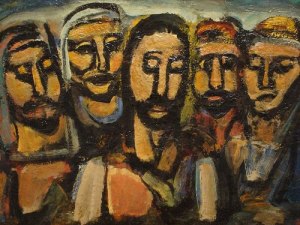 “The Lord appointed seventy-two others whom he sent ahead of him in pairs to every town and place he himself to visit.” –Luke 10:1
 “No one who puts a hand to the plow and looks back is fit for the kingdom of God.” (Lk. 9:62) This saying of Jesus is at the root of a proverb, often quoted in communities struggling for freedom and justice: “Keep your hand on the plow and hold on!” Even in the ordinary of life, haven’t we all, at one time or another, put our hand to the plow and looked back?
  “Peace to this household…” The instructions for how the disciples should receive hospitality are expanded from 9:4, which simply commanded that they stay wherever they were received. Here the instruction has two parts, with commentary on each: (1) say, “Peace to this house,” and (2) remain in the house where you are received. The peace they offer seems like a tangible gift or even a living reality with a mind of its own. This notion of peace rests on the biblical concept of the word of God as being not only a message but somehow an embodiment of God’s own personality and power (Isa 55:10–11; Jer 20:8–9). The peace-wish of the Christian missionary is more than an expression of good will — it is the offer of a gift from God of which they are privileged to be the ministers and heralds (see 1:2; Acts 6:4). Those who bring spiritual gifts can expect their physical needs to be taken care of by the beneficiaries (v. 7; see Gal 6:6 “the one who is being instructed in the Word should share all good things with his instructor.”).
  friarmusings