
Annemarie Reiner (of Adelaide, Australia) posted this reflection on the Transfiguration on her blog “Who Do You Say That I Am.” It is a very nice reflection to consider in this Lenten Season.
When we look at our Gospel today we can understand why daily reflection is so important. These three disciples (and the rest of them) didn’t get who Jesus was until well after his death. They didn’t understand what had happened at the transfiguration. They didn’t understand what was happening as they witnessed Jesus’ life. They didn’t understand what was happening at the crucifixion. But they kept pondering their experiences over and over – if they didn’t we simply wouldn’t have the New Testament.
So what do we learn from this?
Every human life is filled with experiences from when we get up until we go to sleep and even in our sleep we experience our dreams. What do we do with these experiences?
Mostly we ignore them and then we forget them. Even the profound moments that come into our lives, we can shut the depth of their meaning out. We might have gone through a depression – do we take the time to ponder the meaning of this depression in my life or do I just think: thank God that is over and then fill our lives with all sorts of other distractions and then wonder why down the track I fall into another bout of depression?
I might have experienced walking with a loved one who has been sick and has died. Do I sit back and reflect upon the experience or is it too difficult to re enter this painful period, so we try and shut it out hoping it will go away.
I might have experienced a deep hurt. Do I ponder the experience considering my own reactions and responses to the hurt or do I totally throw blame on those who hurt me without any self reflection? So I become the victim in life and I go from one lot of blaming to the next without any examination of my own heart.
I might have deeply hurt someone myself. Do I take the time reflect upon my behaviour (even if it is down the track from the experience) so as to be confronted with what I have done. Or do I just keep running away from this self disclosure because it s too painful?
There are numerous life experiences that we all have. Many of these experiences are profoundly mysterious. Sadly many of them become buried and we lose the richness these experiences can offer us. Not only this but we now have multi million dollar industries offering all sorts of therapies etc to help people cope with the results of their non reflective lives.
Someone once said that a non reflective life is a life not worth living. It might be more accurate to say that a non reflective life is a life not lived – it is life rejected.
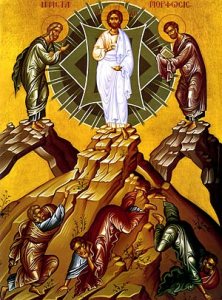
Jesus invites each of us to this holy mountain today. It might be shrouded in mystery – we may not have much of an idea who Jesus is yet – we may be confused by the experiences of life and feel lost – but Jesus says to us today to come with him. To trust him. To have faith in him. To keep thinking about our experiences but to do this with Jesus at our sides.
When we have the courage to come to the mountain with Jesus then we too may see something beyond our imagining. When we truly see Jesus transfigured (see Jesus as he truly is) then the life that Jesus offers us will begin.
A large part of the problem is that we really don’t see who Jesus is. Jesus can become our own creation – a feel safe, feel good guy that we call upon when it suits us, and we try and mould Jesus to be what we want him to be. If we truly believed in Jesus we too would not know what to say, we would be frightened, but we would hear God saying to us: Listen to him. And even in all our blindness and ignorance all we would truly want would be to Listen to Jesus – we would hunger for Jesus – not the Jesus of our own making, but the Jesus who stands before us as mystery. Can we accept such a mystery?
We, the Body of Christ must also be transformed just as Jesus was transformed – but this cannot happen until we come to this mountain in all humility. Then the horrors our world is currently experiencing may begin to fade and the light will truly shine in the darkness.
In the coming week let us pray for the desire and will to come to the mountain that Jesus invites us too so that we may encounter the true mystery before us and then ponder for a lifetime its meaning for ourselves and the whole of creation.
Image credit: Sunrise, Simon Berger, Pexels, CC
 Tomorrow is the
 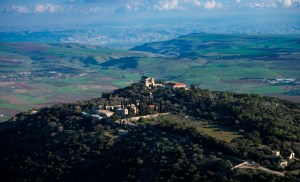 In our well-known account of the Transfiguration, Peter simply says, “Lord, it is good for us to be here.” Of course, he could mean Mount Tabor all in and of itself. It has an amazing 360-degree view of the Jezreel Valley, the mountains of Samaria, Mount Carmel, the Golan Heights, Mt Gilead, Mt Horeb, the whole of Galilee, all as far as the eye can see. On a clear day it is where heaven and earth meet. There atop a mountain, the place where man has gone to meet God, where human and divine touch, the meeting place of the temporal and the eternal. Matthew, Mark and Luke describe the miraculous event of the Transfiguration, as does 2 Peter 1. We celebrate the event that was the revelation of Jesus’s divine nature, exalting him above the Law/Moses and all the prophets/Elijah, foreshadowing his death, and prefiguring his Resurrection. Maybe Peter understood what was unfolding or maybe he was flummoxed and all he could come up with was “…it is good for us to be here.” I am not sure I would have understood what I was seeing much less think of something to say.
  Next Sunday is the
  friarmusings