
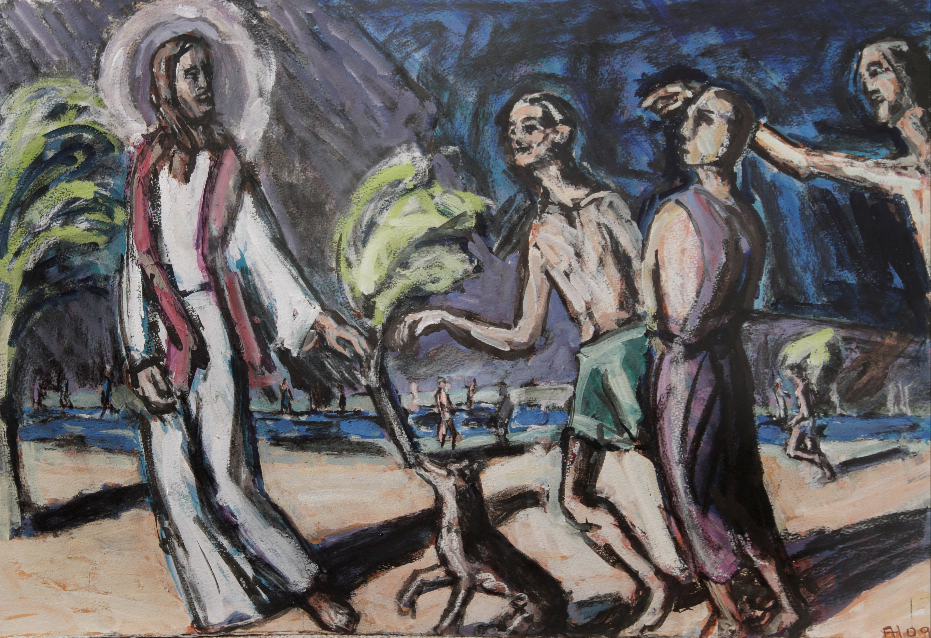
Come after me: context

Ecce Agnus Dei - Francis Hoyland

Ecce Agnus Dei – Francis Hoyland

Mark 1:14 After John had been arrested, Jesus came to Galilee proclaiming the gospel of God: 15 “This is the time of fulfillment. The kingdom of God is at hand. Repent, and believe in the gospel.” 16 As he passed by the Sea of Galilee, he saw Simon and his brother Andrew casting their nets into the sea; they were fishermen. 17 Jesus said to them, “Come after me, and I will make you fishers of men.” 18 Then they abandoned their nets and followed him. 19 He walked along a little farther and saw James, the son of Zebedee, and his brother John. They too were in a boat mending their nets. 20 Then he called them. So they left their father Zebedee in the boat along with the hired men and followed him.

The Bigger Picture. The first major section of Mark’s Gospel extends from 1:14 to 3:6, and describes the initial phase of the Galilean ministry. Within this section the evangelist records the calling of the first disciples (1:16–20; 2:14), Jesus’ ministry in and around Capernaum (1:21–34), and a series of controversies (2:1–3:6) which are climaxed by the decision to seek Jesus’ death (3:6). Continue reading

Lamb of God: calling disciples

Ecce Agnus Dei - Francis Hoyland

Ecce Agnus Dei – Francis Hoyland

Andrew. Three times Andrew is doing something in John – ‘and each time he is bringing someone to Jesus. First, his brother, Simon (v.40). Then, a boy with five barley loaves and two fish (6:8); and finally, “some Greeks” (12:20-22), which signals the hour for the Son of Man to be glorified. Andrew is never mentioned just by himself. Twice he is called Simon Peter’s brother (1:40; 6:8). We are told that Philip came from the city of Andrew and Simon (1:44). Andrew and Philip go and tell Jesus about the Greeks (12:22). It may be that being named as the first follower of Jesus (in the Fourth Gospel) was the first time that he had ever been first in anything. It seems likely to me that he was always living under the shadow of his more flamboyant brother. It also seems to me that our parishes are full of more behind-the-scenes “Andrews” than flamboyant “Peters” who seem to get all the credit. (“Peter” occurs in 32 verses in John – ‘8 times as many as Andrew.) One doesn’t have to be a “Peter” to be an effective follower and witness to Jesus (Stoffregen) Continue reading