
Today is the first weekday of the Season of Advent. The gospel reading is the account of a centurion who approached Jesus and asked that his servant, paralyzed and suffering, be healed. Does it strike you as odd that this is the gospel? It seems like something suited to Ordinary Time rather than Advent. Or does it? I think that here at the very beginning of Advent the choice of this gospel is quite appropriate for Advent. Let me suggest six reasons why this gospel is a great choice.
It highlights Advent’s central theme: It is Faith that welcomes the Messiah. The centurion expresses one of the most remarkable statements of faith in all the Gospel: “Lord, I am not worthy to have you enter under my roof; only say the word and my servant will be healed.” (Mt 8:8) At the start of Advent, the Church places before us the posture we must have to welcome Christ: humble, trusting, expectant faith. This faith is so exemplary that the Church echoes it at every Mass before Communion.
This gospel reveals that Christ came for all nations. Advent looks forward not only to Bethlehem but to the final coming of Christ, when all nations gather before Him. Jesus’ response would have been startling to the listeners in the 1st century: “Many will come from the east and the west, and will recline with Abraham, Isaac, and Jacob…” (Mt 8:11) The centurion is a Gentile, yet he recognizes Jesus more clearly than many in Israel. This scene is a partial fulfillment of Isaiah’s Advent prophecies which proclaim that all nations will come to the Lord – “In days to come, the mountain of the LORD’s house shall be established as the highest mountain and raised above the hills. All nations shall stream toward it. (Isaiah 2:2) Here at the very beginning of Advent we are reminded that Christ’s Kingdom is universal. It is for outsiders, seekers, and anyone drawn to the light of Christ.
The gospel mirrors our Advent longing: “Come, Lord Jesus” The centurion comes seeking the Lord, confident that Jesus’ arrival brings healing. Advent is the season we sing “O’ Come, O’ Come Emmanuel” expressing our longing, a longing embodied by the centurion. He seeks Christ, calls out to Him, and trusts His word even before seeing results. It holds up for us a model of our Advent posture: not passive waiting, but active reaching.
Advent’s weekday readings are filled with Isaiah, a prophet whose words shaped Israel’s hope for the Messiah. This gospel emphasizes the Power of the Word of Christ. The centurion believes Jesus’ word alone is enough: “only say the word and my servant will be healed.” (Mt 8:8) From the Word made flesh, the Word goes out to accomplish its mission. We are given an example that God’s Word fulfills what it promises. As Isaiah foretold and as the centurion believed, the Word made flesh is coming and will accomplish healing and salvation.
The readings for the early Season of Advent carry themes of healing and restoration. The first days of Advent feature several healing miracles: the centurion’s servant, healing the two blind men who cry out to him, sending apostles out with the specific mission of healing, and others. These early readings present Christ as the One who restores creation, heals what is wounded, and makes all things new. This is the very mission promised in Isaiah and fulfilled in Christ’s coming at Christmas and in glory.
And last but not least, this gospel anticipates the Eucharist. The centurion’s words echo through the liturgy: “Lord, I am not worthy…” Placing this Gospel early in Advent highlights the link between Christ who came at Bethlehem, Christ who comes at every Mass, and Christ who will come again in glory. As many have noted: these are the “three comings” of Christ during Advent.
It is a great choice for the first weekday of the Advent Season.
Image credit: The Healing of the Officer’s Son | James Tissot, c.1880 | Brooklyn Museum | PD-US
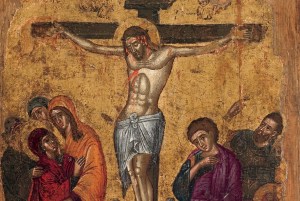 The centurion who witnessed what had happened glorified God and said, “This man was innocent beyond doubt.” 48 When all the people who had gathered for this spectacle saw what had happened, they returned home beating their breasts; 49 but all his acquaintances stood at a distance, including the women who had followed him from Galilee and saw these events. 50 Now there was a virtuous and righteous man named Joseph who, though he was a member of the council, 51 had not consented to their plan of action. He came from the Jewish town of Arimathea and was awaiting the kingdom of God. 52 He went to Pilate and asked for the body of Jesus. 53 After he had taken the body down, he wrapped it in a linen cloth and laid him in a rock-hewn tomb in which no one had yet been buried. 54 It was the day of preparation, and the sabbath was about to begin. 55 The women who had come from Galilee with him followed behind, and when they had seen the tomb and the way in which his body was laid in it, 56 they returned and prepared spices and perfumed oils. Then they rested on the sabbath according to the commandment. (Luke 23:47-56)
  Luke 23:47 The centurion who witnessed what had happened glorified God and said, “This man was innocent beyond doubt.” 48 When all the people who had gathered for this spectacle saw what had happened, they returned home beating their breasts; 49 but all his acquaintances stood at a distance, including the women who had followed him from Galilee and saw these events. 50 Now there was a virtuous and righteous man named Joseph who, though he was a member of the council, 51 had not consented to their plan of action. He came from the Jewish town of Arimathea and was awaiting the kingdom of God. 52 He went to Pilate and asked for the body of Jesus. 53 After he had taken the body down, he wrapped it in a linen cloth and laid him in a rock-hewn tomb in which no one had yet been buried. 54 It was the day of preparation, and the sabbath was about to begin. 55 The women who had come from Galilee with him followed behind, and when they had seen the tomb and the way in which his body was laid in it, 56 they returned and prepared spices and perfumed oils. Then they rested on the sabbath according to the commandment.
  friarmusings