
The Date of Christmas

Christians around the world will gather to celebrate Jesus’ birth. The season is punctuated by carols, gatherings and parties, good cheer, brightly wrapped gifts, festive foods, and family traditions. In my parish we need ten Masses between Christmas Eve and Christmas Day to accommodate all the folks who come to celebrate the Nativity. At the masses the familiar and traditional gospel readings are proclaimed telling of angels, shepherds, and a child wrapped in swaddling born to save us. All of this on the same date each year: December 25th.

How did December 25 come to be associated with Jesus’ birthday? The Bible does not specify the date of the Nativity. Which is interesting in that the gospels are quite specific as regards the Last Supper, the Crucifixion and the Resurrection. Lots of people might offer, it can not have been December since shepherds were tending their flocks in pasture lands; that would be during the spring lambing season; in the cold month of December, on the other hand, sheep might well have been corralled. But then one should have a bit of caution when trying to exact a date from an incidental detail whose purpose is theological.

But it is interesting to note that the earlier New Testament scripture – St. Paul’s epistles and the Gospel of Mark – make no mention of Jesus’ birth. But the Gospels of Matthew and Luke provide us with the well known accounts, although without mentioning a date. The writings of the early Christian era, the first and second century, has no mention of birth celebrations in the writings of folks such as Irenaeus (c. 130–200), Tertullian (c. 160–225) or Origen of Alexandria (c. 165–264). 

In the second century, we see additional details of Jesus’ birth and childhood – but they are written in books not considered part of the Canon of Sacred Scripture (apocryphal writings) such as the Infancy Gospel of Thomas and the Proto-Gospel of James. These texts provide everything from the names of Jesus’ grandparents to the details of his education, but not the date of his birth. In about 200 AD, Clement of Alexandria notes that several different days had been proposed by various Christian groups. Surprisingly, December 25 is not mentioned at all. The dates being bandied about were August 28th and May 20th. By the fourth century we find references to two dates, Dec 25 (West) and January 6 (East), that seemed to be celebrated in the Roman Empire.  In time December 25 would prevail as the date for celebrating  the Nativity, while January 6 eventually came to be known as the Feast of the Epiphany, commemorating the arrival of the magi in Bethlehem.

But why December 25th?

A popular theory is that the Christian Church borrowed from the pagan celebration of Sol Invictus (the Unconquered Sun), a Roman celebration established in 274 AD by the Roman emperor Aurelian. According to this theory, early Christians deliberately chose these dates to encourage the spread of Christmas and Christianity throughout the Roman world. Despite its popularity today, this theory of Christmas’s origins has its problems. It is not found in any ancient Christian writings. Some Christian authors of the time note a connection between the solstice and Jesus’ birth, but in connection with setting a calendar date. Rather they see the coincidence as a providential sign, as natural proof that God had selected Jesus over the false pagan gods.

It’s not until the 12th century that we find the first suggestion that Jesus’ birth celebration was deliberately set at the time of pagan feasts. A marginal note on a manuscript of the writings of the Syriac biblical commentator Dionysius bar-Salibi states that in ancient times the Christmas holiday was actually shifted from January 6 to December 25 so that it fell on the same date as the pagan Sol Invictus holiday. In the 18th and 19th centuries, Bible scholars spurred on by the new study of comparative religions latched on to this idea. They claimed that because the early Christians didn’t know when Jesus was born, they simply assimilated the pagan solstice festival for their own purposes, claiming it as the time of the Messiah’s birth and celebrating it accordingly. This line of argument was extended to show that many of the Christmas holiday’s traditions reflect pagan customs borrowed from pagan practices, e.g., the Christmas tree. But all of these traditions are from a much later period as Christianity expanded into northern and western Europe. 

There are problems with this popular theory. Most significantly, the first mention of a date for Christmas (c. 200) and the earliest celebrations that we know about (c. 250–300) come in a period when Christians were not borrowing heavily from pagan traditions. In the first few centuries, the persecuted Christian minority was greatly concerned with distancing itself from the larger, public pagan religious observances, such as sacrifices, games and holidays. This was still true as late as the violent persecutions of the Christians conducted by the Roman emperor Diocletian between 303 and 312 C.E.

When Constantine came to power and converted to Christianity, Christianity took over pagan temples and converted them to churches, but there is no evidence of Christians adopting pagan festivals in the third century, at which point dates for Christmas were established. Thus, it seems unlikely that the date was simply selected to correspond with pagan solar festivals.

There is some evidence that the Donatist Christians in North Africa were celebrating the Nativity of the Lord on December 25th in the 3rd century before the age of Constantine and perhaps even before the establishment of Sol Invictus.  Which still leaves us with: why December 25th?

Around 200 AD Tertullian of Carthage calculated that the date of Jesus’ death, given in the Gospel of John at 14th of Nissan, was equivalent to March 25th in the Roman calendar.  That date should stand out as it is the date the Catholic Church celebrates the Feast of the Annunciation, Jesus’ conception. And yes, that date is 9 months prior to December 25. 

An idea of the time was that Jesus was conceived and crucified on the same calendar date. The idea appears in an anonymous Christian treatise titled “On Solstices and Equinoxes”, which is likely from fourth-century North Africa. The treatise states: “Therefore our Lord was conceived on the eighth of the kalends of April in the month of March [March 25], which is the day of the passion of the Lord and of his conception. For on that day he was conceived on the same he suffered.” St. Augustine was familiar with this association. In On the Trinity (c. 399–419) he writes: “For he [Jesus] is believed to have been conceived on the 25th of March, upon which day also he suffered; so the womb of the Virgin, in which he was conceived, where no one of mortals was begotten, corresponds to the new grave in which he was buried, wherein was never man laid, neither before him nor since. But he was born, according to tradition, upon December the 25th.”

In Eastern Christianity the same idea was present, but rather than March 25th, the starting date was April 6th. Bishop Epiphanius of Salamis writes that on April 6, “The lamb was shut up in the spotless womb of the holy virgin, he who took away and takes away in perpetual sacrifice the sins of the world.” This led to the dating of the Nativity on January 6th. Thus, we have Christians in two parts of the world calculating Jesus’ birth on the basis that his death and conception took place on the same day (March 25 or April 6) and coming up with two close but different results (December 25 and January 6).

Connecting Jesus’ conception and death is an odd connection for us to make, but it reflects ancient and medieval understandings of the whole of salvation being bound up together. One of the most poignant expressions of this belief is found in Christian art. In numerous paintings of the angel’s Annunciation to Mary, the moment of Jesus’ conception, the baby Jesus is shown gliding down from heaven on or with a small cross; a visual reminder that the conception brings the promise of salvation through Jesus’ death.
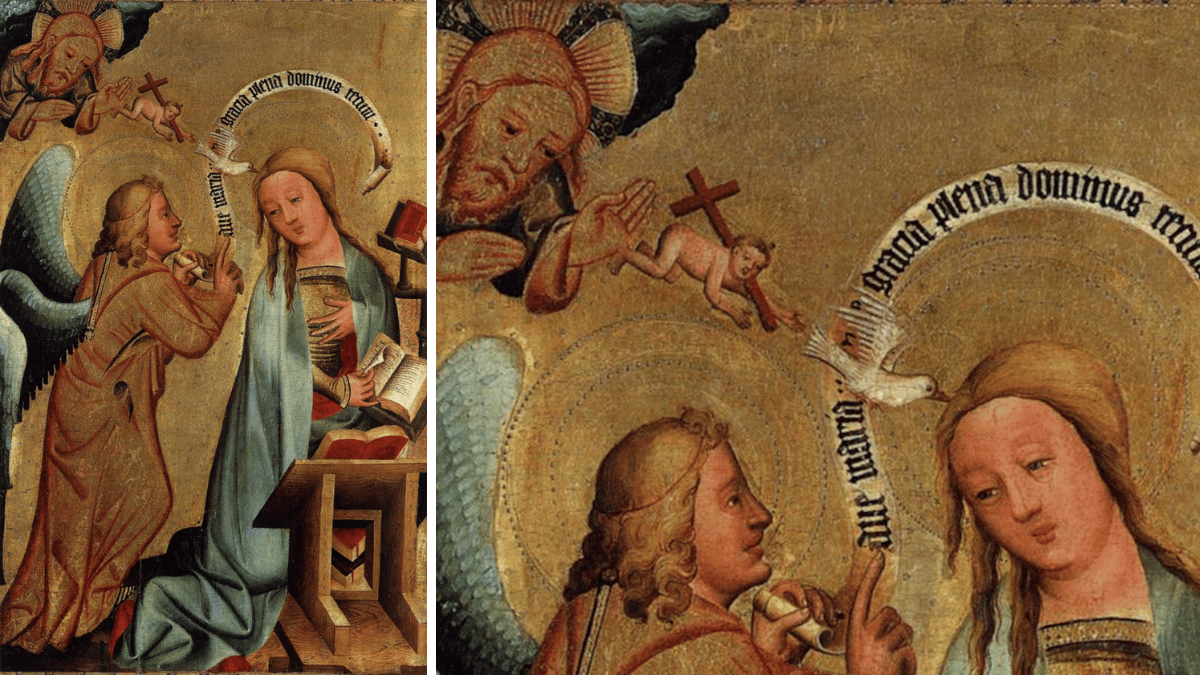

Image credit: The Annunciation | Master Bertram, 1379-1383 | Altarpiece at St Peter (Grabow) | Kunsthalle, Hamburg.  Source credit: Andrew McGowan, Bible History Daily | July 10, 2025
Joy in the days after

 “Rejoice in the Lord always; again I say, rejoice! The Lord is near.”  Such were the words on the Third Sunday of Advent, Gaudete Sunday.  Perhaps we should rephrase the words: “Rejoice in the Lord always; again I say, rejoice! The Lord is here.”  All of Advent we have been waiting and praying for the coming joy of Christmas. On this night the angels proclaim the message of “good news of great joy;” for unto us has born a child, Emmanuel, who is Christ, Lord and Savior. This good news of great joy is for all the people of God. 

The Church’s liturgical seasons of Advent, Christmas and Ordinary Time are shaped to lead us to the experience of joy. In a way it matches a pattern of life of which we are intuitively aware because we are people that live among patterns shaping our lives. It might be simply described simply as three “seasons” similar to the Church’s liturgical seasons. The first season is “Preparation” for an event. It is a season which carries along with it a sense of anticipation. Next comes the “day” itself, when anticipation is realized in an occasion of great joy. And then comes the time after the event and that season where we move on into life but we want to hold on to the joy of the day. Like Christmas: “Rejoice in the Lord always; again I say, rejoice! The Lord is [here].” 

The joy of Christmas is here; all around us, before, behind us, surrounding us.  How do we appropriate it? How do we grab some and put it in our pocket for later? How can we bottle it? How can we capture the joy which pervades this night. And once we have it, keep it safe, and share the joy?

There are lots of events in our life that have that same pattern of anticipation, preparation, and finally the day comes:

  • Your first day of high school
  • Moving into the dorm at college
  • Your first job after college
  • Getting married
  • Your first home
  • Your first child (…second child and more until you have at least four and then you can have your own swimming relay team!)
  • Your children’s first day of school, high school, college… and so the cycle continues.

Parents and grandparents look back and remember the joy.

As a community of faith we have anticipated and prepared for this evening – and here we are at Christmas. Not just us and not just now – but every year. And it has been this way since before the time of Jesus. The Prophet Isaiah, more than 2,500 years ago, looked forward to this day of “abundant joy and great rejoicing” when he prophesied:“For a child is born to us, a son is given us; upon his shoulder dominion rests. They name him Wonder-Counselor, God-Hero, Father-Forever, Prince of Peace.”  And the people of God waited and anticipated – through the days and nights, joys and sorrows, and all that makes up the cauldron of this life. They had faith that the day would come.

And then, out of the dark night sky, there shown above shepherds in the fields, the glory of the Lord and angels who proclaimed good news of great joy: “For today in the city of David a savior has been born for you who is Christ and Lord.”  And then the heaven exploded in an angelic chorus.

Think of the anticipation those shepherds felt as they hurried into Bethlehem to witness what the angels proclaimed. Think of the anticipation of Mary and Joseph. The joy of the world focused on a manger is a backwater town of Bethlehem.

Be it on the grand scale of the history of Redemption, the celebration of one year’s Christmas, or so many events of our life – there is the pattern of anticipation all pointing towards “the day”- be it Christmas, the first day of college, your wedding day, and so much more.

And comes the day after Christmas, the second day of college, the end of the honeymoon and the start of building a life together.

Here at Christmas we are again asked to recall the words of St. Paul to Titus: “The grace of God has appeared, saving all and training us to reject godless ways and worldly desires and to live temperately, justly, and devoutly in this age.” And to carry those words and these memories into the cauldron of life, to face the next day. Likewise, to recall: 

  • Your first day of college – to remember what you hoped to achieve and to renew your efforts toward that goal. 
  • Your wedding day – to remember the covenant vows you exchanged and go back to the work of building a life together in love.  
  • The moment you child your child in your arms – all the promises you made – and to again strive to make those promises come true.

And Christmas – to remember the warm glow of this evening, the close comfort of friends and family, the good cheer, and to recall a Savior has been born to us, saving all, and asking us to be Christ for others. To renew our covenant with God in this Eucharist with our “Amen”, and then to go into the world to strive to make the promises of Christ come true for yourself, your loved ones, for friends, and for those you will meet in the days and years to come. 

With all the anticipation comes the day, and with the day, comes the day after. We are people of the day after but recall this day in memory and rejoicing, for to us a Savior has been born!

Merry Christmas.

Here we come a-wassailing

I am sure many (if not all) are familiar with the Christmas carol that begins, “Here we come a-wassailing / among the leaves so green.” If not there is a video below to remind you – or introduce you to the song. But what is a “wassail” and how does one go about “wassailing”? Our friends at Merriam-Webster have the answer to those questions!

To wassail is to sing carols (popular songs or ballads of religious joy) from house to house at Christmas; the verb is usually used in the phrase “go wassailing.” As a noun, wassail can refer to (among other things) a hot drink that is made with wine, beer, or cider, as well as spices, sugar, and usually baked apples. Wassail is traditionally served in a large bowl especially at Christmastime.

Continue reading

The Arrival of Hope

The gospel reading for the Christmas Eve Vigil Mass is the genealogy of Jesus from the Gospel of Matthew. For a Mass that is typically preceded by or includes a children’s Christmas pageant, it is not exactly the reading one would naturally select. There is a part of us all that want to attend Christmas Mass and be reminded of angelic choruses, shepherds, and an infant in the manger. But the Nativity is more than a nice Christmas card scene. It is the arrival of Hope. Continue reading

The Gospels of Christmas

Did you know that the Church has four different Christmas Masses, each with their own gospels? The four Masses are:

  • The Nativity of the Lord – Vigil Mass
  • The Nativity of the Lord – Mass during the Night (aka: The Midnight Masswhich has rules: can not start before 10 pm and must finish by 2 am)
  • The Nativity of the Lord – Mass at Dawn
  • The Nativity of the Lord – Mass during the Day
Continue reading

What’s next?

A lot of our life hoovers around the question, “What’s next?” It is that part of us that is ever looking ahead to try and pierce the veil that covers our future. Even as we peer into the future life inexorably moved ahead in its journey through time silently pleading that we are mindful of the time give us. And we were just given the Season of Advent. We were asked to prepare, to wait in expectation for Emmanuel, God-with-us, the promised from of old, the King of Kings…and now it is Christmas. And our Savior is born to us! Continue reading

People of the Day After

Christmas is one of those events that has a lot of anticipation associated with it. Certainly, well before Thanksgiving the retail stores began to decorate for Christmas, everywhere we go there is Christmas music playing in the background, and our mailboxes – of all types – began to fill with promotions for Christmas shopping. But that’s OK.  There are lots of events in our life that have that same pattern of anticipation, heightened activity, and finally the day comes.

Here is a short list of such events of our lives

  • Your first day of high school
  • Moving into the dorm at college
  • Your first job after college
  • Getting married
  • Your first home
  • Your first child (…second child and more until you have at least four and then you can have your own swimming relay team!)
  • Their first day of your children’s school, high school, college… and so the cycle continues.

The same in our faith tradition: we have Advent leading up to Christmas. And here we are at Christmas.

It is not just this year, but every year. And it has been this way since before the time of Jesus. The Prophet Isaiah, more than 2,500 year ago, looked forward to this day of “abundant joy and great rejoicing” when he prophesied: “For a child is born to us, a son is given us; upon his shoulder dominion rests. They name him Wonder-Counselor, God-Hero, Father-Forever, Prince of Peace.”  And the people of God waited and anticipated – through the days and nights, joys and sorrows, and all that makes up the cauldron of this life. They had faith that the day would come.

And then, out of the dark night sky, there shown above shepherds in the fields, the glory of the Lord and angels who proclaimed good news of great joy: “For today in the city of David a savior has been born for you who is Christ and Lord.”  And then the heaven exploded in an angelic chorus.

Think of the anticipation those shepherds felt as they hurried into Bethlehem to witness what the angels proclaimed. You know, even the Gospel readings for Christmas Eve and Day have this pattern of anticipation culminating in the one moment. The Vigil Mass recounts the genealogy of Jesus – all the generations leading to this day. The Mass during the Night (aka “Midnight Mass”) tells us of the shepherds in the field, but there is no trek into Bethlehem. That gospel is read at the Christmas Day mass in the morning.

Be it on the grand scale of the history of Redemption, the celebration of one year’s Christmas, or so many events of our life – there is the pattern of anticipation all pointing towards “the day”- be it Christmas, the first day of college, your wedding day, and so much more. And comes the day after Christmas, the second day of college, the end of the honeymoon and the start of building a life together.

Here at Christmas we are again asked to recall the words of St. Paul to Titus: “The grace of God has appeared, saving all and training us to reject godless ways and worldly desires and to live temperately, justly, and devoutly in this age.” And to carry those words and these memories into the cauldron of life, to face the next day. Likewise, to recall:

  • Your first day of college – to remember what you hoped to achieve and to renew your efforts toward that goal.
  • Your wedding day – to remember the covenant vows you exchanged and go back to the work of building a life together in love.
  • The moment you child your child in your arms – all the promises you made – and to again strive to make those promises come true.

And Christmas – to remember the warm glow, the close comfort of friends and family, the good cheer, and to recall a Savior has been born to us, saving all, and asking us to be Christ for others. To renew our covenant with God in this Eucharist with our “Amen”, and then to go into world to strive to make the promises of Christ come true for yourself, your loved ones, for friends, and for those you will meet in the days and year to come.

With all the anticipation comes the day, and with the day, comes the day after. We are people of the day after but recall this day in memory and rejoicing, for to us a Savior has been born!

Merry Christmas.

Being Bethlehem

I wasn’t too sure what to expect for my first Advent/Christmas in the slums of Nairobi, Kenya. Certainly, the slum in which I lived was devoid of any of the commercial excess.  There were no malls, no black Friday, none of the things mark the run-up to Christmas.  Occasionally, you could hear Christmas carols, traditional and tribal, float out of one of the wood sheds/tin roofed stores.  But most of the familiar western signs and markers that Christmas was coming were missing. Continue reading