
Have you got some plans for the rest of the day? It’s playoff time for the NFL. Maybe you’re going to gather with friends and watch the game? Have plans for the week? A summer vacation? We all have plans of one sort or another. God has plans. He had them for you. Had them for John the Baptist and Isaiah, too. And the thing is that God’s plans turn out to be larger than anyone first imagined. That is true for Isaiah, for John the Baptist, for the Apostles, and if we are paying attention, even for us.
In the first reading, Isaiah, the servant, seems pretty clear about his sense of vocation. He knows he has been called by God, formed from the womb, named and claimed. And yet his initial understanding of what God is calling him to do, seems huge. “Isaiah, I need you to gather back all the people and restore Israel to be my Covenant People.” These are people that are scattered from Jerusalem to Baghdad and points East. This is no small task; noble and necessary, but huge. But that is not even the full scope of God’s plan. “It is too little… I will make you a light to the nations, that my salvation may reach to the ends of the earth.” Did you catch that: to the ends of the earth. What Isaiah thought was the whole mission turns out to be only the beginning. God’s plan is vastly larger.
We see the same pattern in the Gospel. John the Baptist is at the Jordan River, likely at the same spot where the people first entered the Holy Land after the wilderness years of the Exodus. It was a sign that they were a Covenant People as they accepted what God had promised Abraham, Issac, Jacob and Moses – a land of their own; the Promised Land. And now John the Baptist has his mission: call the people to repent and recommit themselves to be that Covenant People. John has no idea that he is at the start of something much longer. He knows his role, but not the full scope of what God is about to reveal.
And then he sees Jesus coming toward him and says something no one could have predicted: “Behold, the Lamb of God, who takes away the sin of the world.” Not the sin of a few. Not the sin of Israel alone. But the sin of the world. It is the parallel to Isaiah’s “ends of the earth.” It is becoming clear that Jesus’ mission will cross over national, religious, and cultural boundaries. The scope of God’s plan is way fuller than what we could imagine. But maybe now we can look into the “rear view mirror” and see the pattern.
With Adam and Eve, God began with a family. With Moses, God formed for Himself a clan. In Abraham and Sara, this grows to become a tribe. It becomes a confederation of tribes with Moses and then a nation under David and the kings of Israel and Judah. But now with Jesus Christ, it is all the people of the world. This is the full scope of God’s plan.
This is how God works. God’s call begins in something familiar: a people, a place, a responsibility and then widens. And this pattern does not end with Jesus. If we are paying attention, we who follow Christ are always being drawn beyond what feels comfortable or sufficient. The Church herself is born from a mission that is always bigger than expected. Bigger than one culture, one language, one generation.
Even in our personal lives, God’s work often begins with a simple yes, only to reveal later that he was asking for much more than we first realized and offering much more than we might imagine. 41 years ago I said, “Sure, I can help with the Youth Ministry.”
Realizing we are being asked for more can be unsettling. Such moments require deeper trust. They demand that we loosen our grip on control and allow God to expand our vision.
We are Isaiah in our own time and place. We are the countless known and unknown ancestors in the faith. We are baptized, we are chosen – not because we are perfect, but because God desires us and wants to reveal ourselves to ourself and to others. Slowly, sometimes awkwardly through prayer, experience, ministry, and the movement of the Spirit. We are sent. Go, the Mass has ended. We are sent on missions, not necessarily far away, but into the places where our lives already touch others.
The challenge is that each stage requires trust. Trust with a capital “T.” To trust the movement of the Spirit – even if it is only an inkling, a rumination, a passing thought. To trust that we are chosen even as we feel totally ordinary. To begin even when clarity is incomplete. To accept being sent when the mission feels larger than our ability.
And to trust that God always supplies grace for the mission. That was Isaiah’s experience. That was the experience of the Apostles. It has been the experience of the faith in the millenia since. When John the Baptist pointed to Jesus, he did not explain everything. He simply bore witness to what he had seen. And sometimes that is all faith asks of us: to stand where we are, to recognize what God is doing, and to allow ourselves to be drawn into a mission that is always bigger than we can imagine
This is the Way. It has always been the Way.
Here at the beginning of the year, at the start of Ordinary Time after the Christmas Season, in what way are you being called? Maybe it’s involved in ministry? Maybe being the one who animates family prayer? Perhaps you’ll start listening to the Bible-in-a-Year podcast during your commute to work. Volunteer to prepare meals for the homeless. It’s all there: pay attention to that inkling, rumination, or passing thought. Trust it is the movement of the Spirit. Don’t worry about the full scope. Take the next step.
It is the grace Nike moment of your walk in Christ. Just do it.
 The
The 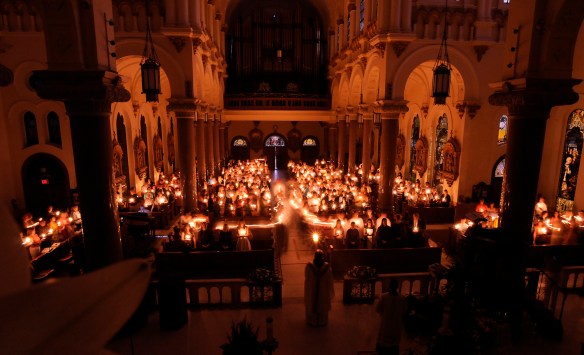 This Easter Vigil, the “homily” is presented in a different way. We chose to have an introduction before each Old Testament Reading that began to thematically weave together the homily message and then conclude during the homily proper. The picture above is our church during the procession of light. A reminder of the richness of the Vigil liturgy.
  friarmusings