
It seems to me that if we have been attentive and following all the events of Holy Week, it is possible to discern a play written in three acts. The curtain rises with a prelude: an intimate act of Mary anointing Jesus’ feet. An act rich in meaning and done in love. Then begins Act 1. It is a scene worthy of a large screen. Palm Sunday as the disciples and believers welcome Jesus into Jerusalem, the royal city, the long-awaited Messiah King.
Act 1 continues with a quiet scene, away from the bustling crowds of Passover, with a last meal with his closest friends and disciples. It is then, at the most sacred table fellowship of the Jewish faith, that Jesus shows the disciples the meaning of the proto-Eucharist just celebrated. On bended knee Jesus washes the feet of his disciples. It was an embodied parable of what it means to be a Eucharistic people: love and service. As the curtain falls on Act 1 and when we consider the meaning of Act 1, it is clear, it is love portrayed.
Continue reading
 The weekly bulletin and this column are a good thing. I enjoy writing; I enjoy the process of thinking about what I want to write, starting to write, and then sometimes watching the column take on a new direction of thought. Now and again by inspiration or necessity, I might write a whole month of columns or more at a go. Late in the month of February, I had produced pastor columns for the first weekend in March (First Sunday in Lent) all the way through and including Easter Sunday. Check that off the “to-do list.” Then life changed as the world declared a pandemic, the churches closed, and the world found out it was a lot safer to be at home. Some columns did not need to be redone: Unmasking (March 15) and the two columns on “Habits of the Heart” (March 22 and 29). When I made the decision to stay with them and not rewrite them in the light of these pandemic days, I thought that they were still appropriate to the moment at hand. In looking at the columns again this morning, it was a good decision.
  In Luke’ narrative there is no account of the Resurrection; there in only the empty tomb – which is not the source of faith for people in Luke’s rendering of the gospel. Rather, in Luke’s gospel it is the empty tomb
 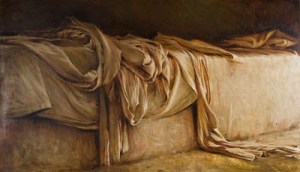 On the first day of the week, Mary of Magdala came to the tomb early in the morning, while it was still dark, and saw the stone removed from the tomb. So she ran and went to Simon Peter and to the other disciple whom Jesus loved, and told them, “They have taken the Lord from the tomb, and we don’t know where they put him.” So Peter and the other disciple went out and came to the tomb. They both ran, but the other disciple ran faster than Peter and arrived at the tomb first; he bent down and saw the burial cloths there, but did not go in. When Simon Peter arrived after him, he went into the tomb and saw the burial cloths there, and the cloth that had covered his head, not with the burial cloths but rolled up in a separate place. Then the other disciple also went in, the one who had arrived at the tomb first, and he saw and believed. For they did not yet understand the Scripture that he had to rise from the dead. (John 20:1-9)
  friarmusings