This coming Sunday we celebrate the Epiphany of the Lord. In yesterday’s post we took a first look at the Magi. Today we will take a second look. Continue reading
From the East
1

This coming Sunday we celebrate the Epiphany of the Lord. In yesterday’s post we took a first look at the Magi. Today we will take a second look. Continue reading
This coming Sunday we celebrate the Epiphany of the Lord. In yesterday’s post we set the context for the gospel reading and what seems to be Matthew’s narrative intent in unfolding the story of Jesus. In today’s post we will take a first look at the Magi. Continue reading
This coming Sunday we celebrate the Epiphany of the Lord. In yesterday’s post we noted the difference between Eastern and Western Christianity’s celebration of the solemnity. In today’s post we will set a little context for the gospel reading and what seems to be Matthew’s narrative intent in unfolding the story of Jesus. Continue reading
This coming Sunday western Christianity celebrates the Epiphany of the Lord. The word comes from the Greek epiphaneia meaning “manifestation” or, “striking appearance.” The feast had its origins in Easter Christian Churches and was a general celebration of the manifestation of the Incarnation of Jesus. Originally its scope was more broad. It was a celebration of a number of events in scripture that revealed Jesus to the world. Those events included: the commemoration of his birth; the visit of the Magi to Bethlehem; all of Jesus’ childhood events, up to and including his baptism in the Jordan by John the Baptist; and even the miracle at the Wedding of Cana in Galilee. Continue reading
“We three kings of Orient are. Bearing gifts we traverse so far, field and fountain, moor and mountain, following yonder star.” So begins one of our familiar Christmas carols. At the end of the gospel account we are simply told that warned in a dream left by another way, not returning to Jerusalem and King Herod. They came expecting to find a newborn child within the settings of the royal court. They found a child born among the poor on the margins of life. The followed the light of a star to come before the One for whom the first reading proclaims: “Nations shall walk by your light, and kings by your shining radiance.” (Is 60:3) Now that the magi have encountered the Light of Christ, how will they walk into their unfolding future? What light will mark the pathway of their lives? I wonder if they no longer looked to the night sky for direction in their lives, but somehow looked to the God of Abraham, Isaac and Jacob for how to live. What did their encounter with the Christ Child reveal to them? Continue reading
Today is the traditional day for the Solemnity of Epiphany. In another post, I provide all kinds of background about this day. It is a day that is called Epiphany, Theophany, and especially in Latino/Hispanic culture, Three Kings Day. No matter the moniker of the day, it is a day that something is revealed. But what? Continue reading
Today we celebrate The Epiphany of the Lord, traditionally celebrated on January 6th in the Eastern Catholic and Orthodox churches; but here in the West we celebrate it on a Sunday. So, welcome to our celebration of The Epiphany. It is a word taken from the Greek epiphaneia meaning “manifestation, striking appearance; from epiphanes meaning “manifest, conspicuous,” and from epiphainein “to manifest, display, show off; come suddenly into view.” Our liturgy marks the arrival of visitors, identified in Scripture as the magi, to the place where Jesus was born. Although we know virtually nothing about them, we do know they brought three gifts, each with traditional meanings. Continue reading
Next Sunday is the The Epiphany of the Lord. You can read a complete commentary on the Sunday Gospel here.
1 When Jesus was born in Bethlehem of Judea, in the days of King Herod, behold, magi from the east arrived in Jerusalem, 2 saying, “Where is the newborn king of the Jews? We saw his star at its rising and have come to do him homage.” 3 When King Herod heard this, he was greatly troubled, and all Jerusalem with him. 4 Assembling all the chief priests and the scribes of the people, he inquired of them where the Messiah was to be born. 5 They said to him, “In Bethlehem of Judea, for thus it has been written through the prophet: Continue reading
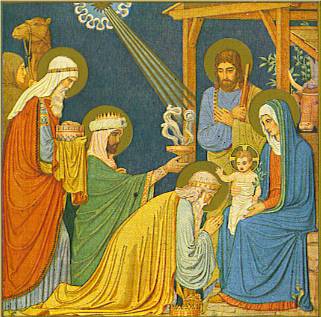 Last century (literally) I was researching for my master’s thesis on early Franciscan Missions. One of the really interesting aspects of the early Franciscan missions was the one to China. The friars arrived in China in 1292 and John of Montecorvino was the first bishop of Beijing. But all that is beside the point. In the course of my research, I ran across The Travels of Marco Polo in which he describes his travels in the far east. I was scanning the text to see if he had any mention of contact with the friars or the Christian monasteries that dotted the silk road in those days. While he had no mention of either – he did recount a most interesting rendition of the account of the Three Magi. Marco Polo wrote that he encountered this version in Persia (modern-day Iran). In that account there are three magi – but they are not traveling together. Each is on his own journey following the star to Bethlehem. Melchior is an older man, Balthazar is an adult in his middle years, and Gaspar is a young man just reaching adulthood.
 January 3rd is the day we typically call “Three Kings Day,” more formally known as The Epiphany. Epiphany is derived from a Greek word ἐπιφάνεια, epiphaneia, meaning “manifestation,” and refers, generally, to Jesus being manifested to the gentile visitors from the East. But in truth it is more complicated than that. What is striking is that there are a variety of liturgical celebrations and dates that are all part of our rich Catholic tradition surrounding “Epiphany.”
 friarmusings