
Love and Commandments

gospel_of_john_logo1Commentary. Jesus’ discourse (at this point) begins to move in a new direction by focusing on the ways in which belief in Jesus empowers the believing community (v.12 ff). Jesus has emphasized that the works he does are not his own but are the Father’s; now Jesus begins to emphasize the link between his works that of the believing community. Our gospel text describes two dimensions of the believer’s relationship with Jesus: (1) the inseparability of one’s love of Jesus and the keeping of his commandments (vv.15, 21, 23-24) and (2) the abiding and indwelling of the presence of God, even after Jesus’ death and departure with those who love him (vv.16-20, 22-23). Continue reading

Farewell: I am the way

Holy-Face-of-Jesus-23 I am the Way. In vv.6-11 we have the explanation the disciples seek. In v.6 there is a shift from the “where” (as in , “where you are going” – to the way to get there (“how can we known the way”). In response to this shift Jesus says “I am the way and the truth and the life.” This statement contains the sixth of seven ‘I am’ sayings with predicates in the Fourth Gospel (6:35, 48, 51; 8:12; 10:7, 9; 10:11, 14; 11:25; 14:6; 15:1, 5). Fundamental to Jesus’ response to Thomas’ question was that Jesus himself is the way (and it this context that Jesus is the truth and the life seem to be supporting statements). Continue reading

Farewell: I will come back again

 I will come back again…and show you the way.  Jesus’ coming back (v.3) has been variously interpreted:

  • his coming to the disciples following his resurrection (cf. 20:19–29);
  • his coming in the person of the Holy Spirit (cf. 14:15–21);
  • his second coming at the end of this age (cf. 14:28; 21:22–23; parousia); and
  • his ‘coming’ to take his disciples to be with him when they die. (This suggestion, comforting though it is to think of Christ ‘coming’ for us when we die, is not something that receives any support in this passage.)

Continue reading

Farewell: in my Father’s house

art by Janet Pfeiffer

art by Janet Pfeiffer

In my Father’s House 2 In my Father’s house there are many dwelling places. If there were not, would I have told you that I am going to prepare a place for you? 3 And if I go and prepare a place for you, I will come back again and take you to myself, so that where I am you also may be

Verse 2 also has some translation options: “In my Father’s house [oikia] there are many dwelling places [monai].”Should oikia be translated “house,” i.e., a physical structure (as in 11:31 & 12:3);”household,” i.e., a community of people (as in 4:53 & 8:35)?; or even “family” – all of which are valid translations [EDNT 2:495]. Often people immediately think of the King James’ translation: “In my Father’s house there are many mansions.” – which immediately moves one thoughts and reference to heaven. Is this the intention of this passage? Continue reading

Behold the Lamb of God: context

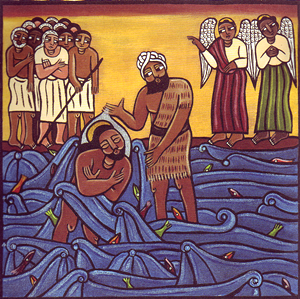
Baptism-JesusJohn 1:29-34 29 The next day he saw Jesus coming toward him and said, “Behold, the Lamb of God, who takes away the sin of the world. 30  He is the one of whom I said, ‘A man is coming after me who ranks ahead of me because he existed before me.’ 31 I did not know him, but the reason why I came baptizing with water was that he might be made known to Israel.” 32 John testified further, saying, “I saw the Spirit come down like a dove from the sky and remain upon him. 33 I did not know him, but the one who sent me to baptize with water told me, ‘On whomever you see the Spirit come down and remain, he is the one who will baptize with the holy Spirit.’ 34  Now I have seen and testified that he is the Son of God.”

Context. In the prologue the Fourth Evangelist presented John as “a man sent from God” who “came for testimony, to testify to the light, so that all might believe through him. He was not the light, but came to testify to the light.” (John 1:6-8; see also 1:15; and later 5:33) This opening characterization sets the stage for the narration of John’s ministry in 1:19–34. John’s identity is further probed when he is called to account by a delegation sent by the Jewish leaders in Jerusalem. Three times John denies being a particular end-time figure: the Christ (1:20; cf. 1:8, 15); Elijah (1:21a); the Prophet (1:21b; cf. 6:14; 7:40; cf. Deut. 18:15, 18). Continue reading