 Love Means…. What? Although the Sermon on the Mount has already included an extensive section of Jesus’ teaching to his disciples on love as fundamental to the life of discipleship (5:21–48), in this concluding encounter with his opponents Matthew gives Jesus another opportunity to summarize the core of his teaching (as 7:12). There, the teaching was to his disciples; here, it is to his opponents, in the controversy situation showing his orthodoxy as an advocate of the whole of the Law and the Prophets. Since Matthew here focuses on the argumentative aspect of the scene, he does not develop the theological issues that interest the contemporary interpreter (cf. Luke, who relocates the passage, 10:25–28): (1) the meaning of “love,” (2) the meaning of “neighbor,” and (3) the meaning of Jesus’ responding with two commands.
While Jesus quotes two OT passages (Deuteronomy 6:5; Leviticus 19:18), it is interesting that commentators offer different opinions about the relationship between these two commandments. Here is but a sample:
- Patte (The Gospel According to Matthew) writes: “… these two commandments remain distinct. They should not be identified with each other. Loving God should not be reduced to loving one’s neighbor! Loving God is an act of love distinct from loving one’s neighbor, and vice versa” [p. 314].
- Boring (Matthew, New Interpreters Bible) writes: “To love God is to love one’s neighbor, and vice versa (25:31-46)” [p. 426]
- Hare (Matthew, Interpretation Commentaries): “Truly to love God is to love the neighbor; truly to love the neighbor is to love God (cf. 1 John 4:20-21)” [p. 260].
All hold an insight. On one hand, I think that loving God means something different than just loving one’s neighbor. One can be a very kind, caring, philanthropic person without giving any thoughts or love to God. On the other hand, I don’t think that a believer can love God without loving neighbor and self, because God loves that neighbor too.
There are three basic Greek words for “love:” agapao/agape, phileo/philos, and eros. There is not always agreement among scholars about the distinction between these three choices. Boring, (Matthew The New Interpreters Bible) says that the words are synonymous — that agape is not necessarily a special word for “God-love”. He writes:
When Christians use the word love with reference to God, to the deepest human relationships, and of the stance they are to exercise toward the world, the content of this word is not to be filled in with supposed meaning of a special Greek word, but from an understanding of God’s nature made known in Christ. It is from this revelatory perspective that we come to know love as unmotivated and unmanipulated, unconditional and unlimited. Such love is not a matter of feeling, which cannot be commanded in any case, but of commitment and action. It is at the farthest pole from sentimentality and is related to the OT word for “covenant love” or “steadfast love” (hesed). [p. 425]
While there is merit to stress the nature and actions of God to give understanding to the word “love,” (i.e., it is God’s actions that give the content to agape, rather than a dictionary meaning of agape that defines God’s actions) and recognizing that the meanings of the three Greek works for “love” overlap — that is, they are partially synonymous, still there are different emphases or nuances in these three words. Given a continuum with “selflessness” on one end and “selfishness” on the other, most place agapao/agape towards the selfless end and eros towards the selfish end with phileo/philos in the middle.
Agapao/agape are words that tend to center on actions (not emotions) towards other people. Eros is a word that tends to center on emotional/sexual actions or feelings that please one’s self. Phileo/philos are words that tend to center on actions and feelings that benefit both parties, e.g., friendships. Especially as a verb, agapao refers to “loving (or caring) actions towards other people for their benefit.” It is not primarily a word to describe one’s emotions, e.g., having warm feelings towards.
For a slightly different definition, Hare, (Matthew, Interpretation Commentaries) writes:
In an age when the word ‘love’ is greatly abused, it is important to remember that the primary component of biblical love is not affection but commitment. Warm feelings of gratitude may fill our consciousness as we consider all that God has done for us, but it is not warm feelings that Deut. 6:5 demands of us but rather stubborn, unwavering commitment. Similarly, to love our neighbor, including our enemies, does not mean that we must feel affection for them. To love the neighbor is to imitate God by taking their needs seriously. [p. 260]
Loving God then implies an attachment to God — a commitment that goes beyond personal, inward feelings. The same is implied towards the neighbor. Within the OT context of this commandment (Lv 19:17-18), neighbor referred to “kin”. (However, Lv 19:33-34) extends the love to “aliens” who reside among them.
Sources
- K. Beale and D. A. Carson, Commentary on the New Testament Use of the Old Testament (Grand Rapids, MI; Nottingham, UK: Baker Academic; Apollos, 2007)
- Eugene Boring, The Gospel of Matthew in The New Interpreter’s Bible, Vol. VIII (Nashville, TN: Abingdon Press, 1994)
- Warren Carter, Matthew and the Margins: A Sociopolitical and Religious Reading (Maryknoll, NY: Orbis Book, 2000)
- R.T. France, The Gospel of Matthew in the New International Commentary on the New Testament (Grand Rapids, MI: William B. Eerdman’s Publishing, 2007)
- R.T. France, Matthew: An Introduction and Commentary in the Tyndale New Testament Commentaries, Vol. 1, ed. Leon Morris (Downers Grove, IL: InterVarsity Press, 1989)
- Daniel J. Harrington, The Gospel of Matthew, vol. 1 of Sacra Pagina, ed. Daniel J. Harrington (Collegeville, MN: Liturgical Press, 1991)
- Arland J. Hultgren, The Parables of Jesus: A Commentary (Grand Rapids, MI: William B. Eerdman’s Publishing, 2000)
- Craig S. Keener, The Gospel of Matthew: A Socio-Rhetorical Commentary (Grand Rapids, MI: William B. Eerdman’s Publishing, 2009)
- Turner and D.L. Bock, Matthew and Mark in the Cornerstone Biblical Commentary, vol. 11 (Carol Stream, IL: Tyndale House Publishers, 2005)
Dictionaries
- David Noel Freedman, The Anchor Yale Bible Dictionary (New York: Doubleday, 1996)
- Gerhard Kittel, Gerhard Friedrich and Geoffrey William Bromiley, Theological Dictionary of the New Testament (Grand Rapids, MI: W.B. Eerdmans, 1995)
- Horst Robert Balz and Gerhard Schneider, Exegetical Dictionary of the New Testament (Grand Rapids, Mich.: Eerdmans, 1990)
Scripture: The New American Bible available on-line at http://www.usccb.org/bible/index.cfm

 In
In  “You shall love the Lord, your God, with all your heart, with all your soul, and with all your mind.” I think the human condition is that we fall short on the “all”. And that raises the question “do we love someone or want something more than we love God?” Tough question. But think how much time, energy and emotion we spend on other things. Seems to me that time, energy, and emotion poured into a relationship will give you some inkling of the degree to which you are in love. Consider what part of your day and week you give over to God in terms of time, energy and emotion.
 “You shall love the Lord, your God, with all your heart, with all your soul, and with all your mind.” Do we love someone or want something more than God? “Love more than God?” that doesn’t seem right, but then again, think how much time, energy and emotion we spend on other things. Seems to me that time, energy, and emotion into a relationship will give you some inkling of the degree to which you are in love. Take a minute and consider what part of your day and week you give over to God in terms of time, energy and emotion. Perhaps a simple measure of your being in love with God – or at least a way to think about it.
 This day’s
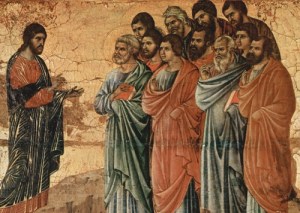
  “Teacher, which commandment in the law is the greatest?” He said to him, “You shall love the Lord, your God, with all your heart, with all your soul, and with all your mind. This is the greatest and the first commandment. The second is like it: You shall love your neighbor as yourself. The whole law and the prophets depend on these two commandments.” (Mt 22:36-40)
  friarmusings