
27 “When he established the heavens I was there, when he marked out the vault over the face of the deep; 28 When he made firm the skies above, when he fixed fast the foundations of the earth; 29 When he set for the sea its limit, so that the waters should not transgress his command; 30 Then was I beside him as his craftsman, and I was his delight day by day, Playing before him all the while, 31 playing on the surface of his earth; and I found delight in the sons of men.
Contextually, in contrast to vv. 22-26, which presented the panorama of the Lord’s creative actions in a movement from below to above, vv. 27–29 present them in the reverse direction, moving from the heavens (v. 27a) and its horizon (v. 27b) to the sky and clouds (v. 28a) downward to the fountains of the deep (v. 28b) and the seashores (v. 29b) and finally to the foundations of the earth (v. 29b). Thematically, Wisdom represents the Lord as firmly establishing the cosmic entities that both sustain and threaten human existence. In both sections (vv. 24–27 and 27–29), however, the earth as the realm of human life is the aim of the presentation. All the metaphors for creation in vv. 27–29 signify that each of the cosmic entities on which human life depends are so firmly fixed within the created order that they cannot overreach themselves or be transgressed by another. Were it otherwise, the cosmos would crumble into chaos. Humanity’s physical existence depends on a firmly structured universe. The Lord’s fixed created order serves as a model of his fixed moral boundaries for human beings to prevent society from collapsing into anarchy.
Continue reading
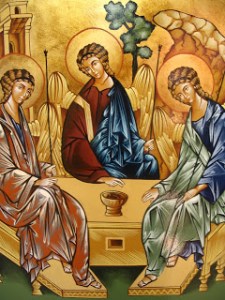
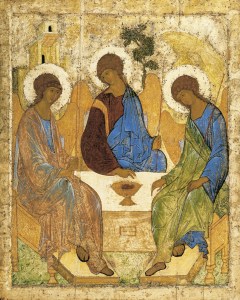 Holy Trinity Sunday. On Trinity Sunday, we are called to reflect with joy and thanksgiving what the Father, Son and Holy Spirit have done to bring about redemption and the possibility of salvation for all. We celebrate to respond to the love God has shown for us, praising Him, and giving Him glory. We that we were created in the image of God, saved by God despite our sins, and our journey in this life is accompanied by God at each moment. It is a celebration and invitation to share the inner life of the Trinity.
  Years ago, while a Franciscan novice, my fellow friars and I attended a gathering of all the Franciscan novices, men and women, who lived in the Eastern United States. During our week-long gathering, each group was responsible for leading morning or evening prayer or animating the Eucharistic celebration. One morning, a group of Franciscan sisters was responsible for morning prayer. Just before we were to begin, the leader of prayer explained that we would not be using the traditional words associated with the sign of the Cross. Rather, we would say “In the Name of the Creator, the Redeemer, and the Sanctifier.” She explained this was a way to remove the gender bias from the opening of prayer and to make all feel welcomed.
  friarmusings