Stories of Friday abstinence

The capybara is the largest member of the rodent family. Abundant over much of northern and central South America, this plump, pig-sized cousin of the sewer rat spends much of its time in the water, foraging for food (mostly aquatic grasses) and protecting itself from predators like jaguars in wetland areas and semi-flooded savannahs. Its webbed feet and easy-dry fur make its semi-aquatic life easier to manage, and it is still possible to encounter herds of up to 40 capybaras in many South American countries. They’ve even showed up as an invasive species in Florida’s endless wetlands. Continue reading

Stories of Friday abstinence

The capybara is the largest member of the rodent family. Abundant over much of northern and central South America, this plump, pig-sized cousin of the sewer rat spends much of its time in the water, foraging for food (mostly aquatic grasses) and protecting itself from predators like jaguars in wetland areas and semi-flooded savannahs. Its webbed feet and easy-dry fur make its semi-aquatic life easier to manage, and it is still possible to encounter herds of up to 40 capybaras in many South American countries. They’ve even showed up as an invasive species in Florida’s endless wetlands. Continue reading

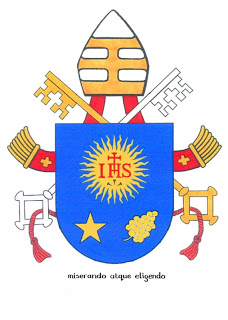
Pope Francis: Papal Coat of Arms

Pope Francis’ Coat of Arms

PopeFrancisCoatArmsPope Francis’ papal coat of arms are the same that he used as bishop. The shield has a bright blue background, at the center top of which is a yellow radiant sun with the IHS christogram representing Jesus (it is also the Jesuit logo). The IHS monogram, as well as a cross that pierces the “H”, are in red with three black nails directly under them. Under that, to the left, is a star representing Mary, Mother of Christ and the Church. To the right of the star is a spikenard flower representing Joseph, Patron of the Universal Church. With these symbols the Pope demonstrates his love for the Holy Family. Continue reading

What was theirs to do

The church’s liturgical calendar marks today as commemorating “St. Paul Miki and Companions.” Paul Miki, a native Japanese convert to Catholicism and a member of the Society of Jesus, was among twenty-six religious and lay missionaries who were sentenced to death by the Emperor of Japan. Miki and two Jesuits were martyred on February 5, 1597, but they were not the only ones martyred that day. There were twenty-three others, all of whom were Franciscans – some members of the First Order (Franciscan friars) and others members of the Third Order (Secular Franciscans). Several of the Franciscans were later canonized as saints: Peter Baptist, Martin of the Ascension, Francis Blanco, Philip of Jesus, Gonsalvo Garzia, and Francis of St. Michael.

“St. Paul Miki and Companions.”  Too often we never ask about or remember the “companions.”  In this commemoration, the seventeen lay people who gave their lives for Christ and their trust in Him.

So, yes the Jesuits and Franciscans celebrate their brethren, but even more importantly let us give thanks for the lay women and men whose work on behalf of others – schools, and hospitals, and activities in support of the poor and hungry.  All were active doing what was theirs to do.