
 1 He came to Jericho and intended to pass through the town. 2 Now a man there named Zacchaeus, who was a chief tax collector and also a wealthy man, 3 was seeking to see who Jesus was; but he could not see him because of the crowd, for he was short in stature. 4 So he ran ahead and climbed a sycamore tree in order to see Jesus, who was about to pass that way. 5 When he reached the place, Jesus looked up and said to him, “Zacchaeus, come down quickly, for today I must stay at your house.” 6 And he came down quickly and received him with joy. 7 When they all saw this, they began to grumble, saying, “He has gone to stay at the house of a sinner.” 8 But Zacchaeus stood there and said to the Lord, “Behold, half of my possessions, Lord, I shall give to the poor, and if I have extorted anything from anyone I shall repay it four times over.” 9 And Jesus said to him, “Today salvation has come to this house because this man too is a descendant of Abraham. 10 For the Son of Man has come to seek and to save what was lost.” Continue reading
When salvation comes: context
Reply
 Luke 23:47 The centurion who witnessed what had happened glorified God and said, “This man was innocent beyond doubt.” 48 When all the people who had gathered for this spectacle saw what had happened, they returned home beating their breasts; 49 but all his acquaintances stood at a distance, including the women who had followed him from Galilee and saw these events. 50 Now there was a virtuous and righteous man named Joseph who, though he was a member of the council, 51 had not consented to their plan of action. He came from the Jewish town of Arimathea and was awaiting the kingdom of God. 52 He went to Pilate and asked for the body of Jesus. 53 After he had taken the body down, he wrapped it in a linen cloth and laid him in a rock-hewn tomb in which no one had yet been buried. 54 It was the day of preparation, and the sabbath was about to begin. 55 The women who had come from Galilee with him followed behind, and when they had seen the tomb and the way in which his body was laid in it, 56 they returned and prepared spices and perfumed oils. Then they rested on the sabbath according to the commandment.
  It is a sometimes very difficult pastoral situation, when a person has been truly wronged by the events that have unfolded with in a marriage, and I know that ultimately – in one form or another – I will let the person know that there are no innocent parties. Indeed some are infinitely more innocent, but in the end there is rarely complete innocence.
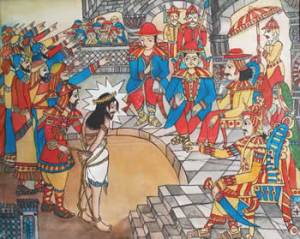 Alan Culpepper commented that reading the arrest and trials of Jesus is, for him, like watching film footage of John Kennedy’s motorcade winding through Dallas in 1963 or the 1986 launch of the Challenger space shuttle. We know what is coming, we know we have no power to undo them, but are compelled to watch because we honor the loss of great people doing what was theirs to do.
 The arrest of Jesus leads into three successive and connected scenes: Peter’s denial (vv. 54-62), the mocking of Jesus (vv. 63-65), and the trial before the religious authorities (vv. 66-71). What is interesting is that in the midst of the Passion narrative of Jesus, there is the scene in all four gospels that concentrate on Peter and his response. Luke’s account is unique in the following respects: sequence – in that the denials occur in the courtyard before the mocking and interrogation; structure – Luke does not connect the denial as a caused by the trial; and detail – such as the servant girl sitting at the fireside where there is light to clearly recognize Peter – and most vividly, it is Luke that reports Jesus looked Peter “dead in the eye,” bringing the full gravitas of the denials to Peter.
  Of course we all know that after the meal with his disciples that Jesus went to the Garden of Gethsemane. Actually, no gospel says that. Matthew and Mark wrote that he went to a garden. John says he went to Gethsemane. Fuse them all together and you get the “Garden of Gethsemane.” What does Luke say? Luke only calls it “the place.” There is no garden specifically mentioned nor is Gethsemane. Is it important? Well, it is a reminder to be attentive to the text before you and not meld the familiar stories and scenes from other sacred writers. Each sacred writer has something distinctive that can be missed if one fuses all the details from other accounts.
 “Are you Jesus?” It is a question I get asked on occasion, most often because of the Franciscan habit that I wear. Lots of times the question comes from small children. Their picture books show Jesus in his robes and then they see me. I suspect the question is more about my Franciscan robes. Maybe on my good days it is about me. Maybe, just maybe there was a moment when I was Jesus for them.
 friarmusings