Behold the Lamb of God: context

Baptism-JesusJohn 1:29-34 29 The next day he saw Jesus coming toward him and said, “Behold, the Lamb of God, who takes away the sin of the world. 30  He is the one of whom I said, ‘A man is coming after me who ranks ahead of me because he existed before me.’ 31 I did not know him, but the reason why I came baptizing with water was that he might be made known to Israel.” 32 John testified further, saying, “I saw the Spirit come down like a dove from the sky and remain upon him. 33 I did not know him, but the one who sent me to baptize with water told me, ‘On whomever you see the Spirit come down and remain, he is the one who will baptize with the holy Spirit.’ 34  Now I have seen and testified that he is the Son of God.”
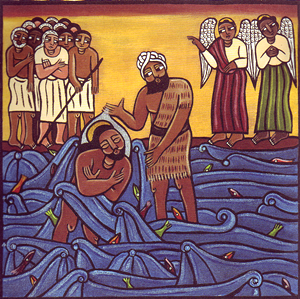
Context. In the prologue the Fourth Evangelist presented John as “a man sent from God” who “came for testimony, to testify to the light, so that all might believe through him. He was not the light, but came to testify to the light.” (John 1:6-8; see also 1:15; and later 5:33) This opening characterization sets the stage for the narration of John’s ministry in 1:19–34. John’s identity is further probed when he is called to account by a delegation sent by the Jewish leaders in Jerusalem. Three times John denies being a particular end-time figure: the Christ (1:20; cf. 1:8, 15); Elijah (1:21a); the Prophet (1:21b; cf. 6:14; 7:40; cf. Deut. 18:15, 18). Continue reading

The Baptism of Jesus – Why?

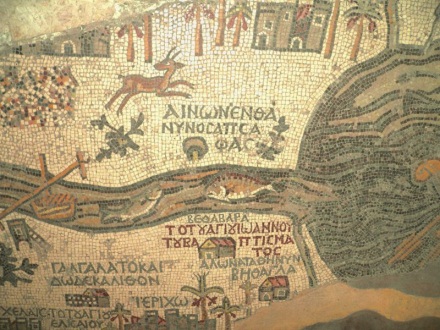
Part of the ancient Madaba Map showing two possible locations of Jesus’ baptism

Part of the ancient Madaba Map showing two possible locations of Jesus’ baptism

Did you ever wonder why Jesus was baptized? This event is recorded in the Canonical Gospels of Matthew, Mark, and Luke. In John 1:29-33, rather than a direct narrative, John the Baptist bears witness to the episode. Here is a part of the Lucan narrative (Luke 3:21–22):21 After all the people had been baptized and Jesus also had been baptized and was praying, heaven was opened 22 and the Holy Spirit descended upon him in bodily form like a dove. And a voice came from heaven, “You are my beloved Son; with you I am well pleased.”

Continue reading

Baptism of the Lord: meaning

English: Baptism of JesusMatthew 3: 13 Then Jesus came from Galilee to John at the Jordan to be baptized by him. 14 John tried to prevent him, saying, “I need to be baptized by you, and yet you are coming to me?” 15 Jesus said to him in reply, “Allow it now, for thus it is fitting for us to fulfill all righteousness.” Then he allowed him. 16 After Jesus was baptized, he came up from the water and behold, the heavens were opened (for him), and he saw the Spirit of God descending like a dove (and) coming upon him. 17 And a voice came from the heavens, saying, “This is my beloved Son, with whom I am well pleased.”

The First Temptation of Christ. Brian Stoffregen has an interesting insight about righteousness as “do, perform” what God requires of us.

John, by trying to prevent the baptism, tempts Jesus not to do all that God requires of him. He tempts Jesus to assume his proper position now: to be the more powerful one; to baptize with the judgmental Holy Spirit and fire; to meet John’s need. I don’t think that these are too dissimilar to the devil’s temptations that occur immediately after the baptism (4:1-11) — temptations for Jesus to use his power now, for his own glory; and avoid his emptying and eventually the pain and suffering of the cross.

Continue reading

Baptism of the Lord: fulfillment

Baptism of Christ. Jesus is baptized in the Jo...Matthew 3: 13 Then Jesus came from Galilee to John at the Jordan to be baptized by him. 14 John tried to prevent him, saying, “I need to be baptized by you, and yet you are coming to me?” 15 Jesus said to him in reply, “Allow it now, for thus it is fitting for us to fulfill all righteousness.” Then he allowed him. 16 After Jesus was baptized, he came up from the water and behold, the heavens were opened (for him), and he saw the Spirit of God descending like a dove (and) coming upon him. 17 And a voice came from the heavens, saying, “This is my beloved Son, with whom I am well pleased.”

John and Jesus in Dialogue.  As John the Baptist mysteriously appeared in the wilderness, so too Jesus. John appeared proclaiming: “Repent, for the kingdom of heaven is at hand” (3:2).  It was a very public appeal to which people responded: “Jerusalem, all Judea, and the whole region around the Jordan were going out to him and were being baptized by him in the Jordan River as they acknowledged their sins” (3:5–6.) Jesus appears on the scene and Matthew makes it clear that Jesus’ purpose is to be baptized by John (v.13). Continue reading

Baptism of the Lord: context

The baptism of Jesus by John the baptist, as i...Matthew 3: 13 Then Jesus came from Galilee to John at the Jordan to be baptized by him. 14 John tried to prevent him, saying, “I need to be baptized by you, and yet you are coming to me?” 15 Jesus said to him in reply, “Allow it now, for thus it is fitting for us to fulfill all righteousness.” Then he allowed him. 16 After Jesus was baptized, he came up from the water and behold, the heavens were opened (for him), and he saw the Spirit of God descending like a dove (and) coming upon him. 17 And a voice came from the heavens, saying, “This is my beloved Son, with whom I am well pleased.”

Context. The story of Jesus in Matthew 3:1–4:16 is bracketed by John the Baptist’s ministry.

  • In those days John the Baptist appeared, preaching in the desert of Judea (and) saying, “Repent, for the kingdom of heaven is at hand!” (3:1-2).
  • From that time on, Jesus began to preach and say, “Repent, for the kingdom of heaven is at hand.” (4:17)

John prepared the way for Jesus and his ministry. Where John’s proclamation is that the kingdom is “right around the corner,” Jesus announces that the kingdom is here in the person of the Messiah, the Son of God.  The “inauguration” of the in-breaking of the kingdom (kairos) into Time (chromos) occurs at the baptism of Jesus which serves as the occasion for the coming of the Spirit and the Father’s approval of his beloved son. Continue reading

Where is the Joy?

counting joy

It is Gaudete Sunday. The name comes from wording in Philippians 4:4 – Rejoice in the Lord always. I shall say it again: rejoice! While there is evident joy in the first readings and the Psalm, and a call for patience in the second reading, the gospel is not one that I would immediately connect with joy.  It seems to me this is a Sunday whose very name asks us, “What gives you joy?  What is the source of joy in your life?”  A good question. Continue reading

For Whom Are You Looking: a final thougth

Matthew 11:2-11. 2 When John heard in prison of the works of the Messiah, he sent his disciples to him 3 with this question, “Are you the one who is to come, or should we look for another?” 4 Jesus said to them in reply, “Go and tell John what you hear and see: 5 the blind regain their sight, the lame walk, lepers are cleansed, the deaf hear, the dead are raised, and the poor have the good news proclaimed to them. 6 And blessed is the one who takes no offense at me.” 7 As they were going off, Jesus began to speak to the crowds about John, “What did you go out to the desert to see? A reed swayed by the wind? 8 Then what did you go out to see? Someone dressed in fine clothing? Those who wear fine clothing are in royal palaces. 9 Then why did you go out? To see a prophet? Yes, I tell you, and more than a prophet. 10 This is the one about whom it is written: ‘Behold, I am sending my messenger ahead of you; he will prepare your way before you.’ 11 Amen, I say to you, among those born of women there has been none greater than John the Baptist; yet the least in the kingdom of heaven is greater than he..

Some Final Thoughts. Within the narrative of Matthew, John the Baptists helps establish the identity of Jesus – something especially key during the Advent Season. “Whose birth are we preparing for, anyway?”  And this is as important a question for us in our day as it was in the life and time of John the Baptist. Continue reading

For Whom Are You Looking: the herald

Jesus meets John the Baptist


The Third Sunday of Advent


Matthew 11:2-11. 2 When John heard in prison of the works of the Messiah, he sent his disciples to him 3 with this question, “Are you the one who is to come, or should we look for another?” 4 Jesus said to them in reply, “Go and tell John what you hear and see: 5 the blind regain their sight, the lame walk, lepers are cleansed, the deaf hear, the dead are raised, and the poor have the good news proclaimed to them. 6 And blessed is the one who takes no offense at me.” 7 As they were going off, Jesus began to speak to the crowds about John, “What did you go out to the desert to see? A reed swayed by the wind? 8 Then what did you go out to see? Someone dressed in fine clothing? Those who wear fine clothing are in royal palaces. 9 Then why did you go out? To see a prophet? Yes, I tell you, and more than a prophet. 10 This is the one about whom it is written: ‘Behold, I am sending my messenger ahead of you; he will prepare your way before you.’ 11 Amen, I say to you, among those born of women there has been none greater than John the Baptist; yet the least in the kingdom of heaven is greater than he.


Jesus’ View of John. John’s preaching had created a sensation (see 3:5), and the movement into the wilderness had been a remarkable phenomenon. Jesus now examines its motives, to show the real significance of John. The series of three questions and answers suggests motives progressively closer to a true understanding of John. A reed shaken by the wind is a metaphor for a weak, pliable person; John was not such a person, and the implied answer is ‘Of course not’. It was John’s rugged independence which attracted a following. Nor was he dressed in fine clothing; far from it, as 3:4 shows. It was as a man conspicuously separate from the royal palace that attracted them. (There may be an ironical reference to his present residence in a ‘royal palace’—as a prisoner of conscience in Herod’s fortress) His rough clothing in fact points to his real role, as a prophet (see 3:4), and the crowds would gladly have accepted this description of John. But even that is not enough. Continue reading

For Whom Are You Looking: tell what you see and hear

Icon of Jesus Christ from the Cathedral of Hag...


The Third Sunday of Advent


Matthew 11:2-11. 2 When John heard in prison of the works of the Messiah, he sent his disciples to him 3 with this question, “Are you the one who is to come, or should we look for another?” 4 Jesus said to them in reply, “Go and tell John what you hear and see: 5 the blind regain their sight, the lame walk, lepers are cleansed, the deaf hear, the dead are raised, and the poor have the good news proclaimed to them. 6 And blessed is the one who takes no offense at me.” 7 As they were going off, Jesus began to speak to the crowds about John, “What did you go out to the desert to see? A reed swayed by the wind? 8 Then what did you go out to see? Someone dressed in fine clothing? Those who wear fine clothing are in royal palaces. 9 Then why did you go out? To see a prophet? Yes, I tell you, and more than a prophet. 10 This is the one about whom it is written: ‘Behold, I am sending my messenger ahead of you; he will prepare your way before you.’ 11 Amen, I say to you, among those born of women there has been none greater than John the Baptist; yet the least in the kingdom of heaven is greater than he..


Commentary. The Baptist, whose proclamation introduced Matthew’s presentation of the Messiah (3:1–12), is now appropriately called as the first witness to the meaning of Jesus’ ministry. Yet John’s response is equivocal, positive but uncertain. Nonetheless his is a preparatory role for the true time of fulfillment. John remains the one who points forward, even if uncertain. Continue reading

For Whom Are You Looking: Context

Icon of Jesus Christ from the Cathedral of Hag...

The Third Sunday in Advent

Matthew 11:2-11. 2 When John heard in prison of the works of the Messiah, he sent his disciples to him 3 with this question, “Are you the one who is to come, or should we look for another?” 4 Jesus said to them in reply, “Go and tell John what you hear and see: 5 the blind regain their sight, the lame walk, lepers are cleansed, the deaf hear, the dead are raised, and the poor have the good news proclaimed to them. 6 And blessed is the one who takes no offense at me.” 7 As they were going off, Jesus began to speak to the crowds about John, “What did you go out to the desert to see? A reed swayed by the wind? 8 Then what did you go out to see? Someone dressed in fine clothing? Those who wear fine clothing are in royal palaces. 9 Then why did you go out? To see a prophet? Yes, I tell you, and more than a prophet. 10 This is the one about whom it is written: ‘Behold, I am sending my messenger ahead of you; he will prepare your way before you.’ 11 Amen, I say to you, among those born of women there has been none greater than John the Baptist; yet the least in the kingdom of heaven is greater than he.

Context. The “works of the Christ” (Mt 11:2), which have been set out in chapters 5–10, provoked different responses from different groups. These responses, most of which consist of misunderstanding if not outright rejection, are examined in chapters 11–12, and explained in the parables of chapter 13. Further examples of the response to Jesus will occur in chapters 14–16, until the true response is found in Peter’s confession in 16:13–20, which will bring the second main part of Matthew’s Gospel to its climax. This is the thread which runs through these chapters. Through them we are led from a view of Jesus as others saw him to the true confession of him as Messiah which eluded most of his contemporaries, conditioned as they were by erroneous or inadequate ideas of the Messiah. Continue reading
