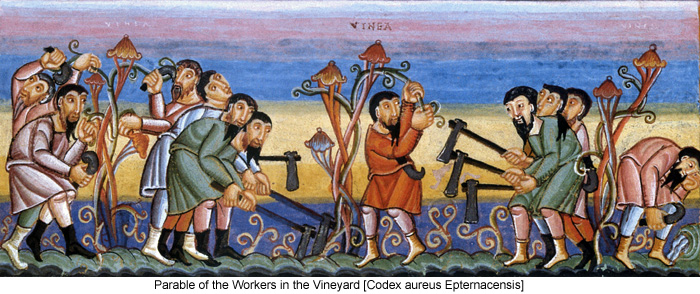
How many times have you heard today’s Gospel of the landowner who went out to hire laborers for his vineyard? Sometimes the homily focuses on a contrast between God’s generosity and our sense of fairness. Sometimes the theme is ‘it’s never too late’. Both are good insights about the parable. At some level we can all relate to the workers that were there at the crack of dawn and worked all day. It is not just that expectations were raised when they heard that those who had just arrived, had not borne the heat of the day, and received the usual wage for the whole day. But when they realized there was no bonus, I think they wondered if all they did and endured had meaning. There is a lot to ponder.
And that is exactly the purpose of each of Jesus’ parables. They are meant to draw us into the scene, to associate with one of the characters. So… what character might you play in the scene? Are you part of the early morning, up-and-at-’em crew? The 9 am crew? The noon crew? Or maybe the end of the day crew?
And what about the end-of-the-day crew? Day labor was a common way to earn a living wage in 1st century Israel. Depending on the circumstances, it might be the difference between food for the family or not on that particular day. Imagine if that were your situation. You’ve been there all day. No one has hired you and suddenly at day’s end you’re hired. And more than that, you receive a full day’s wage. After a day of anxiety, suddenly there is an unexpected blessing. I hope they paused and gave thanks to God for the fortune and blessing – especially at so late an hour.
ANd what about you? You’re here at Mass. After my six years here, I recognize lots of you as regulars. I know names and faces. I even know your regular pews. You take your faith life seriously. You’ve been coming to Mass all your life. You’ve sacrificed, followed the rules, and served the parish. The same attributes can translate to your place of work, your career, your family of origin.
After the Navy I joined a company that was 1-2 years from startup. It had grown to be a multimillion dollar consulting firm. While most of the work was in the DoD-sector, I was part of a commercial technology group that was growing fast and was very profitable. About six years later a senior executive was hired. Three months later the company was bought in a private equity deal. It was the payday we’d worked for…and the rumors about the new guy swept the company. Rumors had it that he did really well. You can imagine the reaction. He had not borne “the day’s burden and the heat.” A strange combination to be rewarded, “but”… at the same time. All that we did and endured, was it just “business” or did it have meaning?
Imagine you are one of five adult children. You live near your aging parents and are the only one who supports and cares for them. Your siblings live far away, have exciting lives, travel abroad and always promise to help “next time.” And next time never seems to come. Then as the parent’s health begins to seriously fail and the end is near, they all arrive. Your parents are so excited to see them and all the parental attention is focused on them. You love your siblings but you feel shunted aside. All that you did and endured, did it have meaning?
We are like the early worker, the parent, the dutiful child, the parishioner who say they have borne “the day’s burden and the heat.” All of the roles we fulfill in life have the potential to place us right there with the beginning-of-the-day crew.
The readings today ask us to focus on our life outside and inside the Church. The parable is a call to answer, for yourself, the question whether all you’ve done and endured had meaning. It is a question for work, home, family, and your life of faith.
The senior executive made a windfall. But he did not have the shared experience of building the company. He did not enjoy the belonging and fellowship of the team. He went on to another company. So did we, our team went and started a new company and had the great reward of the new endeavor.
The siblings were there at the end and were able to say “goodby”. But they weren’t there for all the intimate moments when parents shared stories of growing up, family, dating, and their life before kids. You heard their dreams and joys. Priceless and filled with all the meaning in the world.
What about faith and Church? Underneath the “started at dawn” workers’ complaint is a question we rarely ask: was being in the vineyard all day really a disadvantage?” Do we believe that spending a lifetime knowing Christ, receiving the Eucharist, experiencing forgiveness, belonging to his people, and having the hope of eternal life was somehow the harder deal? That’s when we need to remind ourselves that it has all been a grace and a privilege to receive: unearned, undeserved, but freely given. It is replete with meaning.
Maybe then we begin to understand what it means to work in the vineyard. The years we have spent following Christ were never wages we earned. They were themselves a gift. The Eucharists we have received, the sins forgiven, the prayers answered, and even the prayers we are still waiting to have answered, the people who have accompanied us in faith, the hope that has carried us through difficult days: all of that, that was the vineyard. It comprises the vineyard.
So when the five-o’clock worker finally arrives, perhaps our response should not be, “Why does he get what I get?” Perhaps it should be, “Thank God he finally made it into the vineyard. And thank God I have been here all along.”
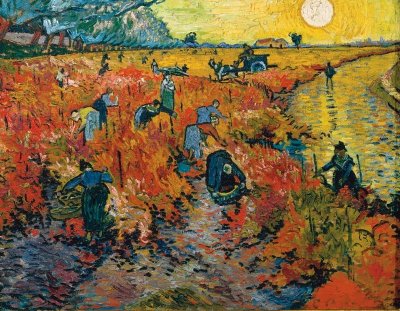
Image credit: Red Vineyards at Arles | Vincent Van Gogh, 1888 | PD from wikiart.org
 In the well known parable of