
Standing in Hope

Over the last several weeks as we near the end of the liturgical year, the Church has chosen readings that are quite apocalyptic. The readings from the Book of Daniel and the gospels – are they meant to scare us into fearful compliance with the demands of God? The imagery easily serves as a source of all manner of end times predictions of death, doom and despair. Yet, that is not the reason why the Church selected these readings. What is common to all the apocalyptic texts is the final triumph of God. We are called to turn our eyes toward the final triumph of God and to recall where our hope truly lies.

Daniel lived in chaotic times. We live in chaotic times. Think of the past year: wars in Ukraine, Gaza and Israel, Syria, Myanmar, Sudan, Yemeni, Haiti, Ethiopia, Rwanda, and Congo – and those are state actors. There are all kinds of conflicts among non-state actors. Sabre rattling, trade wars, the war on drugs, gun violence, political acrimony reaching ever new levels of accusation and calumny.

There’s a word you don’t hear much. Calumny: the act of maliciously misrepresenting someone’s conduct to harm that person’s reputation. There are days when I think the majority of political party statements are calumnious in their nature.  

In Daniel’s vision the chaos arose from the sea, the usual source of such Old Testament beasts. In Scripture, the sea represents chaos, evil, and the forces that oppose God. The beasts symbolize earthly political and military empires – violent, unstable, rising and falling with history. And yet, after all the terrifying beasts, Daniel suddenly says: “As the visions during the night continued, I was watching and saw one like a Son of Man coming… He received dominion, glory, and kingship” (Dan 7:13–14).

This is the heart of the reading: human kingdoms rise and fall, but God’s kingdom, given to the Son of Man, endures forever. Daniel and all the prophets remind us that the last word is not chaos, but Christ and the Kingdom.

It is easy to be mesmerized by the chaos. It is like watching a tornado; we just can’t seem to look away. In the Gospel Jesus uses the fig tree to remind us to learn to see God at work: “When you see it put forth leaves, you know that summer is near. In the same way, when you see these things happening, know that the kingdom of God is near” (Lk 21:30-31). Jesus is telling us to read the signs, to learn how God works in our lives.

The fig tree does not leaf out suddenly. It happens quietly, gradually, almost unnoticed. The same way God’s grace unfolds in our lives. It is there amidst the chaos in a world full of noise, fear, and “beasts” of every kind such as division, conflict, sin, moral and confusion. Mixed right in with signs of His presence: acts of charity, the persistence of faith, forgiveness offered, hope renewed and much more.

Tornadoes demand our attention. Signs of the kingdom demand no such thing but patiently wait to be noticed.

Like the first reading, the gospel is a call to hopeful watchfulness. Daniel says: “Do not be afraid of the beasts; God remains King.” Jesus says: “Watch with faith; the Kingdom is already blossoming.”

Each reading proclaims: no matter how dark the world seems, God’s Kingdom is closer than we think. It is already growing, becoming, patiently waiting for us to spread its borders. “Heaven and earth will pass away, but my words will not pass away” (Lk 21:33).

Empires pass. Cultures pass. Trends pass. Even our worries pass. But Christ’s word, His promise, His presence – these do not pass away.

We can name the beast, the chaos and our fears. But where might we also see the first small leaves of the Kingdom God is quietly unfolding? We need not deny the reality of struggle. But we are not defined by it.

We are defined by the Son of Man who already reigns and who already draws near.


Image credit: Flevit super illam (He wept over it) | Enrique Simonet (1892) | Museo del Prado, Madrid | Wikimedia Creative Commons | PD-US
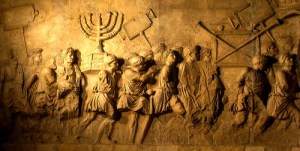
The Fall of Jerusalem

The gospel for this coming Sunday, 33rd Sunday in Ordinary Time, is Jesus’ mini-apocalyptic message about the future of the Jerusalem Temple and the coming days. Throughout this week of posts we have considered St. Luke’s extended commentary on Jesus’ warning of the coming destruction of Jerusalem and its Temple. While our gospel reading ends at Luke 21:19, most commentaries include an additional five verses as part of the commentary

20 “When you see Jerusalem surrounded by armies, know that its desolation is at hand. 21 Then those in Judea must flee to the mountains. Let those within the city escape from it, and let those in the countryside not enter the city, 22 for these days are the time of punishment when all the scriptures are fulfilled. 23 Woe to pregnant women and nursing mothers in those days, for a terrible calamity will come upon the earth and a wrathful judgment upon this people. 24 They will fall by the edge of the sword and be taken as captives to all the Gentiles; and Jerusalem will be trampled underfoot by the Gentiles until the times of the Gentiles are fulfilled.

Continue reading

The Divine Plan for Discipleship

The gospel for this coming Sunday, 33rd Sunday in Ordinary Time, is Jesus’ mini-apocalyptic message about the future of the Jerusalem Temple and the coming days. In yesterday’s post we discussed what is essentially a “theology of history.” Today we focus on the preparation of the disciples for what is coming: the Kingdom of God even as the kingdom of men falls. But before all these things will come persecution. Disciples will need to stand prepared for its coming. “Before all this happens, however, they will seize and persecute you, they will hand you over to the synagogues and to prisons, and they will have you led before kings and governors because of my name.” (v.12) 

The bevy of verbs [seize (lit. lay hands on), persecute, hand you over, led before kings, etc.] are ones that are used again, not only of Jesus during his Passion, but also of the early disciples early in Acts and of St. Paul in the latter parts of Acts. Especially in Acts, these are all settings in which the disciples give witness and testimony. Luke strengthens the connection between Jesus and the following persecutions of the disciples.

Continue reading

Time and The Divine Plan

The gospel for this coming Sunday, 33rd Sunday in Ordinary Time, is Jesus’ mini-apocalyptic message about the future of the Jerusalem Temple and the coming days. In yesterday’s post we explored the passage in which Jesus predicts the destruction of the Temple and the listeners ask “Teacher, when will this happen? And what sign will there be when all these things are about to happen?” (Luke 21:7)

The broad scope of the question in v.7 is significant, since a judgment of Jerusalem that wipes out the temple suggests a time of great catastrophe and a turning point in the nation’s history and identity. Such an event can only signal that God’s plan for the nation is underway. Though Luke’s form of this question is more focused on the temple than the questions in Matthew 24:3 and Mark 13:4, its implications clearly cover the same span.

Continue reading

Portents, Signs and These Things

The gospel for this coming Sunday, 33rd Sunday in Ordinary Time, is Jesus’ mini-apocalyptic message about the future of the Jerusalem Temple and the coming days.. In yesterday’s post we explored the significance of the Temple in the mind and perspective of the Jewish people. Today we begin exploring the passage itself: While some people were speaking about how the temple was adorned with costly stones and votive offerings, he said, “All that you see here—the days will come when there will not be left a stone upon another stone that will not be thrown down.” 7 Then they asked him, “Teacher, when will this happen? (Luke 21:5-6)

When and by what Sign? In v.7 an unnamed interlocutor(s) asked Jesus, “Teacher, when will this happen? And what sign will there be when all these things are about to happen?” Given the introduction in v.5 where the disciples are mentioned, one assumes the disciples are the audience. But one should note that nowhere else in Luke do the disciples call Jesus “teacher.”  This is the eleventh time Jesus is so addressed and in none of the previous ten are the disciples the one addressing Jesus. Luke reserves the address “Teacher” as coming from the Pharisees, lawyers, the crowd, the rich, Sadducees, and scribes.  Given the larger context of Luke, it is more likely that while the disciples are present, Jesus is responding to those present in the Temple complex.

Be assured, Jesus tells them, these things are not permanent. The phrase these things (tauta) becomes central to the discourse, since the disciples ask in v.7: “what sign will there be when all these things are about to happen?” 

Continue reading

The Temple

The gospel for this coming Sunday, 33rd Sunday in Ordinary Time, is Jesus’ mini-apocalyptic message about the future of the Jerusalem Temple and the coming days. In yesterday’s post we set the stage for understanding the nature of the Lucan narrative that is our gospel reading. Today’s post explores the significance of the Jerusalem Temple, its history, and the potential impact of Jesus’ words: “All that you see here—the days will come when there will not be left a stone upon another stone that will not be thrown down.” 

The architectural entity known as the Jerusalem Temple was a complex institution. It played a central religious and cultic role in Israelite life, as well as functioning on a political level. It was a symbol of the national state of which Jerusalem was the capital during the pre-exilic period (Babylonian Exile), then of the semi-autonomous community of Judeans after the exile, and finally of the Jews who continued to live in Jerusalem and the surrounding territory, with sporadic periods of autonomy, in the centuries before its final destruction.

Continue reading

An optional deep dive

This post is a more detailed discussion regarding the nature of Luke’s third prediction of Jerusalem’s fall, a far more detailed speech (the others come in 13:34-35; 19:41-44). It is a bit of a deep dive beyond this morning’s post which included summary information. So, feel free to dive in …. or wait until we pick up the thread tomorrow morning.

The speech’s character emerges when one examines the parallels in Matthew 24:1-35 and Mark 13:1-37. A comparison of these parallels shows how Luke has drawn out some additional teaching and made some distinct points. Some of these points emerge from the additional material Luke includes (vv. 18, 21-22, 24, 28 are certainly additional material; vv. 19-20, 23b-26, 34-36 are probably additional). Other emphases surface because of the way Luke has presented the traditional material. Where Matthew speaks specifically of the “the desolating abomination” (Mt 24:15, referring to Daniel 12:11), for example, Luke simply refers to the “desolation” (Lk 21:20).

The significance of these differences becomes clear as one carefully compares the accounts. Luke emphasizes the destruction of Jerusalem in A.D. 70 in a way the other Gospels do not. Mark and Matthew anticipate the fall of Jerusalem in the way they introduce the discourse, but Luke focuses on the short-term event in a way Matthew and Mark do not. His temporal indicators (vv. 9, 12) draw the reader back toward the present before really focusing on the end in verses 25-28. A transition begins to appear in verses 20-24, but until verse 19 the focus is still on events before the judgment of the capital in A.D. 70, which is not yet the end.

Continue reading

Some Context for the End

This coming Sunday is the 33rd Sunday in Ordinary Time, Lectionary Cycle C. Two Sundays ago was the encounter with Zacchaeus in Jericho (Luke 19:1-10). This followed by Jesus’ parable of the ten gold coins (19:11-27) and Jesus’ entry into Jerusalem and the events of Palm Sunday (v.28). What follows has been a series of confrontations with the Jerusalem authorities in the Temple, an example of which was the previous Sunday gospel in which the Sadducees confronted Jesus around the topic of resurrection. The confrontation now shifts to the future tense. The extended dialogue concerns the:

  • coming persecutions and destruction of the Temple (21:5-19), our gospel reading;
  • destruction of the Jerusalem (21:20-24); and
  • coming of the Son of Man (21:25-36).

It is tempting to refer to these verses as St. Luke’s “little apocalypse,” given its similarity to the accounts in Mark and Matthew – and the ongoing fascination of evangelical American Christianity with the “end times” popularized by the “Left Behind” series of books and movies. Described in another post later this morning with more details for those interested, Luke’s account is different in that all the “temporal markers” in the telling are focused on the present. Luke reserves the future focus for later verses outside our gospel text. Up through verse 18 the focus remains on events before the judgment of the capital in A.D. 70, which is not yet the end. While there are apocalyptic elements, it is not the final words of Jesus, but an introduction to his suffering and death.

Continue reading

The temple within

In Jesus’ day there was one thing that dominated the skyline of Jerusalem – the Temple – easily seen from across the way on the Mount of Olives, hovering over the Old City, and visible from every balcony in the upper city. It wasn’t the original Temple, that had been destroyed some 600 years before by the armies of King Nebuchadnezzar and Babylon. This the second temple. Construction started about 520 years before Jesus’ time but it was King Herod the Great who make the temple a “wonder of the world.” While some people were speaking about how the temple was adorned with costly stones and votive offerings (Luke 21:5). Continue reading