
Being Complete

There is a contrast between our first reading and the gospel. In the first reading (Genesis 18:1–15) Abraham is praised for his generous hospitality to the three visitors who are often interpreted as angels or a theophany of God. In the gospel (Luke 10:38–42), Martha is busy serving Jesus but is gently corrected for being “anxious and worried” rather than sitting and listening to the Lord like Mary. It might raise the question: why is Abraham’s activity in service to the guests rewarded while Martha’s service to the guests is gently admonished? Let’s explore that question.

Abraham’s hospitality is framed as a model of ancient Near Eastern virtue. He rushes to provide water, organize bread, meat, and rest — crucial life-saving gestures in a desert setting. That is what Abraham offers. Did the visitors offer anything other than their presence? Yes, in the end they offer the divine promise of a son in response to that hospitality. The reading underscores the virtue of hospitality as a means to encounter God – and in the encounter to enter more deeply into the covenant promises and so step on the path to completeness.

Continue reading
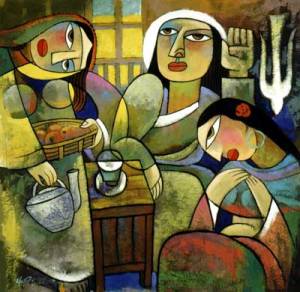
A Reflection: Rules and Boundaries

This coming Sunday is the 16th Sunday of Ordinary Time  and the story of Martha and Mary. In yesterday’s post we considered the gospel text and offered some thoughts about it as regards “place” in our culture. Today we offer a final reflection on this passage.

Part of Culpepper’s (Luke, New Interpreter’s Bible, 232) final “Reflections:”

In its own way, the conjunction of the stories about the good Samaritan and the female disciple voices Jesus’ protest against the rules and boundaries set by the culture in which he lived. As they develop seeing and hearing as metaphors for the activity of the kingdom, the twin stories also expose the injustice of social barriers that categorize, restrict, and oppress various groups in any society (Samaritans, victims, women). To love God with all one’s heart and one’s neighbor as oneself meant then and now that one must often reject society’s rules in favor of the codes of the kingdom — a society without distinctions and boundaries between its members. The rules of that society are just two — to love God and one’s neighbor — but these rules are so radically different from those of the society in which we live that living by them invariably calls us to disregard all else, break the rules, and follow Jesus’ example.

To judge from the story of the Samaritan, Martha should have been praised for her practical service to Jesus. Her action, in fact, is neither praised nor condemned, but she is challenged to consider her priorities. The whole gospel is not contained in loving service to others, no matter how important that is. Christian discipleship is first and foremost personal adherence to Jesus. There must be time to listen to his “word;” devotion to Jesus is the one thing required. This relationship shows itself in loving service, but without prayer, care for others’ needs may not be love.


Image credit: Jesus at the home of Martha and Mary | Diego Velázquez, 1618 | National Gallery, London| PD-US

Out of Her Proper Place

This coming Sunday is the 16th Sunday of Ordinary Time  and the story of Martha and Mary. In yesterday’s post we considered the gospel text and offered some thoughts about it. Today we consider the proper role and place of discipleship and service.

There are some things that are culturally amiss here.  First of all, Mary is not in her “proper place” according to the culture. In the gender-based division of space in that culture, it is very likely Mary who is sitting with Jesus in an area reserved for men (whether dining area or “living room” area). Second, it is not clear who is the elder sister here. Since Jesus interacts with Mary here and in John 11, perhaps Martha might have been the younger sister. But since Martha extended the hospitality into “her” (?) home, she is the elder sister.

In the Mediterranean cultural perspective on human activity men are expected to be spontaneous, to react to the challenge, opportunity, or invitation of the moment (see Luke 7:31-35). Women are expected to work, achieve, to be involved in purposeful activity.  Mary is spontaneously engaging Jesus when she should be involved in purposeful activity.  This can be seen when men are healed in Luke’s gospel, they respond spontaneously and run out to spread the word. When Simon’s mother-in-law is healed, her first response is the measured activity of serving a meal.

Continue reading

The Encounters with Jesus

This coming Sunday is the 16th Sunday of Ordinary Time  and the story of Martha and Mary. In yesterday’s post we took a deep dive into the biblical meaning and implications of hospitality. Today we will move from the welcome of hospitality to the scene most remembered:

“She [Martha] had a sister named Mary (who) sat beside the Lord at his feet listening to him speak. Mary was listening to Jesus’ word or message (logos in the singular) when “Martha, burdened with much serving, came to him and said, “Lord, do you not care that my sister has left me by myself to do the serving? Tell her to help me.” 

Culpepper simply states: “Martha presumes to tell Jesus what he should do; Mary lets Jesus tell her what she should do.” Is that a bad thing?  As we shall see next week (Luke 11:1-13), Jesus is clear about the importance of persistence in prayer, e.g., the friend at midnight (11:5-8), the widow before the judge (18:1-8). Telling God repeatedly what we want God to do is not necessarily bad! However, Martha’s words, like the Pharisee’s prayer in Luke 18:9-14, indicate flaws in their motivations.

Continue reading

Hospitality

This coming Sunday is the 16th Sunday of Ordinary Time  and the story of Martha and Mary. In yesterday’s post we provided some points of contact showing how this story and last week’s gospel (the lawyer who wanted to know what he must do to gain eternal life), together portray a fuller picture of what it means to be a disciple of Christ. Today’s post is a long one – delving into the biblical meaning of hospitality

Hospitality in the Greek is philoxenia. The practice of receiving a guest or stranger graciously was common to all cultures in the period of both the Old and New Testament. The word most often associated with hospitality in the LXX and the NT is xenos, which literally means foreigner, stranger, or even enemy. In its derived sense, however, the term comes to denote both guest and host alike. Typically, the verb used to describe the extending of hospitality is xenizein (Sir 29:25; 1 Macc 9:6; Acts 10:23; Heb 13:2). In the NT one who receives visitors is said to be philoxenos, i.e., a “lover of strangers,” or to be practicing the virtue of philoxenia (1 Tim 3:2; 1 Pet 4:9; Rom 12:13; Heb 13:2). 

Continue reading

Hospitality vs. Distraction

This coming Sunday is the 16th Sunday of Ordinary Time  and the story of Martha and Mary. In yesterday’s post we provided some context and raised the question of this gospel and the one in which the lawyer asks Jesus what he must do to gain eternal life.

Looking at these stories together, it suggests that the contrast is not between doing and listening, but between being anxious and not. Green (The Gospel of Luke) notes in a footnote (p. 436) that the contrast is not really between Martha’s doing or service and Mary’s listening, but between “hearing the word” (namely, discipleship) and “anxious” behavior (namely, the antithesis of discipleship). 

Continue reading

A Contrast

This coming Sunday is the 16th Sunday of Ordinary Time in Lectionary Cycle C. This week we will encounter the well known story of Martha and Mary. Our pericope (story) has an immediate context:

  • Jesus sending out on mission the 72 other disciples to proclaim the Kingdom of God
  • A scholar of the Law who quizzes Jesus, who in response tells the parable of the Good Samaritan, asking who acted as neighbor?
  • Our passage herein, the oft told story of Martha and Mary
  • Immediately followed by Jesus teaching his disciples to be persistent in prayer

38 As they continued their journey he entered a village where a woman whose name was Martha welcomed him. 39 She had a sister named Mary (who) sat beside the Lord at his feet listening to him speak. 40 Martha, burdened with much serving, came to him and said, “Lord, do you not care that my sister has left me by myself to do the serving? Tell her to help me.” 41 The Lord said to her in reply, “Martha, Martha, you are anxious and worried about many things. 42 There is need of only one thing. Mary has chosen the better part and it will not be taken from her.”

Continue reading

Lessons from Martha

In this gospel story I think poor Martha is given a bit of a hard time. After all, Jesus says that Mary has chosen the better part and it will not be denied her. And what do we then conclude about the part that Martha has chosen. Another way to look at this is to put yourself in Martha’s shoes. Jesus shows up at your door – would you have the presence of mind and the willingness to throw open the door and invite him in? Regardless of the readiness or what’s in the refrigerator?  Maybe there is a thing or two to learn from Martha for our own spiritual enrichment Continue reading

St. Mary: another look

Today is the feast of St. Martha, a woman who listened to what Jesus said to her and corrected herself. We know St. Martha as the distracted host who complained to Jesus that no one was helping her. We met Martha just recently when she and Mary, Lazarus’ sisters, had Jesus over to dinner. Mary sat at the feet of the Lord listening to him speak, while Martha did all the work. She couldn’t help but be annoyed, and she couldn’t stop herself from complaining about it. “Lord, do you not care that my sister has left me to do the serving?” she asks. “Tell her to help me.” Jesus’ reply is famous: “Martha, Martha, you are anxious and worried about many things. … Mary has chosen the better part.” Continue reading

Stretching Imaginations

Let me confess to you: I have never much liked the story of Martha and Mary. Maybe it is because there is a part of me that likes “to do,” to see measurable progress, and know we are moving ahead. Don’t get me wrong, I treasure my quiet time, but… Most of my life I have heard that the point of this story was that Mary’s attention to Jesus’ teaching is better and more important than what Martha is doing – the work of hospitality. The women in Kenya heard it that way and it rubbed them the wrong way. They quickly pointed out the biblical importance of their work: “Do not neglect hospitality, for through it some have unknowingly entertained angels.” (Hebrews 13:2) They also could have just stayed here in the Gospel of Luke where hospitality is evangelical. In the end, these women felt that the story undervalues or dismissed their efforts to be welcoming, hospitable and to serve. Continue reading