Lifted up to Eternal Life 

This coming Sunday the celebration of the Exaltation of the Cross replaces the normally scheduled 25th Sunday of Ordinary Time. In yesterday’s post we considered the first reading, the bronze serpent episode from the Book of Numbers. In John’s Gospel, the sacred writer clearly echoes the scene from Numbers 21, our first reading. As mentioned, our gospel reading is taken from a larger passage (John 3:1-21). 

Picking up the dialogue between Nicodemus and Jesus in John 3, we hear

11 Amen, amen, I say to you, we speak of what we know and we testify to what we have seen, but you people do not accept our testimony. 12 If I tell you about earthly things and you do not believe, how will you believe if I tell you about heavenly things? 13 No one has gone up to heaven except the one who has come down from heaven, the Son of Man. 14 And just as Moses lifted up the serpent in the desert, so must the Son of Man be lifted up, 15 so that everyone who believes in him may have eternal life.”


The significance of the ascension of the Son of Man is elaborated through an OT example (Num 21:8-9). The key to interpreting this analogy between Moses’ lifting up of the serpent in the wilderness and the ascension of the Son of Man is the verb (hypsoō), meaning both “lift up” and “exalt.” (The Hebrew verb nāsā’ has a similar double meaning; see the pun based on this verb in Gen 40:9-23.) Once again the Fourth Evangelist asks the reader to hold two meanings together simultaneously. As the serpent was lifted up in the wilderness, so the Son of Man must be lifted up on the cross. The double meaning of hypsoō implies, however, that the physical act of lifting up is also a moment of exaltation. That is, it is in the crucifixion that Jesus is exalted. John 3:14 is one of three statements about the “lifting up” of the Son of Man in John (see also 8:28; 12:32-34). These three sayings are the Johannine analogue to the three passion predictions in the synoptic Gospels (Mark 8:31; 9:31; 10:33.34; and parallels).

The overlap of crucifixion and exaltation conveyed by v. 14 is crucial to Johannine understanding of salvation, because the Fourth Evangelist understands Jesus’ crucifixion, resurrection, and ascension as one continuous event. Verse 14 also contains a key to the theological grounding of the Evangelist’s attraction to irony; the cross as humiliation is actually exaltation. This will become especially clear in the crucifixion narrative of John 18-19. The Fourth Gospel is often criticized for having an inadequate theology of the cross, but such criticism misconstrues the Johannine treatment of the crucifixion. As v. 14 makes clear, there is no exaltation apart from the crucifixion for John.

The overlap of crucifixion/exaltation also provides the context for interpreting the role of the ascent/descent language in v. 13 (and 1:51) and the Fourth Evangelist’s use of the title “Son of Man.” The Fourth Evangelist appropriates the traditional apocalyptic figure of the Son of Man (cf. Dan. 7:13) and invests it with his christological perspective. Ascent/descent language thus speaks of Jesus’ relationship to God and to the world. The Son of Man’s ascent to heaven is salvific, because he is the one who has descended from heaven, the very one whom the Prologue celebrates.

John 3:15 makes explicit the salvific dimension of the crucifixion. Jesus’ offer of his life through being lifted up on the cross makes “eternal life” (zōēn aiōnion) possible for those who believe. “Eternal life” is one of the dominant metaphors in the Fourth Gospel to describe the change in human existence wrought by faith in Jesus (e.g., 3:36; 4:14; 5:24; 6:27; 17:4). To have eternal life is to live life no longer defined by blood or by the will of the flesh or by human will, but by God (cf. 1:13). “Eternal” does not mean mere endless duration of human existence, but is a way of describing life as lived in the unending presence of God. To have eternal life is to be given life as a child of God. To speak of the newness available to the believer as “eternal life” shifts eschatological expectations to the present. Eternal life is not something held in abeyance until the believer’s future, but begins in the believer’s present. The focus on the crucifixion in 3:13-15 provides the key to interpreting Jesus’ earlier metaphors of new birth and the kingdom of God. The offer of new life, “to be born anal-hen,” has only one source—Jesus’ offer of his own life. The cross thus makes sense of the double meaning of anōthen: To be born from above is to be born again through the lifting up of Jesus on the cross.


Image credit: Moses and the Brazen Serpent | Esteban March (1610-1668) | Banco Santander Collection, Madrid |  PD-US

Everyone who believes: context

Bronze-Serpent14 And just as Moses lifted up the serpent in the desert, so must the Son of Man be lifted up, 15 so that everyone who believes in him may have eternal life.” 16 For God so loved the world that he gave his only Son, so that everyone who believes in him might not perish but might have eternal life. 17 For God did not send his Son into the world to condemn the world, but that the world might be saved through him. 18 Whoever believes in him will not be condemned, but whoever does not believe has already been condemned, because he has not believed in the name of the only Son of God. 19 And this is the verdict, that the light came into the world, but people preferred darkness to light, because their works were evil. 20 For everyone who does wicked things hates the light and does not come toward the light, so that his works might not be exposed. 21 But whoever lives the truth comes to the light, so that his works may be clearly seen as done in God. Continue reading

What is it you believe?

There are many different scenes and settings in which this basic scenario can play out. Barbara Taylor Brown tells of a woman in her congregation who left church, her mind and attention already turned to many things. She did not notice a lost-looking man on the sidewalk staring up at the cross on the steeple. She excused herself and started to walk on her way when the man called to her, and, pointing to the doors of the church, asked, “What is it that you believe in there?” She started to answer and then was unsure of what to say, or how to say it, or if she should say it. After a long uncomfortable silence, the man said, “Sorry to have bothered you” and walked away. Continue reading

Trinity Sunday: water and spirit

waterandspiritThe Dialogue Continues… Nicodemus is oblivious to the two levels of meaning. He focuses on one meaning of “born anōthen” (“again”) and protests that what Jesus calls for is physiologically impossible (3:4). As in v. 2, Nicodemus’s categories of what is possible intrude into the conversation. On the level that Nicodemus understands Jesus’ words, Nicodemus’s protest is correct. It is impossible for a grown man to reenter his mother’s womb and be born a second time. Nicodemus’s protest is ironic, however, because his words are correct and incontestable on one level, but that level stands in conflict and tension with what Jesus intends by the expression “to be born anōthen.” Jesus’ words speak of a radical new birth, generated from above, but Nicodemus’s language and imagination do not stretch enough to include that offer. Continue reading

Trinity Sunday: prelude to belief

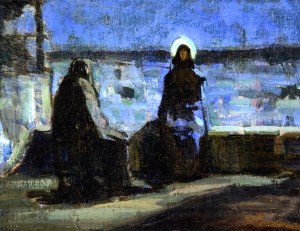
Nicodemus and JesusCommentary. In John 3:1-21, the focus shifts from the interaction of the many with Jesus to Jesus’ interaction with a single individual, Nicodemus. What follows seems to naturally divide into two parts: vv. 1-10, the dialogue between Jesus and Nicodemus; and vv. 11-21, a discourse by Jesus. This text is the first instance of a common Johannine pattern of a central event, in this case a dialogue, followed by a discourse that draws general theological themes out of the particular event. Continue reading

At the well: context

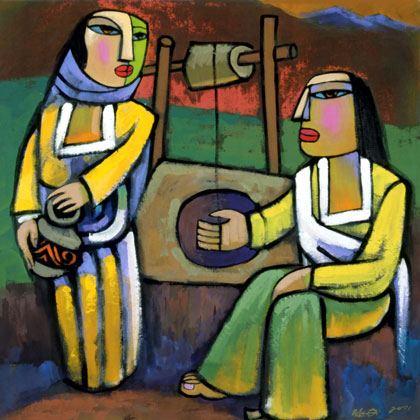
SamaritanWomanAtTheWellJohn 4:5-42 5 So he came to a town of Samaria called Sychar, near the plot of land that Jacob had given to his son Joseph. 6 Jacob’s well was there. Jesus, tired from his journey, sat down there at the well. It was about noon.

7 A woman of Samaria came to draw water. Jesus said to her, “Give me a drink.” 8 His disciples had gone into the town to buy food. 9 The Samaritan woman said to him, “How can you, a Jew, ask me, a Samaritan woman, for a drink?” (For Jews use nothing in common with Samaritans.) 10 Jesus answered and said to her, “If you knew the gift of God and who is saying to you, ‘Give me a drink,’ you would have asked him and he would have given you living water.” 11 (The woman) said to him, “Sir, you do not even have a bucket and the cistern is deep; where then can you get this living water? 12 Are you greater than our father Jacob, who gave us this cistern and drank from it himself with his children and his flocks?” 13 Jesus answered and said to her, “Everyone who drinks this water will be thirsty again; 14 but whoever drinks the water I shall give will never thirst; the water I shall give will become in him a spring of water welling up to eternal life.” 15 The woman said to him, “Sir, give me this water, so that I may not be thirsty or have to keep coming here to draw water.” Continue reading

The Samaritan Women: a context

SamaritanWomanAtTheWellJohn 4:5-42 5 So he came to a town of Samaria called Sychar, near the plot of land that Jacob had given to his son Joseph. 6 Jacob’s well was there. Jesus, tired from his journey, sat down there at the well. It was about noon.

7 A woman of Samaria came to draw water. Jesus said to her, “Give me a drink.” 8 His disciples had gone into the town to buy food. 9 The Samaritan woman said to him, “How can you, a Jew, ask me, a Samaritan woman, for a drink?” (For Jews use nothing in common with Samaritans.) 10 Jesus answered and said to her, “If you knew the gift of God and who is saying to you, ‘Give me a drink,’ you would have asked him and he would have given you living water.” 11 (The woman) said to him, “Sir, you do not even have a bucket and the cistern is deep; where then can you get this living water? 12 Are you greater than our father Jacob, who gave us this cistern and drank from it himself with his children and his flocks?” 13 Jesus answered and said to her, “Everyone who drinks this water will be thirsty again; 14 but whoever drinks the water I shall give will never thirst; the water I shall give will become in him a spring of water welling up to eternal life.” 15 The woman said to him, “Sir, give me this water, so that I may not be thirsty or have to keep coming here to draw water.” Continue reading

Whoever believes: context

Bronze-Serpent14 And just as Moses lifted up the serpent in the desert, so must the Son of Man be lifted up, 15 so that everyone who believes in him may have eternal life.” 16 For God so loved the world that he gave his only Son, so that everyone who believes in him might not perish but might have eternal life. 17 For God did not send his Son into the world to condemn the world, but that the world might be saved through him. 18 Whoever believes in him will not be condemned, but whoever does not believe has already been condemned, because he has not believed in the name of the only Son of God. 19 And this is the verdict, that the light came into the world, but people preferred darkness to light, because their works were evil. 20 For everyone who does wicked things hates the light and does not come toward the light, so that his works might not be exposed. 21 But whoever lives the truth comes to the light, so that his works may be clearly seen as done in God. Continue reading

Trinity Sunday: water and spirit

waterandspiritThe Dialogue Continues… Nicodemus is oblivious to the two levels of meaning. He focuses on one meaning of “born anōthen” (“again”) and protests that what Jesus calls for is physiologically impossible (3:4). As in v. 2, Nicodemus’s categories of what is possible intrude into the conversation. On the level that Nicodemus understands Jesus’ words, Nicodemus’s protest is correct. It is impossible for a grown man to reenter his mother’s womb and be born a second time. Nicodemus’s protest is ironic, however, because his words are correct and incontestable on one level, but that level stands in conflict and tension with what Jesus intends by the expression “to be born anōthen.” Jesus’ words speak of a radical new birth, generated from above, but Nicodemus’s language and imagination do not stretch enough to include that offer. Continue reading

Trinity Sunday: prelude to belief

Nicodemus and JesusCommentary. In John 3:1-21, the focus shifts from the interaction of the many with Jesus to Jesus’ interaction with a single individual, Nicodemus. What follows seems to naturally divide into two parts: vv. 1-10, the dialogue between Jesus and Nicodemus; and vv. 11-21, a discourse by Jesus. This text is the first instance of a common Johannine pattern of a central event, in this case a dialogue, followed by a discourse that draws general theological themes out of the particular event. Continue reading