The description of the first Pentecost in the Acts of the Apostles tells us that when devout Jews from many different nations heard the Spirit-inspired proclamation of the gospel by the disciples, “each one heard them speaking in his own language.” The outpouring of the Spirit of God united this very diverse group of people in a powerful moment of God’s self-revelation. Such is the power of Spirit.
During one of the first masses I attended in Kenya – well before I really had any clue about Kiswahili – I was sitting near a Kenyan family. Their daughter, probably about seven or eight, was wheelchair bound and was possessed of serious developmental disabilities. After the first few minutes of what turned out to be a very lengthy homily, she became agitated and began to cry out. Her mother just calmly reached out and put her arm around this little girl; she drew her close, caressed her hair and spoke to her very softly. And her little girl became quiet and peaceful. It happened again at a later point in the mass; she became troubled and began to cry. And her mother did the same thing – drew her close and calmed her. Her tenderness with her daughter was truly touching. What is more remarkable is that in Kenya there is a real reluctance to bring such children out in public. And yet there she was – with the family, in church, fully loved. And not a word was said.
I did not understand the homily that day. But I had been privileged to see a homily between mom and daughter in a language I understood. That mom proclaimed the Easter message of the risen Christ. In her tender care for her daughter, this young mother spoke the language of the Spirit. I am sure that Saint Francis must have been smiling.
Some Catholics are disheartened by what they perceive as the “institutional church.” Others bemoan the lack of catechetical knowledge of the faith. Others are riled that other parishioners could possibly vote for “that guy.” Others are just not very interested in the practice of faith at this time in their lives. They don’t seem to find inspiration in it; it is not compelling for them. The milieu of people, perspectives, and perceived problems are complex. And what surrounds it all is words – that too often are like a homily in Kiswahili given in Tampa.
But what is not complex is the “language of the Spirit,” the language spoken by that young mother in the church in a Kenyan slum, the language of compassion and of faithful care for the most vulnerable of our world. It is the language that we as Catholics should speak in committed service, of faithful care, of peacemaking in a violent world, of prayerful worship even when our hearts do not know rest.
And sometimes the “language of the Spirit” is in the first words we speak. When the risen Christ appeared to his disciples on the first Easter night – disciples hiding in fear, the breath of life sucked out of them by the horror of Calvary – Jesus’ first words could have been “Where were you when I needed you most.” Instead, his greeting and his presence instill peace and healing in the midst of fear and turmoil. And then he directs these disciples to open themselves to the gift of the Spirit, the Spirit that enables them to receive and to grant forgiveness. It is only through the power of forgiveness that the air can be cleared and all can breathe in the peace for which we so long and that the Risen One desires to give. As the risen Lord, Jesus gifts his disciples with the Spirit that empowers them to be to the world what He has been. They are sent forth to the world to speak the language of the Spirit, a language of peace, of forgiveness, of generous care and faithful service, of healing and of hope.
May the Holy Spirit fill our innermost being and enable us to speak a word of hope to a world in need

 “Receive the holy Spirit” – Verses 21–22 are a key passage in Johannine theology. The disciples receive the Holy Spirit at this second coming of Jesus: the eschaton, the final era, is now; future is present. In 7:39, the Spirit had not yet been given, since Jesus was not yet glorified. On the cross, Jesus, manifesting the nature of God, which is love, delivers over the Spirit (19:30), symbolized immediately afterward by the flow of the sacramental symbols of blood and water. Continue reading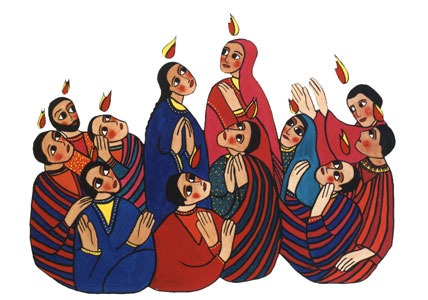
 friarmusings