
Opening the doors…

PopeFrancisThis past week, at a daily Mass, Pope Francis shared some wonderful thoughts that I thought would be good to share here on the Solemnity of the Body and Blood of Christ.  He said, “I remember once, coming out of the city of Salta, on the patronal feast, there was a humble lady who asked for a priest’s blessing.  The priest said, ‘All right, but you were at the Mass’ and explained the whole theology of blessing in the church.  ‘Ah, thank you father, yes father,’ said the woman.  When the priest had gone, the woman turned to another priest:  ‘Give me your blessing!’  All these words [of the first priest] did not register with her, because she had another necessity:  the need to be touched by the Lord.  That is the faith that we always look for, this is the faith that brings the Holy Spirit.  We must facilitate it, make it grow, help it grow.”

The question he raised is do we as Church, as pastors, as priests, and as the faithful help other people’s faith to grow?

The Pope also mentioned the story of the blind man of Jericho, who was rebuked by the disciples because he cried to the Lord, “Jesus, Son of David, have mercy on me!”  The Pope said, “The Gospel says that they didn’t want him to shout, they wanted him not to shout but he wanted to shout more, why?  Because he had faith in Jesus!  The Holy Spirit had put faith in his heart.  And they said, ‘No, you cannot do this!  You don’t shout to the Lord.  Protocol does not allow it.’”

This weekend past, someone mentioned that after my homily she wanted to stand up and give out an “Amen” and applause.  Over the particular quality or delivery of the homily?  No, I think because she was moved by the Spirit… but our “protocol” does not allow such things in the church – just not done in the Catholic Church, don’t you know?

Maybe it is that we try to control the Holy Spirit – or as the Pope remarked, “try and take possession of the Lord.”  It can become very dangerous if we try to overly bind the Sacraments in rules that blind us to the movements of the Spirit in a person.  The Pope remarked:  “Think about a single mother who goes to church, in the parish and to the secretary she says:  ‘I want my child baptized.’  And then this Christian, this Christian says:  ‘No, you cannot because you’re not married!’  But look, this girl who had the courage to carry her pregnancy and not to return her son to the sender, what is it [that she faces]?  A closed door!  This is not zeal!  It is far from the Lord!  It does not open doors!’”

As Christians we have a choice:  we can be “the controllers of faith, or the facilitators of the faith of the people…[or] We think today of Jesus, who always wants us all to be closer to Him, we think of the Holy People of God, a simple people, who want to get closer to Jesus, and we think of so many Christians of goodwill who are wrong and that instead of opening a door they close the door of goodwill … So we ask the Lord that all those who come to the Church find the doors open, find the doors open, open to meet this love of Jesus.  We ask this grace.”

Perfect Joy Isn’t Fun

Pope Francis

This is the lesson that Pope Francis drew from the Acts of the Apostles at Friday morning Mass (May 10) as he described the disciples joy in the days between our Lord’s Ascension and Pentecost and what we can learn from them.

“A Christian is a man and a woman of joy. Jesus teaches us this, the Church teaches us this, in a special way in this [liturgical]time. What is this joy? Is it having fun? No: it is not the same. Fun is good, eh? Having fun is good. But joy is more, it is something else. It is something that does not come from short term economic reasons, from momentary reasons : it is something deeper. It is a gift. Fun, if we want to have fun all the time, in the end becomes shallow, superficial, and also leads us to that state where we lack Christian wisdom, it makes us a little bit stupid, naive, no?, Everything is fun … no. Joy is another thing. Joy is a gift from God. It fills us from within. It is like an anointing of the Spirit. And this joy is the certainty that Jesus is with us and with the Father”.

“Can we ‘bottle up’ this joy in order to always have it with us? No, because if we keep this joy to ourselves it will make us sick in the end, our hearts will grow old and wrinkled and our faces will no longer transmit that great joy only nostalgia, melancholy which is not healthy. Sometimes these melancholy Christians faces have more in common with pickled peppers than the joy of having a beautiful life. Joy cannot be held at heel: it must be let go. Joy is a pilgrim virtue. It is a gift that walks, walks on the path of life, that walks with Jesus: preaching, proclaiming Jesus, proclaiming joy, lengthens and widens that path. It is a virtue of the Great, of those Great ones who rise above the little things in life, above human pettiness, of those who will not allow themselves to be dragged into those little things within the community, within the Church: they always look to the horizon”.


Pope Francis – reforming from the inside out

As Archbishop of Buenos Aires, there was a clear motif of collaborative ministry with his episcopal peers. It seems that way of ministering is continuing with his episcopal peers from the continents across the globe. Pope Francis continues to be a source of hope. How that hope takes shape, we will see – but for the moment all the signs seem to point us towards Hope

From John Allen: Pope taps eight cardinals to lead reform | National Catholic Reporter.

What is ours to do

tn_2013 Holy Thursday foot washingThe days of Holy Week, Triduum, and Easter are very special, but these days just past seemed especially so. With the help of many people, we were able to do two new things this year: (a) use San Damiano as our place of Eucharistic Reserve following the Holy Thursday Mass of the Lord’s Supper, and (b) process through the streets of downtown Tampa as part of the celebration. Many, many people have called, emailed, or made a point to mention to me how special Holy Thursday was for them.  One email commented that in almost 70 years of Holy Thursdays, none had moved her spiritually as did that evening.

And Holy Thursday was just the start. The celebrations of Good Friday, the Easter Vigil, and Easter Sunday were just as moving and Spirit-filled. All of the Easter Sunday services were standing-room only with three of the morning masses having people extending out the front door onto the steps.  We friars were wondering if we should add more Masses on Easter Sunday – but the questions of when and where left us scratching our heads.

There just seemed to be a wonderful spirit about these celebrations. I wonder if the Holy Spirit has ushered in a new sense of Hope along with the election of Pope Francis.  Our Holy Father continues to demonstrate what is ours to do by simple acts of humility and direct words about how the love of Christ is to form us and our actions in the world.

At the Chrism Mass, the pope spoke directly to priests about their ministry – but they are words that should speak to each one of us who would carry the name “Christian:”

A good priest can be recognized by the way his people are anointed. This is a clear test. When our people are anointed with the oil of gladness, it is obvious: for example, when they leave Mass looking as if they have heard good news. Our people like to hear the Gospel preached with “unction,” they like it when the Gospel we preach touches their daily lives, when it runs down like the oil of Aaron to the edges of reality, when it brings light to moments of extreme darkness, to the “outskirts” where people of faith are most exposed to the onslaught of those who want to tear down their faith. People thank us because they feel that we have prayed over the realities of their everyday lives, their troubles, their joys, their burdens, and their hopes. And when they feel that the fragrance of the Anointed One, of Christ, has come to them through us, they feel encouraged to entrust to us everything they want to bring before the Lord: “Pray for me, Father, because I have this problem,” “Bless me,” “Pray for me,” – these words are the sign that the anointing has flowed down to the edges of the robe, for it has turned into prayer. The prayers of the people of God. When we have this relationship with God and with his people, and grace passes through us, then we are priests…. (Pope Francis, Chrism Mass homily 2013)

Then at the Mass of the Lord’s Supper on Holy Thursday – celebrated in a youth detention facility – he washed and anointed the feet of young men and women, Catholic and not.  Words and action – simple yet speaking volumes.

But not all are so enamored with Pope Francis.  One group has called for Pope Emeritus Benedict to come out of retirement, take up again the Petrine Ministry and declare Francis an “anti-pope” before he destroys the Church. They hear the words of the Gospel, and their witness of Pope Francis washing the feet of the imprisoned is quite different from mine. Here is one view:

“I am a young, recently ordained priest. Tonight, I planned on preaching about the Eucharist and the institution of the priesthood. How can I speak about such things – the self-offering of Christ, the 12 viri selecti – when our Holy Father is witnessing to something different? I feel like going up to the congregation and saying, “I don’t have any idea what the symbolism of the washing of the feet is. Why don’t we just all do what we want.”

Hmmm? When I look back on my life as a leader in the Navy and business, I wish I had “washed a few more feet.”  Perhaps not a literally as Jesus, but in a way that served others consistent with the mission, vision, and values of the company.

Christian ministry is about vision (the Kingdom of God), mission (go to the ends of the earth), and values (salvific service). It is not about doing what one wants. If one is a pastor, the people will do what you do. So? We should be asking if what we do is true, necessary, and helpful in the light of the Kingdom of God and salvation?  And do you let others know why you do what you do? In that moment our values are writ large; our struggles for holiness and a virtuous life are on display.

St. Bonaventure once wrote that humility is the guardian and gateway to all the other virtues. It seems to me that Jesus washing feet and the pope washing feet portrays the core value of what it means to serve as priest. Humility – while you are reviewing the parish finances, meeting with the bake sale people, after having heard hours of Holy Week confessions and you thought you might actually get lunch today, another person says, “Hey Father, can you hear one more confession?” – or one of a hundred other tasks that seminary never mentioned.  In that moment your sense of vision, mission, and action as priest will speak volumes about the model of priest one enacts.  The question is will it model Jesus? Will people see Jesus in our priestly ministry?  Will it encourage them to follow Christ? That is why we are ordained.

While I thought of all this in the light of the young, newly-ordained priest who is not enamored with Pope Francis, in truth, all the above is larger than ordination. This is why we are baptized. It is what is ours to do.

May God in his mercy, grace us to do what is ours.


A clear test….

Folks who read blogs don’t always know too much about the person whose writings they have taken the time to read.  You can always find out a little something on an “About” page. Here is mine. I am a Franciscan friar and an ordained Catholic priest.  It is who I am.

Speaking at the Chrism Mass on Holy Thursday at St. Peter’s Basilica yesterday, Pope Francis gave “a clear test” of the meaning of ordained priesthood.

A good priest can be recognized by the way his people are anointed. This is a clear test. When our people are anointed with the oil of gladness, it is obvious: for example, when they leave Mass looking as if they have heard good news. Our people like to hear the Gospel preached with “unction”, they like it when the Gospel we preach touches their daily lives, when it runs down like the oil of Aaron to the edges of reality, when it brings light to moments of extreme darkness, to the “outskirts” where people of faith are most exposed to the onslaught of those who want to tear down their faith. People thank us because they feel that we have prayed over the realities of their everyday lives, their troubles, their joys, their burdens and their hopes. And when they feel that the fragrance of the Anointed One, of Christ, has come to them through us, they feel encouraged to entrust to us everything they want to bring before the Lord: “Pray for me, Father, because I have this problem”, “Bless me”, “Pray for me” – these words are the sign that the anointing has flowed down to the edges of the robe, for it has turned into prayer. The prayers of the people of God. When we have this relationship with God and with his people, and grace passes through us, then we are priests….

Pray for me that I may be a priest who strives to daily pass this “clear test.”

Pope Francis – honeymoon, challenges, and legends

While we are still in the early days of the papacy of Pope Francis, the reports, accounts, stories and insights continue to pour into the “newsverse.”  I thought it might be helpful to have a summary of some of the ones I have seen that I think are helpful.

There are lots of others posts available out there – one only needs to query.  And while 88% of American Catholics are currently happy to extremely happy with his election, that still leaves 12% who are not – and some of their blogs are scathing. But I will leave you to find them

And for the history of Jorge Mario Bergoglio in graphic form, you can look here.


Lifting the Shadow of Scandal

When I was a missionary is Kenya there was a story told to me about the 1920s and big game hunting in Trans-Mara and the coastal regions.  The gist of the story is that the “great white hunters” had to be reminded – even if they had made the perfect killing shot on a charging rhinoceros, they had to move out of the way.  Even though the animal was technically dead, that message had not gotten to the rest of the beast.  And it was the momentum of the rest of the beast that could still run you over.
That story came to mind reading Ross Douthat – a NY Times columnist – as he paints a sober picture of the institutional (and sometimes insider) momentum that will drag at the edges of any reform movement or efforts on the part of Pope Francis. Lifting the Shadow of Scandal – NYTimes.com.

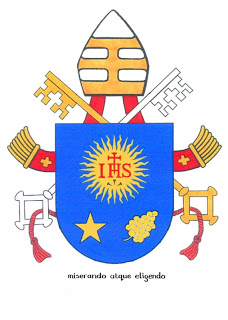
Pope Francis: Papal Coat of Arms

Pope Francis’ Coat of Arms

PopeFrancisCoatArmsPope Francis’ papal coat of arms are the same that he used as bishop. The shield has a bright blue background, at the center top of which is a yellow radiant sun with the IHS christogram representing Jesus (it is also the Jesuit logo). The IHS monogram, as well as a cross that pierces the “H”, are in red with three black nails directly under them. Under that, to the left, is a star representing Mary, Mother of Christ and the Church. To the right of the star is a spikenard flower representing Joseph, Patron of the Universal Church. With these symbols the Pope demonstrates his love for the Holy Family. Continue reading

Pope Francis and the Spirit of LaVerna

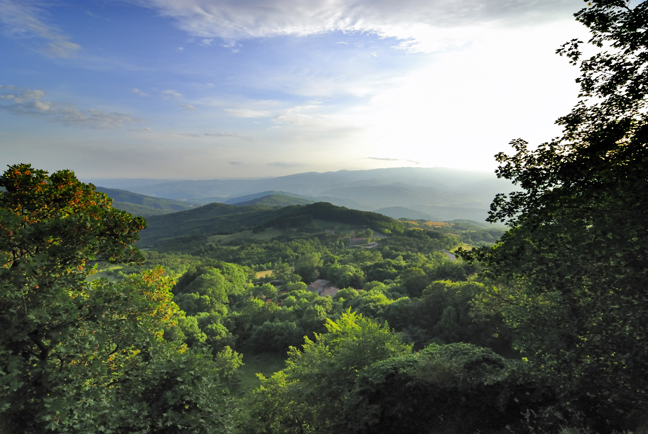
On May 8, 1213, St. Francis of Assisi was given a mountain.  Count Orlando of Chiusi gave La Verna to Francis and his friar brothers as a retreat especially for prayer and contemplation.  Five year later in 1218 Count Orlando built the friars the chapel Santa Maria degli Angeli (St Mary of the Angels).

LaVerna

In September of 1993, Pope John Paul II went to La Verna for prayer, contemplation and to meet with the bishops of Tuscany.  During lunch while John Paul II was speaking with the friar brothers and bishops, he said here at both La Verna and Assisi, Franciscanism was born and in a certain way Christianity too by rediscovering the simplicity and fervor of the beginnings.

Sunday, May 17, 2013, the the Archpriest of St. Peter’s Basilica, Cardinal Angelo Comastri, in greeting Pope Francis at the beginning of the celebration of Mass at St. Anna’s Parish, recalled the words of John Paul II – and said that is what is happening with his election.  In the taking of the name “Francis” we all reminded of the need to rediscover Christianity by rediscovering the simplicity and fervor of our faith.

There is a moment when Francis of Assisi called together his friar brothers – men who had already accomplished so much.  He told them: “Up to now we have done nothing…. Let us begin again and do what is ours to do.

May we be blessed to do what is ours to do – as we pray for Pope Francis to do what is his.