 It’s hard to sustain a regular life of prayer. Why? Why is it so difficult to pray regularly? Some reasons are obvious: over-busyness, tiredness, and too many demands on our time, constant distraction, spiritual laziness, worship services that bore us, and methods of prayer that leave us flat and inattentive.
But there is another reason too, suggested by monks and mystics. The problem we have in sustaining prayer, they say, is often grounded in the false notion that prayer needs to be interesting, exciting, intense, and full of energy all the time, but that is impossible. Nothing is meant to be exciting all the time, including prayer and church services, and nobody has the energy to always be alert, attentive, intense, and actively engaged all the time.
Sometimes we don’t pray regularly precisely because we simply cannot find within ourselves the energy, time, intensity, and appetite for active participation that we think prayer is demanding of us. But prayer respects the natural rhythms of our energy. Praying is like eating. You don’t always want a banquet – sometimes we just want a quick sandwich by ourselves.
Eating has a natural rhythm: banquets and quick snacks, rich meals and simple sandwiches, high times with linen serviettes and low times with paper napkins; meals which take a whole evening, and meals which you eat on the run. And the two depend upon each other: You can only have high season if you mostly have ordinary time.
Healthy eating habits respect our natural rhythms: our time, energy, tiredness, the season, the hour, our boredom, our taste. Prayer should be the same, but too often we are left with the impression that all prayer should be this wonderful moment sensing the presence of God. And when it is not, we wonder about our faith, our prayer, or if God is listening.
Monks have secrets worth knowing. They know that it is the rhythm, routine, and established ritual of prayer that is key. For monks, the key to sustaining a daily life of prayer is not so much variety, novelty, and the call for higher energy, but rather a reliance on the expected, the familiar, the repetitious, the ritual, the clearly defined. They know that what’s needed is a clearly delineated prayer form which gives you a clear time expectation and does not demand of us an energy that we cannot muster on a given day. What clear, simple, and brief rituals provide is precisely prayer that depends upon something beyond our own energy. The rituals carry us, our tiredness, our lack of energy, our inattentiveness, and our indifference. They keep us praying even when we are too tired to muster up our own energy.
The rhythm, routine, and established ritual of prayer can sustain our love for God and our neighbor – even if we don’t have the energy for it.

 7 Will not God then secure the rights of his chosen ones who call out to him day and night? Will he be slow to answer them? 8 I tell you, he will see to it that justice is done for them speedily. But when the Son of Man comes, will he find faith on earth?”
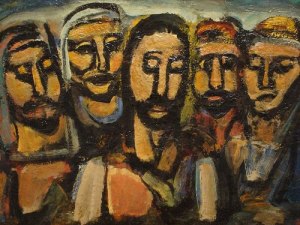 Praying for Faith: 5 And the apostles said to the Lord, “Increase our faith.”
  The Olympics are over…. alas. I have to tell you, I watched every moment of the Rio Swimming that I could. US Swimming, not expected to be all that strong, was amazing – record numbers of gold and total medals. There were a few races that had me on the edge of my seat. It was so much fun. That being said, I can totally beat Michael Phelps.*
 Of course we all know that after the meal with his disciples that Jesus went to the Garden of Gethsemane. Actually, no gospel says that. Matthew and Mark wrote that he went to a garden. John says he went to Gethsemane. Fuse them all together and you get the “Garden of Gethsemane.” What does Luke say? Luke only calls it “the place.” There is no garden specifically mentioned nor is Gethsemane. Is it important? Well, it is a reminder to be attentive to the text before you and not meld the familiar stories and scenes from other sacred writers. Each sacred writer has something distinctive that can be missed if one fuses all the details from other accounts.
  friarmusings