
The Prodigal Son – part 2

The Departure of the Younger Son. This is a post that continues the thought in an earlier post today about our Sunday gospel specifically considering the parable of the Prodigal Son.

Earlier today we began our look into the details of the parable of the Prodigal Son. This post continues our look. The parable begins with the younger son asking for what he considers his share of the inheritance – something that is for the father to decide. In the asking, the son communicates that he does not view the inheritance as a gift given because of his father’s good graces; rather he sees it as his due. Continue reading
Some thoughts

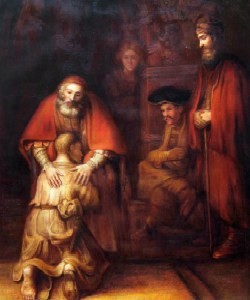
This coming Sunday is the 4th Sunday in Lent, Year C: the Prodigal Son. The parable offers that the father has extended unconditional forgiveness to both sons prior to their repentance. What then does this say about the fuller meaning of repentance?

The parable of the Lost Sheep ends with: “I tell you, in just the same way there will be more joy in heaven over one sinner who repents than over ninety-nine righteous people who have no need of repentance.”  The parable of the Lost Coin ends with: “In just the same way, I tell you, there will be rejoicing among the angels of God over one sinner who repents.” Taken at face value, the idea of a sheep repenting is only slightly less absurd than the idea of a coin repenting. Continue reading

The other Son

This coming Sunday is the 4th Sunday in Lent, Year C: the Prodigal Son. The story would be complete as it stands with the return of the prodigal son and the father’s open-armed acceptance. But another story interlocks with this: the story of the elder son who has not appeared in the story. The father has responded to the prodigal son’s return with compassion. How will the elder brother respond?

Then the celebration began. Now the older son had been out in the field and, on his way back, as he neared the house, he heard the sound of music and dancing. He called one of the servants and asked what this might mean. (vv. 24-26)

In anger, the elder son refuses to join in the celebration, thus physically distancing himself from his family and his own role as elder son in a celebration of this kind. “At such a banquet the older son has a special semi-official responsibility. He is expected to move among the guests, offering compliments, making sure everyone has enough to eat, ordering the servants around and, in general, becoming a sort of major-domo of the feast. [Baily, 294] Continue reading

Father and Son

This coming Sunday is the 4th Sunday in Lent, Year C: the Prodigal Son. The parable begins with the younger son asking for what he considers his share of the inheritance – something that is for the father to decide. In the asking, the son communicates that he does not view the inheritance as a gift given because of his father’s good graces; rather he sees it as his due.

Kenneth Bailey, a NT scholar who lived for years in the Middle East, asked many people in the Near East cultures how one is to understand the younger son’s request.  The answer is consistent and harsh: the son would rather have his father dead so as to gain the inheritance. In an honor/shame society it would be appropriate to ask, “What father having been asked by a son to give him inheritance…” No father would do such a thing. Again the Lucan answer is not the answer of the society. The father grants the request. Where the younger son asks for “the share of your estate (ousia) that should come to me.” Luke tells us that the father “divided between them his property.” Continue reading

Inheritance Customs

This coming Sunday is the 4th Sunday in Lent, Year C: the Prodigal Son. The parable, the longest in the Gospels, consists of three main parts: (1) the departure of the younger son to a distant land where he squanders his inheritance (vv.11-19), (2) the homecoming of the son and welcome by his father (vv.20-24), and (3) the episode between the father and the older son who stayed at home (vv.25-32).  How this parable differs from the two preceding it is that what is lost is a human person – one who has existing human relationships with his father and his brother – and whose relationship gets tangled up in the oldest of family squabbles: inheritance. Continue reading

Prodigal Son: context

This coming Sunday is the 4th Sunday in Lent, Year C. The gospel is one of most familiar of all parables: the Prodigal Son, part of a trilogy of parables thematically joined with joy over the recovery of what was lost. All three parables of Luke 15 (the Lost Sheep, the Lost Coin, and the Prodigal Son) point to the idea of the return of one that was lost.  To the simple structure of lost/found/joy, in the Prodigal Son parable, there is further development of the theme of God’s love and the contrast of the older brother’s hostility. Luke uses this motif to teach a newer, more full meaning of repentance.  Continue reading

Hungers, Empathy and Homecoming

“A man had two sons …” (Luke 15:11) – such is the beginning of the beloved and well-known Parable of the Prodigal Son. But you know Scripture doesn’t come with titles for such things. That’s just what the parable has always been called. But we could call it something else. The Parable of the Waiting Father? Or perhaps the Parable of the Petulant Older Brother? I guess it all depends on what draws your interest and attention. What about you? Where are your thoughts drawn: to the younger son’s selfish greed, the older son’s arrogant fury, or perhaps the patient father’s extravagant love? Continue reading

The Lost: returning

Prodigal_Sons_web17 Coming to his senses he thought, ‘How many of my father’s hired workers have more than enough food to eat, but here am I, dying from hunger.  18 I shall get up and go to my father and I shall say to him, “Father, I have sinned against heaven and against you.  19 I no longer deserve to be called your son; treat me as you would treat one of your hired workers.”  20 So he got up and went back to his father. While he was still a long way off, his father caught sight of him, and was filled with compassion. He ran to his son, embraced him and kissed him.  21 His son said to him, ‘Father, I have sinned against heaven and against you; I no longer deserve to be called your son.’  22 But his father ordered his servants, ‘Quickly bring the finest robe and put it on him; put a ring on his finger and sandals on his feet.  23 Take the fattened calf and slaughter it. Then let us celebrate with a feast, 24 because this son of mine was dead, and has come to life again; he was lost, and has been found.’ Then the celebration began.  Continue reading

The Lost: going away

Prodigal_Sons_web11 Then he said, “A man had two sons, 12 and the younger son said to his father, ‘Father, give me the share of your estate that should come to me.’ So the father divided the property between them.  13 After a few days, the younger son collected all his belongings and set off to a distant country where he squandered his inheritance on a life of dissipation.  14 When he had freely spent everything, a severe famine struck that country, and he found himself in dire need.  15 So he hired himself out to one of the local citizens who sent him to his farm to tend the swine.  16 And he longed to eat his fill of the pods on which the swine fed, but nobody gave him any.  17 Coming to his senses he thought, ‘How many of my father’s hired workers have more than enough food to eat, but here am I, dying from hunger.  18 I shall get up and go to my father and I shall say to him, “Father, I have sinned against heaven and against you.  19 I no longer deserve to be called your son; treat me as you would treat one of your hired workers Continue reading