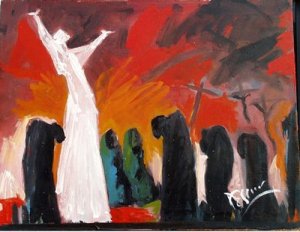
 As a liturgical season, Lent is rather straightforward. It is kinda’ easy to write about. There is Ash Wednesday to dramatically mark its beginning, and we all know we are moving relentlessly towards Easter. We count the days even as we mark Lent’s beginning. The Ashes make a visible mark upon us, reminding us that we are dust and to dust we shall return – but that is not the end of the story. We are reminded to repent and believe in the Gospel – but that is not the end goal. We are encouraged to pray, fast, and give alms – but those practices are meant to make room in our lives for God that we too may rise to the newness of life at Eastertide.
Perhaps some will wonder why I did not write, “the newness of life at Easter.” Isn’t Easter that day when we celebrate Jesus’ being raised from dead? Isn’t Easter the finish line, the ultimate, the highest of the high holy days, the pinnacle of the Church’s liturgical celebrations? No, yes, yes, and yes. Easter is not the finish line. Allow me some poetic license here, but Easter is to Eastertide, what Ash Wednesday is to Lent. It is the day we begin to count.
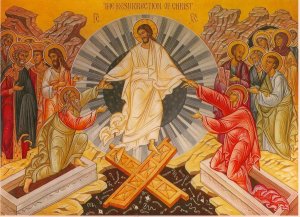
Eastertide is the 50-day season beginning on Easter Sunday with a dramatic mark in the celebration of the Resurrection of Christ, relentlessly moving to Pentecost Sunday. Easter and Pentecost correspond to two Jewish holy days, the first day of Pesach and the holiday of Shavu’ot. In the Jewish tradition, the days between these holidays are known as Counting of the Omer. The idea of counting each day represents spiritual preparation and anticipation for the giving of the Law to Moses on Mount Sinai.
Easter is not the finish line, but the “Ash Wednesday” of Eastertide when we again begin to count, to spiritually prepare and anticipate the giving of the Spirit on Pentecost. If in Lent we have traditional practices to help prepare us to celebrate the Risen Christ, what are we practicing in Eastertide? I think the answer is profoundly simple: we practice what we witnessed on Easter – resurrection.
The Catholic writer, Megan McKenna, has a wonderful vignette about practicing resurrection in her book, Not Counting Women and Children: Neglected Stories from the Bible. She had shared in a Bible study, “that life happens when we are interrupted, and that some of the most powerful acts of resurrection happen to the least likely people; that we are the people of resurrection and hope, called to live passionately and compassionately with others, to defy death, to forgive, and to bring others back into the community, to do something that is life-giving, that fights death and needless suffering.” It is at this point that someone asks, somewhat harshly, “Have you ever brought someone back from the dead.” I love her answer: “My response was, ‘Yes … Every time I bring hope into a situation, every time I bring joy that shatters despair, every time I forgive others and give them back dignity and the possibility of a future with me and others in the community, every time I listen to others and affirm them and their life, every time I speak the truth in public, every time I confront injustice — yes — I bring people back from the dead.”’
If in Lent we made room for God, here in Eastertide we work with Christ, practicing what he has already shown us: newness of life. And so we practice resurrection in our own lives by introducing joy, forgiveness, listening, justice, compassion… and so much more. And we count the days to Pentecost when the Spirit is given that we may take the honed skills of resurrection into a waiting world.

 27 Some Sadducees, those who deny that there is a resurrection, came forward and put this question to him, 28 saying, “Teacher, Moses wrote for us, ‘If someone’s brother dies leaving a wife but no child, his brother must take the wife and raise up descendants for his brother.’ 29 Now there were seven brothers; the first married a woman but died childless. 30 Then the second 31 and the third married her, and likewise all the seven died childless. 32 Finally the woman also died. 33 Now at the resurrection whose wife will that woman be? For all seven had been married to her.” 34 Jesus said to them, “The children of this age marry and remarry; 35 but those who are deemed worthy to attain to the coming age and to the resurrection of the dead neither marry nor are given in marriage. 36 They can no longer die, for they are like angels; and they are the children of God because they are the ones who will rise. 37 That the dead will rise even Moses made known in the passage about the bush, when he called ‘Lord’ the God of Abraham, the God of Isaac, and the God of Jacob; 38 and he is not God of the dead, but of the living, for to him all are alive.” 39 Some of the scribes said in reply, “Teacher, you have answered well.” 40 And they no longer dared to ask him anything. Continue reading
 friarmusings