
This coming weekend is the 3rd Sunday of Lent in lectionary cycle A. The gospel account is that of the Samaritan Woman at the well. It is a long passage and on several days there are two posts. In addition the Tuesday and Wednesday posts are fairly lengthy because St. John has just packed so much into the telling of the encounter. Today’s post is going to provide some context. I’d suggest that while the story stands on its own, it is best read with an eye toward the story that precedes it: Jesus’ encounter with Nicodemus. It then stands as bookends framing the whole of Jesus’ ministry even as it is positioned at the beginning of the Johannine telling of the story of Jesus. So, before moving ahead let us review the encounter with Nicodemus so that we understand the deep contrasts between these two protagonists. Continue reading
Tag Archives: Samaritan woman at the well
Nuance
The Gospel of John is a wonderful text at every level of reading and understanding. It is poetic, it has amazing narratives such as the Samaritan Woman at the Well (today’s gospel), and more. It is also a quite nuanced text. Consider the following segment of the conversation:
16 Jesus said to her, “Go call your husband and come back.” 17 The woman answered and said to him, “I do not have a husband.” Jesus answered her, “You are right in saying, ‘I do not have a husband.’ 18 For you have had five husbands, and the one you have now is not your husband. What you have said is true.” 19 The woman said to him, “Sir, I can see that you are a prophet. Continue reading
Understanding
Next Sunday is the 3rd Sunday in Lent, Year A. You can read a complete commentary on the Sunday Gospel here.
5 So he came to a town of Samaria called Sychar, near the plot of land that Jacob had given to his son Joseph. 6 Jacob’s well was there. Jesus, tired from his journey, sat down there at the well. It was about noon. 7 A woman of Samaria came to draw water. Jesus said to her, “Give me a drink.” 8 His disciples had gone into the town to buy food. 9 The Samaritan woman said to him, “How can you, a Jew, ask me, a Samaritan woman, for a drink?” (For Jews use nothing in common with Samaritans.) 10 Jesus answered and said to her, “If you knew the gift of God and who is saying to you, ‘Give me a drink,’ you would have asked him and he would have given you living water.” 11 (The woman) said to him, “Sir, you do not even have a bucket and the cistern is deep; where then can you get this living water? 12 Are you greater than our father Jacob, who gave us this cistern and drank from it himself with his children and his flocks?” 13 Jesus answered and said to her, “Everyone who drinks this water will be thirsty again; 14 but whoever drinks the water I shall give will never thirst; the water I shall give will become in him a spring of water welling up to eternal life.” 15 The woman said to him, “Sir, give me this water, so that I may not be thirsty or have to keep coming here to draw water.” Continue reading
The history we write – the lives we lead
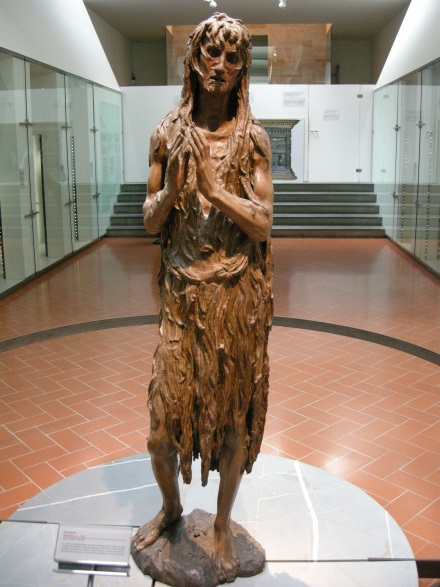
Most people still think of Mary Magdalene as the unnamed sinner (possibly a prostitute) in Luke 7:36-50. Of course we think of her as “the repentant prostitute” because she turns her life around because of the encounter with Jesus. The problem is that for the first 300+ years of the Church, she was only seen as the first witness to the Resurrection. Did you know that Mary Magdalene is mentioned 12 times in the gospels, more than most of the Apostles? She was present at the crucifixion and was the first witness to the Resurrection (John 20 and Mark 16:9). She was the “Apostle to the Apostles,” an honorific that St. Augustine bestowed upon her in the fourth century, and possibly he was but repeating a moniker already in use. Continue reading