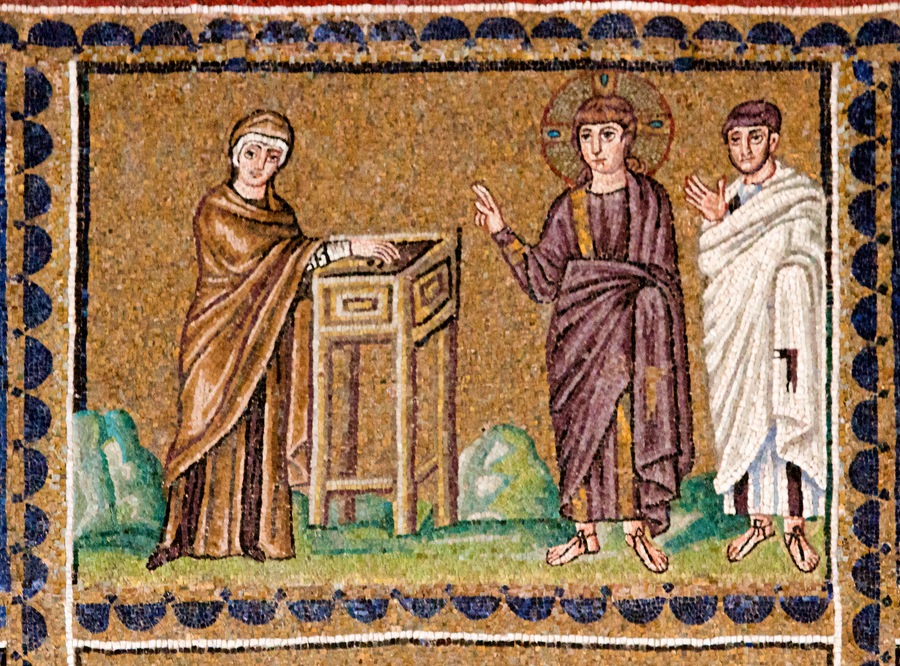
This coming Sunday is the 31st Sunday in Ordinary Time. This has been a series of posts critiquing the scribes and Pharisees and admonishing the disciples to take another path and follow Jesus as the authoritative teacher of the Law. 11 The greatest among you must be your servant. 12 Whoever exalts himself will be humbled; but whoever humbles himself will be exalted. Continue reading
Tag Archives: scribes
Admonitions
This coming Sunday is the 31st Sunday in Ordinary Time. In the previous posts we considered the three critiques of the scribes and Pharisees. At this point the conversation seems fully directed to Jesus’ disciples.
8 As for you, do not be called ‘Rabbi.’ You have but one teacher, and you are all brothers. 9 Call no one on earth your father; you have but one Father in heaven. 10 Do not be called ‘Master’; you have but one master, the Messiah. 11 The greatest among you must be your servant. 12 Whoever exalts himself will be humbled; but whoever humbles himself will be exalted.
More critique
This coming Sunday is the 31st Sunday in Ordinary Time. In the previous post we considered the second of the three critiques of the scribes and Pharisees: they burden others while failing to act themselves. This post considers the final critique: they act for the wrong reasons: to make an impression on others Continue reading
The stringent path
This coming Sunday is the 31st Sunday in Ordinary Time. In the previous post we considered the first of the three critiques of the scribes and Pharisees: they teach but they don’t practice what they preach. In this post we move to the second: They burden others while failing to act themselves.
4 They tie up heavy burdens (hard to carry) and lay them on people’s shoulders, but they will not lift a finger to move them.
Critique of the Scribes and Pharisees
This coming Sunday is the 31st Sunday in Ordinary Time. In Matthew’s timeline it is (still) Tuesday of Holy Week and Jesus is still in Temple precincts. The audience continues to be the crowds gathered around the man from Galilee, but the conversation will soon pivot to the disciples – in each case a critique and warning. Jesus’ critique of the scribes and Pharisees will have three elements Continue reading
Setting the scene
This coming Sunday is the 31st Sunday in Ordinary Time, Lectionary Cycle A. For several Sundays we have been in the midst of confrontations between Jesus and the Jerusalem leadership. On the 29th Sunday, we moved into a section of Matthew’s gospel that comprises a series of controversies between Jesus and the religious authorities of Jerusalem.
- “Is it lawful to pay taxes to the emperor, or not?” (asked by Pharisees and Herodians: 22:17);
- “In the resurrection, whose wife of the seven will she be?” (asked by Sadducees; v. 27);
- “which commandment in the law is the greatest” (asked by a lawyer; v.34; the core of the Gospel for the 30th Sunday, Year A)
Widow’s mite: scribes
38 In the course of his teaching he said, ‘Beware of the scribes, who like to go around in long robes and accept greetings in the marketplaces, 39 seats of honor in synagogues, and places of honor at banquets. 40 They devour the houses of widows and, as a pretext, recite lengthy prayers. They will receive a very severe condemnation.’
There is always a pause when I read this passage. Being a Franciscan Friar, I go around in long robes, inevitably accept greetings as I move out and about, whether I want it or not, I end up in the places of honor at banquets, and in the church, and I occupy the ‘big chair’ reserved for the presider at Mass. During Mass, some parishioners might accuse me of reciting lengthy homilies (hopefully not as a pretext). The only part for which I am hopefully safe is devouring the houses of widows. Perhaps it is cautionary pause. Continue reading
Widow’s mite: scribes
38 In the course of his teaching he said, ‘Beware of the scribes, who like to go around in long robes and accept greetings in the marketplaces, 39 seats of honor in synagogues, and places of honor at banquets. 40 They devour the houses of widows and, as a pretext, recite lengthy prayers. They will receive a very severe condemnation.’
There is always a pause when I read this passage. Being a Franciscan Friar, I go around in long robes, inevitably accept greetings as I move out and about, whether I want it or not, I end up in the places of honor at banquets, and in the church, and I occupy the ‘big chair’ reserved for the presider at Mass. During Mass, some parishioners might accuse me of reciting lengthy homilies (hopefully not as a pretext). The only part for which I am hopefully safe is devouring the houses of widows. Perhaps it is cautionary pause. Continue reading