
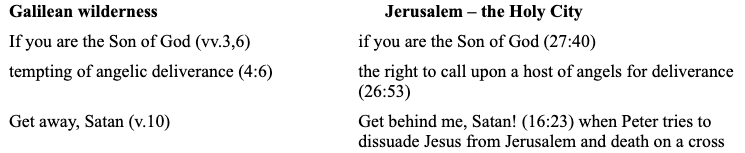
This coming Sunday is the First Sunday in Lent. In yesterday’s post we considered the second temptation. Today will move on to the third: 8 Then the devil took him up to a very high mountain, and showed him all the kingdoms of the world in their magnificence, 9 and he said to him, “All these I shall give to you, if you will prostrate yourself and worship me.” 10 At this, Jesus said to him, “Get away, Satan! It is written: ‘The Lord, your God, shall you worship and him alone shall you serve.’”
The view from the mountain recalls Moses’ view of the promised land from Mount Nebo (Deut. 34:1–4). The devil’s dominion over all the world, implied here and explicit in Luke 4:6, is stated also in John 12:31 (cf 2 Cor. 4:4; 1 John 5:19). France (2007, 135) considers that Satan’s offer is mere bluff and bluster – or did in fact Satan have some dominion over the world? Several times in the NT Satan will be described in such language, e.g., “ruler of the world” (John 12:31, 14:30, 16:11; 2 Cor 4:4; Eph 6:11-12; 1 John 5:19; Rev 12:9-17). The gospels seem to take for granted that Satan does have such power but that is always seen within the ultimate victory of God.
Ironically it was this very dominion which Jesus had come to claim (Dan. 7:14; cf. Matt. 28:18), and the resulting contest was fierce. The devil was not too subtle in seeking to avoid the conflict by asking for Jesus’ allegiance. Nonetheless, it provided a crucial test of Jesus’ loyalty to his Father, even where it meant renouncing the easy way of allowing the end to justify the means.
Israel had fallen to this temptation again and again, and had renounced their exclusive loyalty to God for the sake of political advantage. At the entry to the promised land the temptation met them in an acute form (Deut. 6:10–15; Jesus’ reply quotes v. 13). But the true Son of God cannot compromise his loyalty, and sharply dismisses the devil, using now for the first time the name which reveals his true purpose, Satan, ‘the enemy’ of God and of God’s purpose of salvation.
There is only one answer: The Lord, your God, shall you worship and him alone shall you serve (Dt 6:13 – with an implication of v.14: You shall not follow other gods). Nothing more need be said and Satan is dismissed curtly leaving no doubt about who is in control. Unlike Luke, Matthew does not say that Satan’s withdrawal is temporary, but as is clear in narratives that follow there are other encounters with the demonic ahead.
Angelic help arrives…
The angelic help of Psalm 91:11, which Jesus refused to call for illegitimately (vv. 6–7), is now appropriately given. Ministered implies particularly the provision of food, and again the experience of Elijah seems to be recalled (1 Kgs 19:5–8). The lessons of the period of hunger have been well learnt, and God’s messengers break the fast that Jesus himself would not break (vv. 3–4).
Final thoughts…
Boring (165) raises an important question and provides some good answers:
Is Satan language passé? The interpreter’s first question today may be whether there is still a place in our thinking for images of Satan, especially since such images can be abused by a literalism that uses “the devil made me do it” as an escape from personal responsibility and that brands its opponents as tools of the devil. Yet, language and imagery of the demonic played an important theological role for Matthew, and it can continue to do so for us. Such imagery provides a way of acknowledging the reality of an evil greater than our own individual inclinations to evil, a supra-personal power often called “systemic evil” today. Another valuable aspect of such language is that it can prevent us from regarding our human opponents as the ultimate enemy, allowing us to see both them and ourselves as being victimized by the power of evil.
Perhaps too quickly we readers consider this passage as a model of “resisting temptation” of greed, lust, and other sins of the earthly realm. In reality, it is a deeper model of discipleship that is on display. The temptation is to misuse Scripture and our gifts for ourselves and our own will and ambition. We are tempted to do our own will rather than the Father’s. Unless the LORD build the house, they labor in vain who build. Unless the LORD guard the city, in vain does the guard keep watch. (Psalm 127:1)
Image credit:The Temptation in the Wilderness, Briton Rivière (1898) | Public Domain

 friarmusings