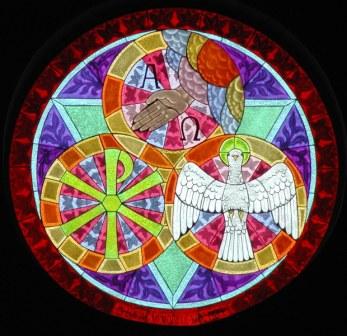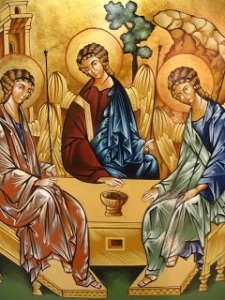
This coming Sunday is the Solemnity of the Most Holy Trinity. “Go, therefore, and make disciples of all nations.” Jesus’ universal reign demands a universal mission. The restriction of the disciples’ mission to Israel alone in 10:5–6 can now be lifted, for the kingdom of the Son of man as described in Daniel 7:14 requires disciples of all nations. Continue reading
Tag Archives: Trinity Sunday
All in All
This coming Sunday is the Solemnity of the Most Holy Trinity. One should be struck by the repetition of the word “all” in this passage:
- Jesus has been given all power (v.18).
- Disciples are to be made of all nations (v.19).
- Disciples are to obey all that Jesus commanded (v.20).
- Jesus will be with the disciples always (literally “all the days”; v.20).
The universality of Jesus’ power and his continuing presence provide the dynamic for the universal discipleship mandate. The disciples will be able to make disciples of all the nations only as they recognize that Jesus has been given all authority and that he will be with them all the days until the end. The universal task is daunting, but it can be done because of the continuing power and presence of Jesus. Continue reading
Doubt/hesitation
This coming Sunday is the Solemnity of the Most Holy Trinity. When they saw him, they worshiped, but they doubted. Many English translations offer “but some doubted.” Unfortunately the word “some” does not appear in the Greek text. The only two valid translations are “they worshiped, but they doubted (hesitated)” or “they worshiped and they doubted (hesitated).” It is hard to avoid the simple statement of the text: those who worship are also those who doubt. Continue reading
Being Sent
This coming Sunday is the Solemnity of the Most Holy Trinity. 16 The eleven disciples went to Galilee, to the mountain to which Jesus had ordered them. 17 When they saw him, they worshiped, but they doubted. 18 Then Jesus approached and said to them, “All power in heaven and on earth has been given to me. 19 Go, therefore, and make disciples of all nations, baptizing them in the name of the Father, and of the Son, and of the holy Spirit, 20 teaching them to observe all that I have commanded you. And behold, I am with you always, until the end of the age.” (Mt 28:16-20) Continue reading
Trinity
This coming Sunday is the Solemnity of the Most Holy Trinity. 16 The eleven disciples went to Galilee, to the mountain to which Jesus had ordered them. 17 When they saw him, they worshiped, but they doubted. 18 Then Jesus approached and said to them, “All power in heaven and on earth has been given to me. 19 Go, therefore, and make disciples of all nations, baptizing them in the name of the Father, and of the Son, and of the holy Spirit, 20 teaching them to observe all that I have commanded you. And behold, I am with you always, until the end of the age.” (Mt 28:16-20) Continue reading
God is love
Years ago, while a Franciscan novice, my fellow friars and I attended a gathering of all the Franciscan novices, men and women, who lived in the Eastern United States. During our week-long gathering, each group was responsible for leading morning or evening prayer, or animating the Eucharistic celebration. One morning, a group of Franciscan sisters was responsible for morning prayer. Just before we were to begin, the leader of prayer explained that we would not being using the traditional words associated with the sign of the Cross. Rather, we would say “In the Name of the Creator, the Redeemer, and the Sanctifier.” She explained this was a way to remove the gender bias from the opening of prayer and so to make all feel welcomed. Continue reading
Trinity Sunday: context
Holy Trinity Sunday is celebrated on the first Sunday following Pentecost in most of the liturgical churches in Western Christianity. It is a solemn celebration of the belief in the revelation of one God, yet three divine persons. It was not uniquely celebrated in the early church, but as with many things the advent of new, sometime heretical, thinking often gives the Church a moment in which to explain and celebrate its own traditions; things it already believes and holds dear. In the early 4th century when the Arian heresy was spreading, the early church, recognizing the inherent Christological and Trinitarian implications, prepared an Office of Prayer with canticles, responses, a preface, and hymns, to be recited on Sundays to proclaim the Holy Trinity. Pope John XXII (14th century) instituted the celebration for the entire Church as a feast; the celebration became a solemnity after the liturgical reforms of Vatican II. Continue reading
Trinity Sunday: context
Holy Trinity Sunday is celebrated on the first Sunday following Pentecost in most of the liturgical churches in Western Christianity. It is a solemn celebration of the belief in the revelation of one God, yet three divine persons. It was not uniquely celebrated in the early church, but as with many things the advent of new, sometime heretical, thinking often gives the Church a moment in which to explain and celebrate its own traditions; things it already believes and holds dear. In the early 4th century when the Arian heresy was spreading, the early church, recognizing the inherent Christological and Trinitarian implications, prepared an Office of Prayer with canticles, responses, a preface, and hymns, to be recited on Sundays to proclaim the Holy Trinity. Pope John XXII (14th century) instituted the celebration for the entire Church as a feast; the celebration became a solemnity after the liturgical reforms of Vatican II. Continue reading
Holy Trinity Sunday – why we celebrate
We have all kinds of solemnities, feast days, and other special days in the church year. We commemorate happenings in the life of Christ: Mary’s visit from Gabriel announcing the miraculous child she was to bear into the world. We celebrate the arrival of the Three Kings, the Baptism of our Lord, the Transfiguration when the glory of Christ is revealed, and on Palm Sunday, we celebrate Jesus riding triumphant into Jerusalem amidst palms and cheers. We celebrate the empty tomb and Resurrection of Easter, the glorious Ascension, the explosive coming of God’s spirit to the church at Pentecost … and then we have Holy Trinity Sunday. And suddenly it is like we have moved from these great events in the life of Christ, and now…. tadah!! We are celebrating a …..a….. a church doctrine. Continue reading